

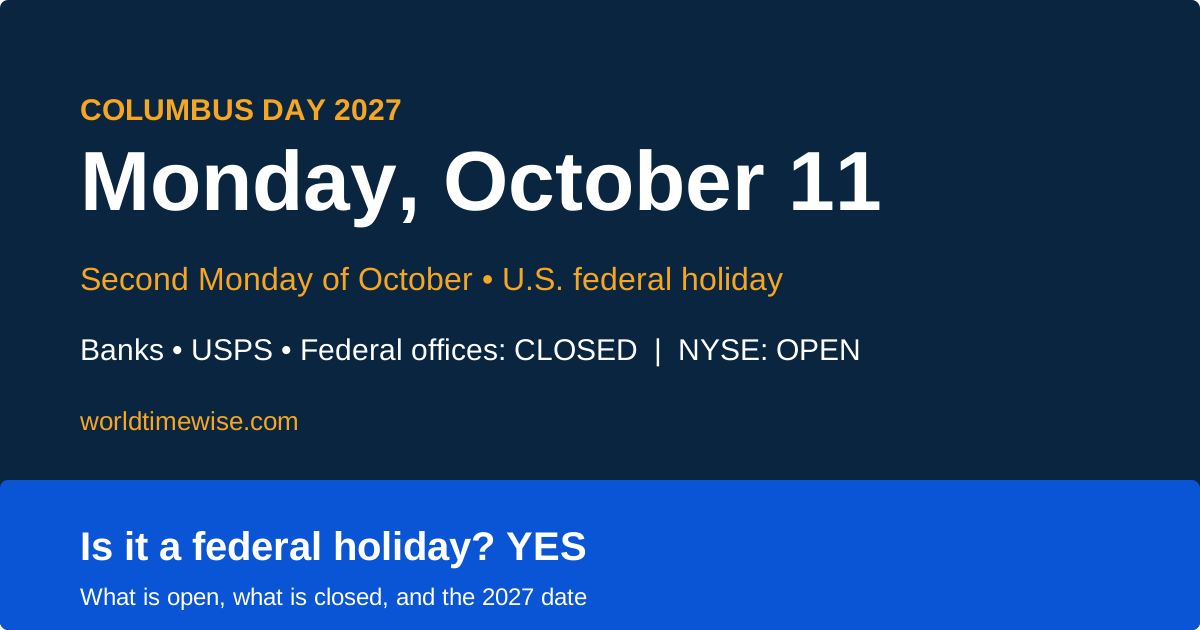
Columbus Day 2027 is Monday, October 11 — in 357 days. Federal offices, banks, and USPS are closed; the NYSE is open. As of October 19, 2026.
TL;DR: **Yes — Columbus Day IS a federal holiday.** Columbus Day 2027 is **Monday, October 11**. Because the Federal Reserve is closed, **banks are closed**; **USPS does not deliver mail**; and **federal offices are closed**. The **NYSE stays open**. State and school observance varies — check locally.
Contents
- Quick Answer: Is Columbus Day a Federal Holiday?
- What’s Open and What’s Closed
- The Date: Second Monday of October
- History of Columbus Day
- Indigenous Peoples’ Day on the Same Date
- State-by-State Observance
- Columbus Day in the 2027 Federal Holiday Calendar
- Practical Tips
- Common Myths
- Related Guides
- FAQ
- Sources
- How We Verified This
Quick Answer: Is Columbus Day a Federal Holiday?
Yes. Columbus Day is one of the 11 U.S. federal holidays listed by the Office of Personnel Management (OPM). It is observed on the second Monday of October each year, which makes Monday, October 11 the date in 2027.
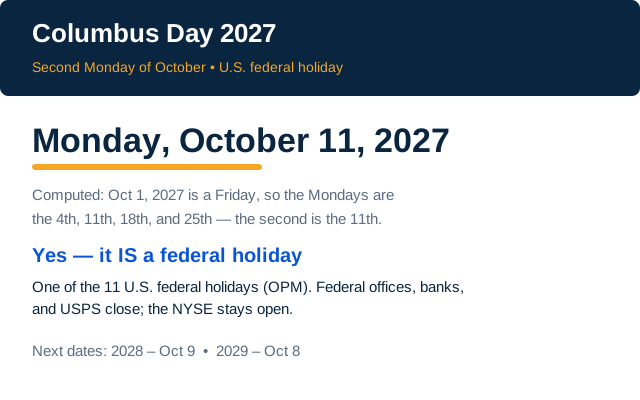
The short version of why this question keeps coming up: Columbus Day is a federal holiday, but it is not observed as uniformly as holidays like Thanksgiving or Christmas. The NYSE stays open. Many states do not treat it as a state holiday. And a growing number of cities and states observe Indigenous Peoples’ Day on the same date instead. So it feels like a holiday in Washington, D.C. and at your bank, but not necessarily everywhere else.
Federal holiday status has one firm, nationwide meaning: federal offices close, and the Federal Reserve closes — which is why your bank closes too. Everything beyond that (states, schools, private employers) is decided locally.
What’s Open and What’s Closed

| Status | Notes | |
|---|---|---|
| Banks | Closed | Federal Reserve closed (K.8); ATMs/online work |
| Federal Reserve | Closed | Listed on the Fed’s K.8 holiday schedule |
| USPS | Closed | No mail delivery or pickup, per the USPS holiday schedule |
| Federal offices | Closed | One of the 11 federal holidays per OPM |
| NYSE / Nasdaq | Open | Not a market holiday; normal trading hours |
| State offices | Varies | Many states do not observe it |
| Public schools | Varies | Check your district |
| Retail stores | Open | Normal hours typical |
| Restaurants | Open | Normal hours typical |
The single most useful rule: follow the Federal Reserve, not the name of the holiday. Banks close on Columbus Day because the Fed’s payment systems are closed — the same reason banks are closed on Veterans Day, another federal holiday where the NYSE stays open. By contrast, the stock market sets its own holiday calendar, and it does not include Columbus Day — trading continues normally.
Private carriers (FedEx, UPS) generally operate on Columbus Day, but service levels can differ by product. Check with your carrier for your specific service level.
“Check with your bank branch / employer / school district” — branch hours, company policies, and school calendars can vary. When in doubt, call ahead.
Major US banks closing for Columbus Day (October 11, 2027): Because Columbus Day is a Federal Reserve holiday, all major US banks — including Chase, Bank of America, Wells Fargo, Citibank, and U.S. Bank — close their branches on Monday, October 11, 2027. This surprises some people because the stock market stays open, but banks follow the Fed calendar, not the NYSE calendar.
The Date: Second Monday of October
Columbus Day falls on the second Monday of October each year — a placement set by the Uniform Monday Holiday Act, which took effect in 1971.
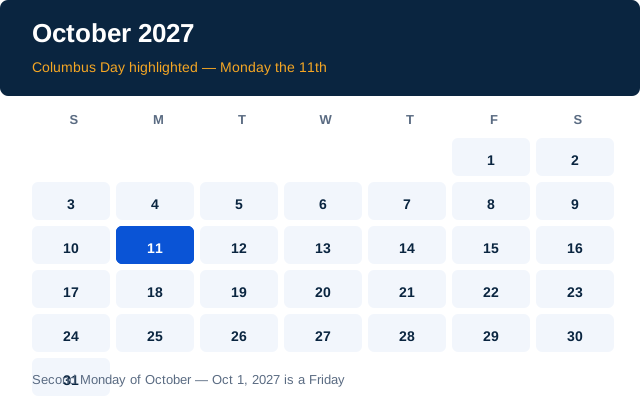
Columbus Day 2027: Monday, October 11.
We verified this computationally: October 1, 2027 is a Friday, so the Mondays of October 2027 are the 4th, 11th, 18th, and 25th. The second Monday is the 11th.
Recent and upcoming Columbus Days:
- 2025: October 13
- 2026: October 12
- 2027: October 11
- 2028: October 9
- 2029: October 8
Before 1971, Columbus Day was observed on the fixed date of October 12 — the anniversary of Columbus’s 1492 landing. The Monday-holiday reform moved it (along with Washington’s Birthday, Memorial Day, and Veterans Day at the time) to create three-day weekends. Veterans Day later returned to its fixed November 11 date, but Columbus Day kept the second-Monday slot.
History of Columbus Day
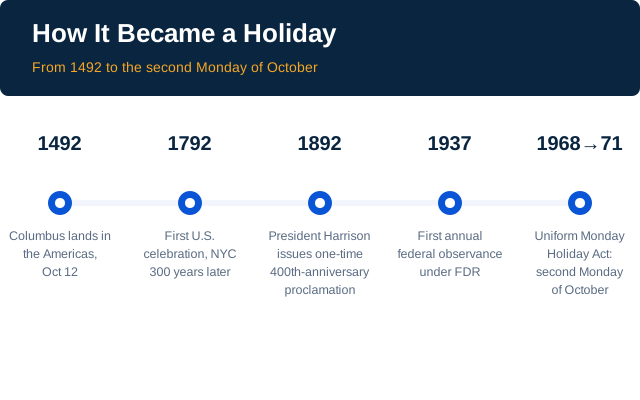
1492 — The voyage. On October 12, 1492, Christopher Columbus, an Italian explorer sailing under the Spanish flag, came ashore at Guanahaní, an island in the Bahamas. His expedition — the Niña, the Pinta, and the Santa María — had taken about three months to cross the Atlantic. Columbus believed he had reached the East Indies; the land he encountered was the Americas, unknown to Europeans at the time.
1792 — The first U.S. celebration. The anniversary of the landing was first formally celebrated 300 years later, in 1792, by the Columbian Order (Society of St. Tammany) in New York City. Early celebrations were closely tied to Italian-American heritage and pride.
1892 — The Harrison proclamation. For the 400th anniversary, President Benjamin Harrison issued a one-time national proclamation marking Columbus’s arrival — a single observance, not a recurring federal holiday. The gesture came partly amid diplomatic tensions with Italy following the 1891 lynching of eleven Italian immigrants in New Orleans.
1934 — Becoming a recurring federal observance. Congress passed a joint resolution in 1934 asking the president to proclaim Columbus Day each year, and on September 30, 1934, President Franklin D. Roosevelt issued Proclamation 2101 — the first annual federal observance — designating October 12 of each year as Columbus Day. Annual proclamations continued under the same resolution (including in 1936 and 1937). The Knights of Columbus, a Catholic fraternal organization, was among the most persistent advocates for formal recognition.
1968 — The Uniform Monday Holiday Act. Signed by President Lyndon B. Johnson in 1968 and effective from 1971, the Act moved Columbus Day from the fixed October 12 to the second Monday of October, creating the three-day weekend format. It also established the pattern for Washington’s Birthday, Memorial Day, and several other Monday holidays — the same legal framework behind New Year’s Day and Christmas observations shifting when they fall on weekends.
The through-line: Columbus Day started as an anniversary of an event in 1492, became a heritage celebration in the 1700s and 1800s, and only became a federal holiday in the 20th century. When people say “Columbus Day isn’t a real holiday,” they are usually confusing its uneven local observance with its federal status — which is firmly established.
Indigenous Peoples’ Day on the Same Date

Any honest account of Columbus Day has to note what shares its date. On the second Monday of October, a growing number of states, cities, and universities observe Indigenous Peoples’ Day — a day honoring the history, cultures, and contributions of Indigenous peoples of the Americas. Here are the documented facts:
- 1977: The idea was first raised as a replacement observance at an international conference on discrimination against Indigenous populations in the Americas in Geneva, Switzerland.
- 1990: South Dakota became the first state to replace the observance, naming the second Monday of October “Native Americans’ Day.”
- 1992: Berkeley, California became the first U.S. city to officially observe Indigenous Peoples’ Day, on the 500th anniversary of Columbus’s voyage.
- 2021: President Joe Biden issued the first-ever presidential proclamation of Indigenous Peoples’ Day (October 8, 2021), marking the first time a sitting president formally recognized the day. His proclamations continued through 2024; Columbus Day proclamations were issued alongside them.
- 2025: A proclamation refocused the day on Columbus Day specifically, reflecting the continuing national debate.
Two important distinctions. First, Indigenous Peoples’ Day is not a federal holiday — Congress has not voted to replace or rename the federal observance, and federal offices close under the Columbus Day name. Second, practices differ by place: some jurisdictions observe both, some observe only one, and many observe neither. We present this neutrally because the facts are what they are: the federal holiday is Columbus Day, and the local observance picture is genuinely varied. Check with your employer and your state.
State-by-State Observance

This is where Columbus Day gets confusing, and it is the main reason people question whether it is “really” a holiday. The federal layer is uniform: every federal office in every state closes. The state layer is not:
- Federal government: Closed in all 50 states, no exceptions.
- State governments: Vary. Most states do not observe Columbus Day as a state holiday (state offices stay open), while others close. A number of states instead observe Indigenous Peoples’ Day — or Native Americans’ Day, as South Dakota has since 1990 — on the same date.
- Cities and counties: Vary even more. Some close city offices; many do not. Some, like Berkeley, have observed Indigenous Peoples’ Day for decades.
- Schools: Vary by district. Some districts close, some hold regular classes, and some observe Indigenous Peoples’ Day. Check your district’s calendar — do not assume.
- Private employers: Not required to observe federal holidays at all. Whether you get the day off is entirely up to company policy. Many banks close (because the Fed closes), but most retail, restaurant, and service businesses stay open. If you work for a state or local government, your state’s choice is what matters for you.
We deliberately do not publish a fixed “list of states” here, because state observance changes: legislatures rename and add observances over time, and a list we print today could be wrong by next October. The reliable move is local: check with your employer and your state government’s posted holiday schedule.
One more reason the day feels uneven: private employers are never required to grant federal holidays as paid time off — that choice belongs entirely to company policy. In workplaces where Columbus Day is not on the paid-holiday list, and in states where it is not observed, the day simply looks like a regular workday, even though it is a federal holiday. That gap between federal status and local practice is exactly why “is it a federal holiday” is such a popular search.
Columbus Day in the 2027 Federal Holiday Calendar
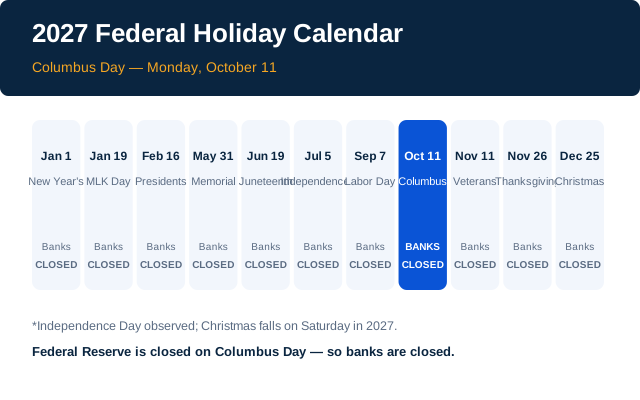
Columbus Day is the eighth federal holiday of 2027. Here is the full picture:
| 2027 Holiday | Date | Day | Banks |
|---|---|---|---|
| New Year’s Day | January 1 | Friday | Closed |
| Martin Luther King Jr. Day | January 18 | Monday | Closed |
| Presidents Day | February 15 | Monday | Closed |
| Memorial Day | May 31 | Monday | Closed |
| Juneteenth | June 19 | Saturday | Open* |
| Independence Day (observed) | July 5 | Monday | Closed |
| Labor Day | September 6 | Monday | Closed |
| Columbus Day | October 11 | Monday | Closed |
| Veterans Day | November 11 | Thursday | Closed |
| Thanksgiving | November 25 | Thursday | Closed |
| Christmas | December 25 | Saturday | Open* |
*Juneteenth 2027 falls on a Saturday — per the Fed’s K.8 schedule, Federal Reserve Banks are open Friday, June 18 (the Board of Governors is closed). Christmas 2027 also falls on a Saturday; Federal Reserve Banks are open Friday, December 24 (Board closed), so most banks are open, often with reduced hours — check with your branch. Columbus Day, by contrast, falls squarely on a Monday, so the closure is unambiguous.
See our full Federal Holidays 2027 guide for every holiday, our MLK Day 2027 and Veterans Day 2026 guides for the two other federal holidays with the same banks-closed / NYSE-open pattern, and our Juneteenth 2027 and Labor Day 2027 guides for the neighboring summer holidays.
Practical Tips
If You Need Banking Services
Do your in-branch banking by Friday, October 8. Anything submitted after that waits until Tuesday, October 12. Online transfers scheduled for Monday will process Tuesday. ATMs and mobile banking work normally throughout.
If You Are Expecting Mail
USPS does not deliver on Monday, October 11. Plan for a one-day delay on anything in transit. Private carriers generally operate, but check your specific service level.
If You Are Trading Stocks
Good news for traders: markets are open. Columbus Day is one of the federal holidays the NYSE ignores, so there is no need to adjust your trading calendar.
If You Have Kids in School
School observance is genuinely mixed on Columbus Day — more mixed than on most federal holidays. Check your district’s calendar rather than assuming a day off.
If You Work for the Government
Federal employees get the day off with pay. State and local employees: your jurisdiction’s holiday schedule decides. Look it up now, not the week before.
Three-Day Weekend Travel
Columbus Day weekend (October 9–11, 2027) is a popular fall-foliage travel weekend in the Northeast and a mild-weather weekend in the South. If you are taking the three-day weekend, book early — and note that Thanksgiving 2026 and Christmas 2026 travel windows are the next big ones after it.
Common Myths
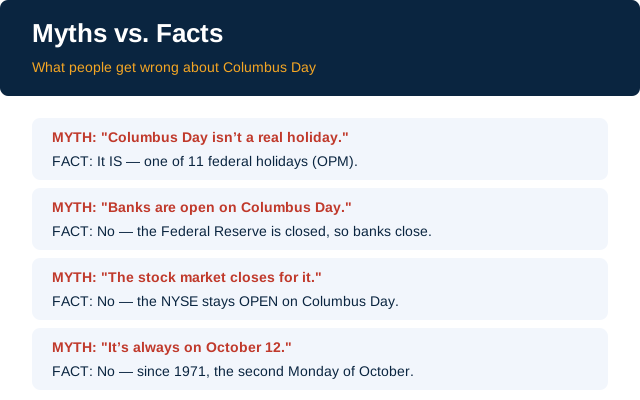
Myth: “Columbus Day isn’t a real holiday.” Reality: It is a full federal holiday — one of 11 listed by OPM. Federal offices, the Federal Reserve, and USPS all close.
Myth: “Banks are open on Columbus Day.” Reality: No. The Federal Reserve is closed on Columbus Day (it is on the Fed’s K.8 holiday schedule), so banks close. This is the same logic that closes banks on Veterans Day.
Myth: “The stock market closes for Columbus Day.” Reality: No — and this one surprises people. The NYSE sets its own holiday calendar and does not include Columbus Day. Trading continues normally, as it does on New Year’s Day-eve schedules adjustments and other non-market holidays.
Myth: “Columbus Day is always October 12.” Reality: It was observed on October 12 before 1971. Since the Uniform Monday Holiday Act took effect, it is the second Monday of October — anywhere from October 8 to October 14.
Myth: “Every state celebrates Columbus Day.” Reality: Most states do not observe it as a state holiday, and a growing number observe Indigenous Peoples’ Day on the same date. State practice is the most variable part of this holiday.
Related Guides
- Federal Holidays 2027: Learn more about federal holidays 2027.
- Are Banks Open Today?: Learn more about are banks open today?.
- Veterans Day 2026: Learn more about veterans day 2026.
FAQ
Is Columbus Day a federal holiday? Yes. Columbus Day is one of the 11 U.S. federal holidays. Federal offices are closed on the second Monday of October.
What day is Columbus Day in 2027? Monday, October 11, 2027 — the second Monday of October.
Are banks open on Columbus Day? No. The Federal Reserve is closed on Columbus Day, so banks are closed. ATMs and online banking remain available.
Is there mail delivery on Columbus Day? No. USPS does not deliver mail on Columbus Day, and post offices are closed.
Is the stock market open on Columbus Day? Yes. The NYSE and Nasdaq operate normal trading hours on Columbus Day — it is not a market holiday.
Why is Columbus Day controversial? Critics argue the holiday honors Columbus despite the violence and colonization that followed his 1492 voyage, while supporters cite Italian-American heritage. Many states and cities now observe Indigenous Peoples’ Day on the same date.
Which states do not observe Columbus Day? Observance varies. Most states do not observe Columbus Day as a state holiday, and a growing number observe Indigenous Peoples’ Day on the same date instead. Check with your state and employer.
What is Indigenous Peoples’ Day? An observance honoring Indigenous peoples of the Americas, held by many states and cities on the second Monday of October. It is not a federal holiday.
Are schools closed on Columbus Day? It varies by district. Some schools close, many do not. Check your local school district’s calendar.
How We Verified This
The October 11, 2027 date was computed (October 1, 2027 is a Friday; the Mondays are the 4th, 11th, 18th, and 25th; the second is the 11th), not recalled — the same computation gives October 9 for 2028 and October 8 for 2029. Bank closure follows from the Federal Reserve’s K.8 holiday schedule: the Fed is closed on Columbus Day, and banks follow the Fed. USPS closure is from the USPS holiday schedule; the NYSE’s open status is from the NYSE holiday calendar, which does not list Columbus Day. Federal holiday status is from OPM’s list of 11 federal holidays. The history dates (1492 landing, 1792 first U.S. celebration in New York, 1892 Harrison proclamation, 1934 first annual federal observance under Roosevelt (Proclamation 2101), 1968 Uniform Monday Holiday Act effective 1971) are from the historical record as documented in the sources above. The Indigenous Peoples’ Day facts (1977 Geneva conference, 1990 South Dakota, 1992 Berkeley, 2021 first presidential proclamation) are from the documented record. Where observance varies — states, schools, private employers — we say so explicitly instead of claiming universality.
Related: Federal Holidays 2027 · Are Banks Open Today? · When Do the Clocks Fall Back?