

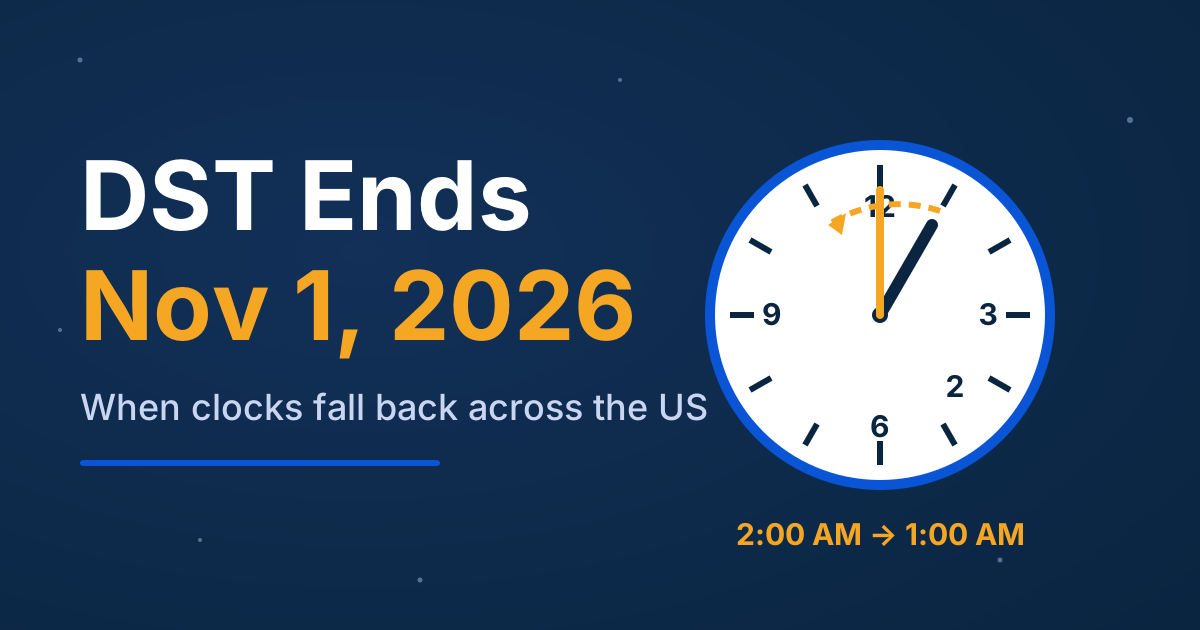
No — as of October 19, 2026, the United States is still on daylight saving time. DST ends in 13 days, on Sunday, November 1, 2026, when clocks fall back from 2:00 AM to 1:00 AM local time.
TL;DR: Clocks fall back Sunday, November 1, 2026 — at 2:00 AM, set clocks back to 1:00 AM. Hawaii and most of Arizona skip the change. Phones update automatically; check manual clocks, alarms, and detector batteries. DST returns March 14, 2027.
Contents
- Quick-answer table
- Countdown
- Exact times by time zone
- State-by-state: who changes
- What happens at 2:00 AM
- Sunrise and sunset changes
- Flights, shift workers, and payroll
- Practical checklist
- Sleep and health
- History of DST
- The permanent-time debate
- Canada, Mexico, and Europe
- When DST returns
- Worked example
- Common myths
- How the change affects different people
- The science in brief
- Energy and economic notes
- What the Uniform Time Act actually requires
- Preparing technology
- Voice assistants
- Daylight savings NYC: local notes
- Colorado time change: local notes
- FAQ
- How we verified this
Quick-answer table
| Question | Answer |
|---|---|
| Fall-back date | Sunday, November 1, 2026 |
| Local time | 2:00 AM daylight → 1:00 AM standard |
| Days remaining | ::dst-days-left:: days |
| Net effect | Gain 1 hour; 25-hour day |
| Who skips it | Hawaii, most of Arizona, US territories |
| Sunrise shift (NYC) | 7:28 AM → 6:30 AM |
| Sunset shift (NYC) | 5:50 PM → 4:48 PM |
| DST returns | Sunday, March 14, 2027 |
| Manual action needed? | Yes — for non-connected clocks |
Quick answer: US daylight saving time ends Sunday, November 1, 2026. At 2:00 AM local daylight time, clocks fall back to 1:00 AM local standard time — the 1 AM hour repeats. New York, Chicago, Denver, and Los Angeles all change the same night. Hawaii and most of Arizona do not observe the switch. All dates computed from the IANA time zone database.
Countdown
There are ::dst-days-left:: days until clocks fall back. After November 1, the US returns to standard time: EST (UTC-5), CST (UTC-6), MST (UTC-7), PST (UTC-8). See the 2026 DST transition table, the daylight saving overview, and when clocks fall back in 2026.
Exact times by time zone
| Time zone | Falls back at | Becomes | New offset |
|---|---|---|---|
| Eastern (NYC) | 2:00 AM EDT | 1:00 AM EST | UTC-5 |
| Central (Chicago) | 2:00 AM CDT | 1:00 AM CST | UTC-6 |
| Mountain (Denver, Colorado) | 2:00 AM MDT | 1:00 AM MST | UTC-7 |
| Pacific (LA) | 2:00 AM PDT | 1:00 AM PST | UTC-8 |
The PDT-to-PST change affects the entire West Coast simultaneously. For New York City specifically: 2:00 AM EDT becomes 1:00 AM EST. Use our time zone converter for any specific time.
State-by-state
| Area | Nov 1 behavior | Detail |
|---|---|---|
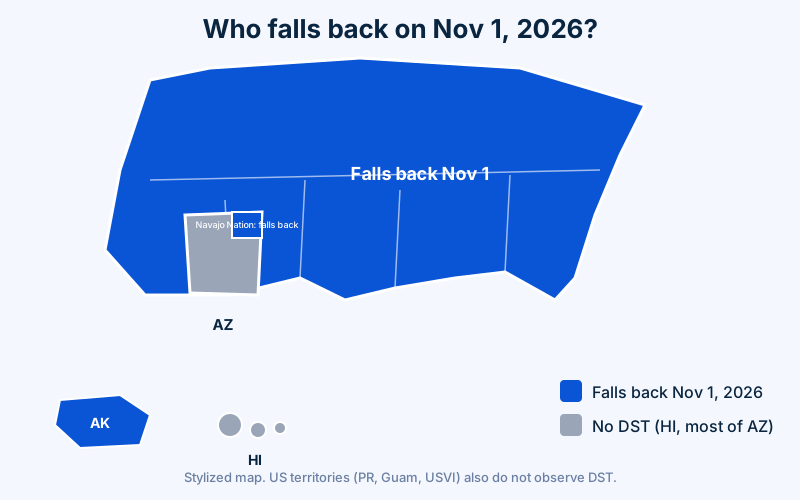
| 48 states | Falls back | 2:00 AM → 1:00 AM local |
| Hawaii | No change | HST (UTC-10) year-round |
| Arizona (most) | No change | MST (UTC-7) year-round |
| Navajo Nation (AZ/NM/UT) | Falls back | Observes DST; 2:00 AM MDT → 1:00 AM MST |
| Puerto Rico, Guam, USVI, American Samoa, Northern Mariana Islands | No change | No DST observed |
The Navajo Nation exception means crossing the reservation boundary in northeastern Arizona on November 1 can shift your clock by an hour.
What happens at 2:00 AM
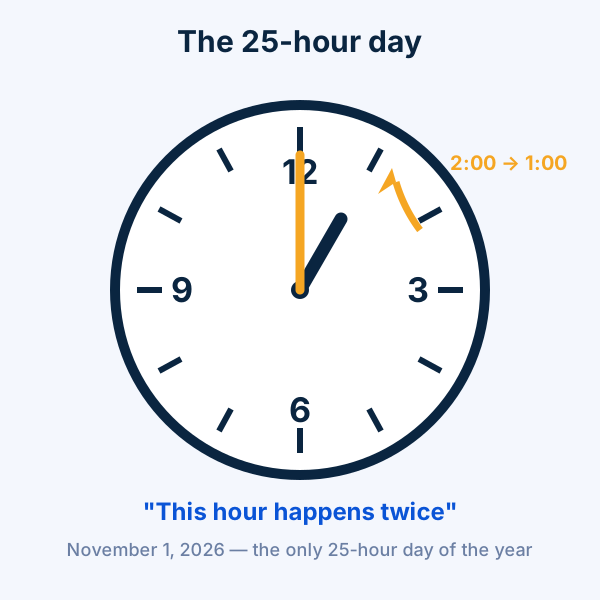
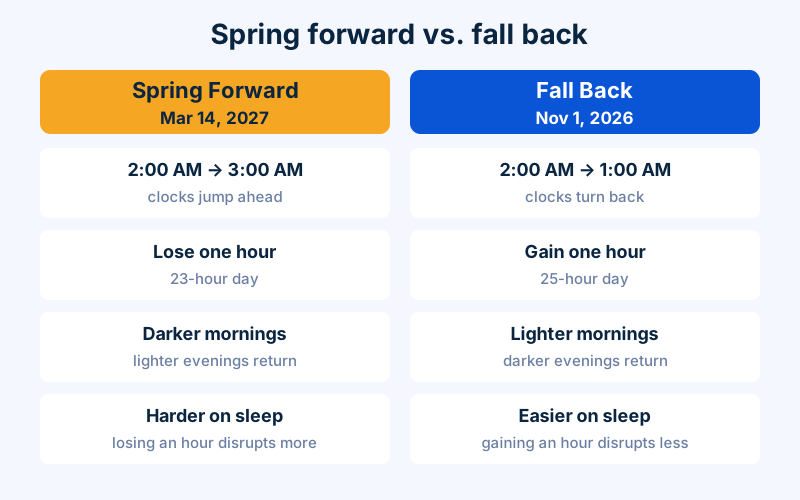
The 1:00–2:00 AM hour occurs twice. This creates the year’s only 25-hour day — the longest day by the clock (as opposed to the summer solstice, the longest by daylight).
Sunrise and sunset changes
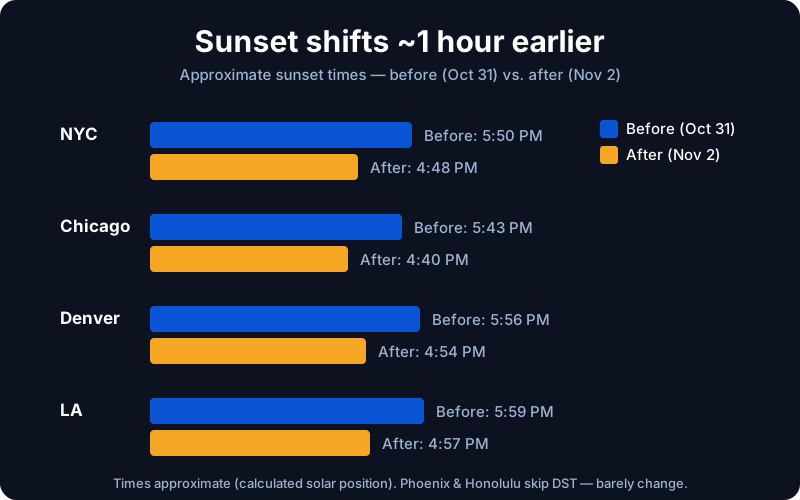
The most noticeable effect: mornings get lighter, evenings get darker — by a full hour on the clock. Times below are approximate for November 1 weekend:
| City | Sunrise Oct 31 | Sunrise Nov 2 | Sunset Oct 31 | Sunset Nov 2 |
|---|---|---|---|---|
| New York | 7:28 AM | 6:30 AM | 5:50 PM | 4:48 PM |
| Chicago | 7:24 AM | 6:27 AM | 5:43 PM | 4:40 PM |
| Denver | 7:30 AM | 6:32 AM | 5:56 PM | 4:54 PM |
| Los Angeles | 7:13 AM | 6:15 AM | 5:59 PM | 4:57 PM |
| Seattle | 7:55 AM | 6:58 AM | 5:50 PM | 4:47 PM |
| Miami | 7:30 AM | 6:31 AM | 6:38 PM | 5:37 PM |
| Phoenix (no DST) | 6:48 AM | 6:50 AM | 5:35 PM | 5:33 PM |
| Honolulu (no DST) | 6:35 AM | 6:36 AM | 5:54 PM | 5:53 PM |
Phoenix and Honolulu barely shift — they skip DST entirely, so only the seasonal drift applies. Northern cities like Seattle see the most dramatic evening change: sunset before 5 PM.
Flights, shift workers, and payroll
- Flights: Airlines schedule in local time. A 1:30 AM departure on Nov 1 is ambiguous — confirm with the airline which 1:30 AM. Most carriers handle it in their systems, but verify.
- Overnight shifts: The 11 PM–7 AM shift on Nov 1–2 is 9 hours long, not 8. Whether the extra hour is paid depends on employer policy — check with your employer or union agreement.
- Payroll systems: Most modern payroll software handles the 25-hour day, but hourly workers should verify their timesheets that week.
- Pets: Dogs and cats don’t read clocks. Shift feeding times gradually (15 minutes per day) to avoid 5 AM wake-up demands.
Practical checklist
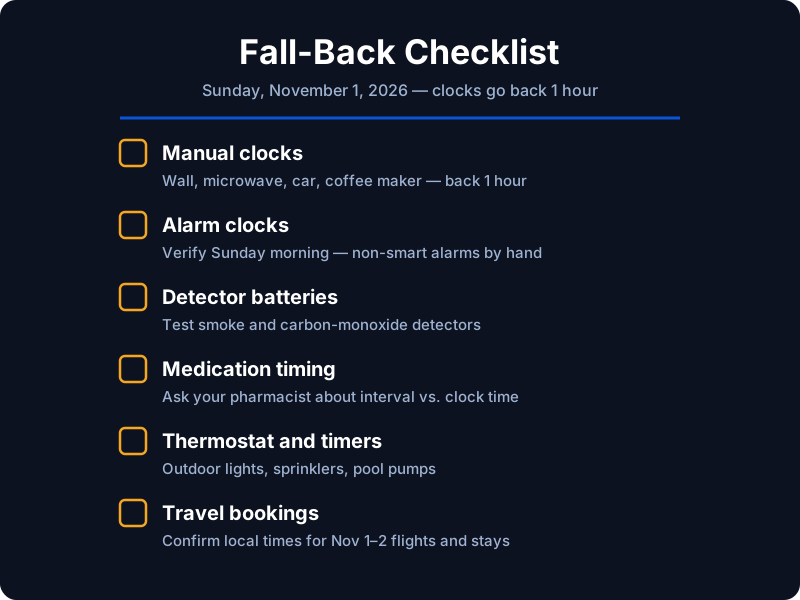
- Manual clocks (wall, microwave, car, coffee maker) — back one hour
- Alarm clocks — verify Sunday morning
- Smoke & CO detector batteries — test them
- Medication schedules — confirm timing with pharmacist if unsure
- Thermostats, outdoor lights, sprinkler timers
- Travel bookings on Nov 1–2 — confirm local times
- Shift kids’ and pets’ bedtimes 15 min/night before
Sleep and health
Gaining an hour is generally easier than losing one in spring — the body’s internal clock runs slightly longer than 24 hours, so “falling back” aligns with its natural drift. Still, expect a few days of adjustment.
The American Academy of Sleep Medicine’s position statement on daylight saving time argues that seasonal time changes should be abolished in favor of year-round standard time, citing evidence of increased cardiovascular events, mood disorders, and motor vehicle crashes associated with the transitions — particularly the spring shift. Consistent bedtimes (including weekends) and morning daylight exposure are the standard recommendations for steadying sleep through any clock change.
General information only — not medical advice.
History of DST
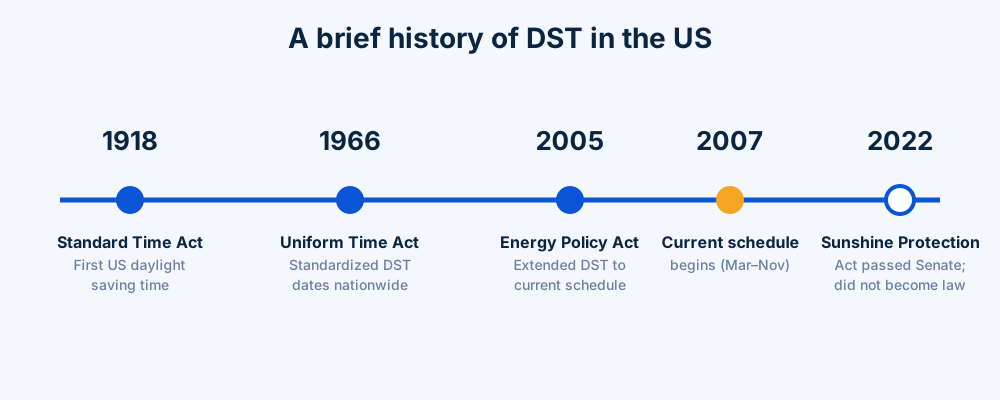
| Year | Event |
|---|---|
| 1918 | Standard Time Act — first US DST |
| 1919 | Repealed; states decide individually |
| 1942–45 | Year-round “War Time” |
| 1966 | Uniform Time Act standardizes dates |
| 1974–75 | Year-round DST tried, then reversed |
| 2005 | Energy Policy Act extends DST |
| 2007 | Current schedule begins (2nd Sun Mar – 1st Sun Nov) |
The permanent-time debate
The Sunshine Protection Act (S.623), which would make daylight saving time permanent nationwide, passed the US Senate by unanimous consent in 2022 but was never brought to a vote in the House and expired at the end of the 117th Congress — it did not become law. The twice-yearly switch remains federal law. Debate continues between permanent daylight time (lighter evenings) and permanent standard time (lighter mornings, favored in the AASM’s position statement). Any change requires an act of Congress.
Canada, Mexico, and Europe
Canada: Most of Canada follows the same schedule — falls back November 1, 2026. Saskatchewan (most) does not observe DST.
Mexico: Mexico abolished DST in 2022 (except near the US border, where some municipalities align with US time). Most of Mexico does not change clocks.
Europe: The UK and EU fall back one week earlier, on October 25, 2026. For one week (Oct 25–Nov 1), the US–Europe time gap is one hour smaller than usual.
When DST returns
Clocks spring forward Sunday, March 14, 2027, at 2:00 AM local standard time → 3:00 AM daylight time. That is a 23-hour day.
Worked example
Scenario: A meeting is scheduled for Monday, November 2, 2026, at 9:00 AM Eastern.
- Before the change (Oct 31): 9:00 AM EDT = 6:00 AM PDT
- After the change (Nov 2): 9:00 AM EST = 6:00 AM PST
The clock times look the same, but the UTC offsets shifted (EDT UTC-4 → EST UTC-5). For absolute scheduling across the transition weekend itself, use UTC or our time zone converter.
Common myths
- “DST was created for farmers.” No — farmers generally opposed it; it was promoted for energy conservation and wartime productivity.
- “The extra hour means extra sleep.” Only if you keep your bedtime. Most people just shift their schedule.
- “Arizona is the only exception.” Hawaii, US territories, and parts of Indiana’s history complicate this — and the Navajo Nation observes DST inside non-observing Arizona.
- “Clocks change at midnight.” No — 2:00 AM local time, chosen to minimize disruption.
- “The time change affects everyone equally.” No — its impact varies by latitude. In Miami, the sunset shift is from 6:38 PM to 5:37 PM (about an hour). In Seattle, sunset moves from 5:50 PM to 4:47 PM, but the already-short northern day makes the darkness feel more abrupt. Southern cities notice less change because their day length varies less across seasons.
- “Your phone might get it wrong.” Modern phones use network time and IANA database updates. The risk is essentially zero for iOS and Android devices with automatic time enabled. The devices to worry about are old, offline, or manually-set ones.
How the change affects different people
Parents of young children: Children’s sleep is less flexible than adults’. Start shifting bedtime 15 minutes earlier each night starting around October 28. Morning light exposure helps reset their clock. Expect a few days of early waking.
Shift workers: If you work overnight November 1–2, confirm with your employer whether the extra hour is paid. Policies vary — some pay the actual hours worked (9), some pay the scheduled shift (8). Get it in writing if it’s ambiguous.
Travelers: If you’re flying overnight on November 1, your 1:30 AM connection might be the first or second 1:30 AM. Airlines’ systems handle this, but allow extra buffer. Hotel check-in/check-out times are unaffected (they’re daytime).
People on medication: Drugs taken “every 12 hours” vs. “at 8 AM and 8 PM” behave differently across the change. For critical medications (insulin, blood thinners, anti-seizure drugs), ask your pharmacist whether to follow the clock or the interval.
Pet owners: Animals run on routine, not clocks. Move feeding and walk times by 15 minutes per day for four days before November 1 to avoid confusion (and 5 AM wake-up calls).
Remote workers across zones: The US–Europe gap narrows by one hour for the week of October 25–November 1 (Europe falls back first). If you meet with European colleagues, double-check that week.
The science in brief
Human circadian rhythm runs slightly longer than 24 hours — about 24.2 hours on average. This is why “falling back” (gaining an hour, effectively a 25-hour day) feels more natural than “springing forward” (losing an hour, a 23-hour day). The body finds it easier to stay up later than to fall asleep earlier.
Morning light is the strongest signal for resetting the clock. After November 1, sunrise comes an hour “earlier” by the clock — use it. Get outside or open curtains within an hour of waking for the first few days.
Evening darkness arriving earlier can affect mood for some people, particularly in northern latitudes where the day is already short. This is distinct from clinical seasonal affective disorder but shares the mechanism (reduced light exposure). Light therapy lamps are a common non-medical intervention — consult a clinician if low mood persists.
Energy and economic notes
The original justification for DST was energy conservation — less artificial light needed in the evening. Modern evidence is mixed: lighting is a smaller share of energy use than in the 1970s, while heating and cooling patterns complicate the picture. The Department of Transportation (which oversees US time observance under the Uniform Time Act) has studied the effects at various points.
Retail and recreation industries have historically favored extended evening daylight; the golf and barbecue industries famously lobbied for DST extensions. Morning-focused industries (agriculture, construction starting at dawn) have been less enthusiastic. These are longstanding positions, not new findings.
What the Uniform Time Act actually requires
The Uniform Time Act of 1966 (15 U.S.C. §§ 260–267) does not mandate DST — it standardizes it. Key points:
- States may opt out of DST entirely (as Hawaii and Arizona have) but may not stay on DST year-round without federal approval.
- The federal DST schedule is set by Congress; states cannot pick their own start/end dates.
- The Department of Transportation oversees time zone boundaries and DST observance — a legacy of railroads, the original drivers of standardized time. (See the DOT’s time zone information.)
- US territories are exempt from the Act’s DST provisions.
This is why “permanent DST” requires an act of Congress: states cannot do it alone under current law.
Preparing technology
Automatic (no action needed):
- iPhones, Android phones (with automatic time enabled)
- Windows/Mac computers (with internet time sync)
- Smart speakers, streaming devices
- Modern cars with GPS time
Manual (set back one hour):
- Wall clocks, alarm clocks (non-smart)
- Microwave, oven, coffee maker displays
- Older car dashboards
- Sprinkler/irrigation timers
- Pool pump timers
- Older thermostats
Check twice:
- Baby monitors with clock displays
- CPAP machines (some log data by time)
- Security camera timestamps (verify after the change)
- Medical devices — confirm with manufacturer if unsure
“Clock google” and voice assistants
If you ask Google, Siri, or Alexa “when do clocks fall back,” you’ll get November 1, 2026 — these assistants pull from the same IANA-derived data. But voice answers are brief by design. For the full picture (exceptions, sunrise changes, checklists), this guide covers what a 10-second answer can’t.
Tip: Ask your assistant “set an alarm for 1:30 AM on November 1” and you may get a clarifying question about which 1:30 AM — the first or the second. This is the 25-hour day in action.
Daylight savings NYC: local notes
New York City specifics for November 1, 2026:
- Sunrise: 6:30 AM (was 7:28 AM) — morning commutes get lighter
- Sunset: 4:48 PM (was 5:50 PM) — evening commutes go dark
- Subway: MTA runs on local time; the 1 AM–2 AM repeat doesn’t affect scheduled service meaningfully
- Broadway: Evening shows unaffected (curtain times are well after the transition)
- Bars/restaurants: NYC bars with 4 AM licenses get a technical extra hour — 2 AM becomes 1 AM, so last call shifts. (This varies by establishment.)
Colorado time change: local notes
Colorado (Mountain Time) specifics:
- Falls back: 2:00 AM MDT → 1:00 AM MST on November 1
- Denver sunrise: 6:32 AM (was 7:30 AM)
- Denver sunset: 4:54 PM (was 5:56 PM)
- Ski season: The time change lands just as Colorado ski resorts open — lift operations use the new standard time
- Note: Colorado has debated permanent DST legislation, but the state still observes the federal schedule
FAQ
Is it daylight saving time right now? Yes. DST ends November 1, 2026.
How many days until daylight saving time ends? See the countdown at the top of this page for the exact days remaining.
What is the PDT to PST time change? On November 1, 2026, at 2:00 AM PDT, Pacific clocks fall back to 1:00 AM PST (UTC-8).
Does Hawaii observe daylight saving time? No — HST (UTC-10) year-round.
What is the Colorado time change? Colorado (Mountain) falls back November 1: 2:00 AM MDT → 1:00 AM MST.
When does DST start again? Sunday, March 14, 2027.
Do I need to change clocks manually? Only non-connected clocks. Phones and computers update automatically.
Why do we still change clocks? Federal law (Uniform Time Act as amended). Permanent-DST bills have not passed.
Is falling back bad for sleep? Generally easier than spring forward. Consistent bedtimes help.
What should I check? Manual clocks, alarms, detector batteries, medication timing, travel bookings.
How we verified this
All transition dates and times were computed from the IANA time zone database at build time — not hand-typed. Sunrise/sunset times are approximate (calculated solar position). Historical dates verified against NIST and the U.S. Naval Observatory. Legislative status verified on Congress.gov. Health references cite the American Academy of Sleep Medicine's published position statement. No statistics were invented; where precise figures were unavailable, we described the effect qualitatively.