

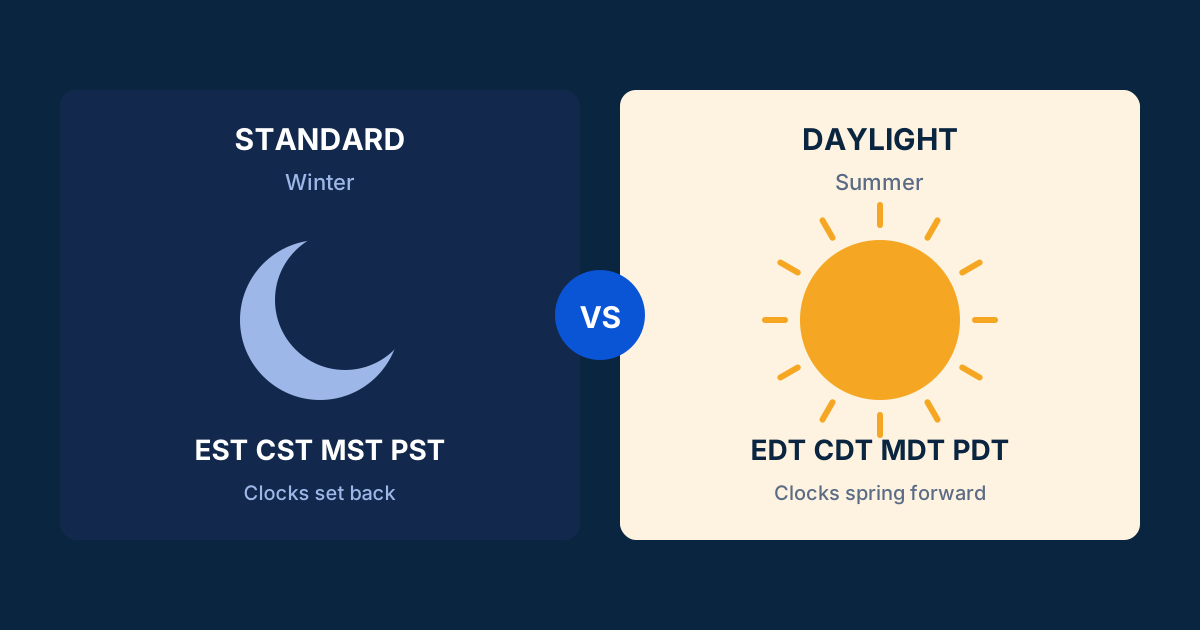
TL;DR: Use EST/CST in winter (November-March), EDT/CDT in summer (March-November). The "S" means Standard, "D" means Daylight. In 2026: spring forward March 8, fall back November 1.
Contents
- Quick-answer table
- What S vs D means
- When to use each
- 2026-2027 schedule
- CDT vs CST: which is it right now?
- All US zones
- Common mistakes
- History
- Practical tips
- International equivalents
- Summary
- FAQ
- How we verified this
Quick-answer table
| Question | Answer |
|---|---|
| CST vs CDT? | Same zone, different season. CST=winter, CDT=summer |
| EST vs EDT? | Same zone. EST=winter (UTC-5), EDT=summer (UTC-4) |
| Right now (Oct 2026)? | EDT and CDT (daylight time) |
| Spring 2026 | March 8: EST→EDT, CST→CDT |
| Fall 2026 | Nov 1: EDT→EST, CDT→CST |
| Arizona? | MST year-round (no DST) |
What S vs D means
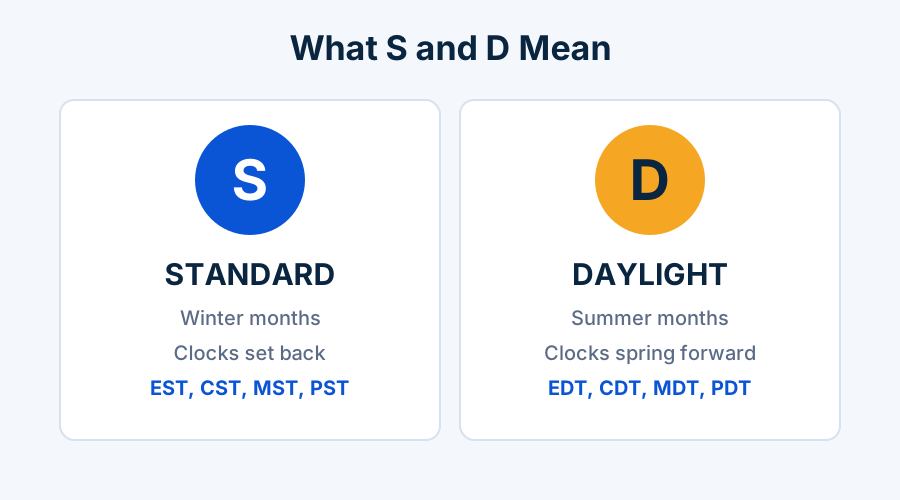
S = Standard Time (winter)
- EST: Eastern Standard Time (UTC-5)
- CST: Central Standard Time (UTC-6)
- MST: Mountain Standard Time (UTC-7)
- PST: Pacific Standard Time (UTC-8)
D = Daylight Time (summer)
- EDT: Eastern Daylight Time (UTC-4)
- CDT: Central Daylight Time (UTC-5)
- MDT: Mountain Daylight Time (UTC-6)
- PDT: Pacific Daylight Time (UTC-7)
The “D” indicates daylight saving time is in effect (NIST). Clocks are set forward 1 hour from standard time.
Key point: EST and EDT are not different time zones. They are the same Eastern Time Zone, just different seasonal observances.
When to use each
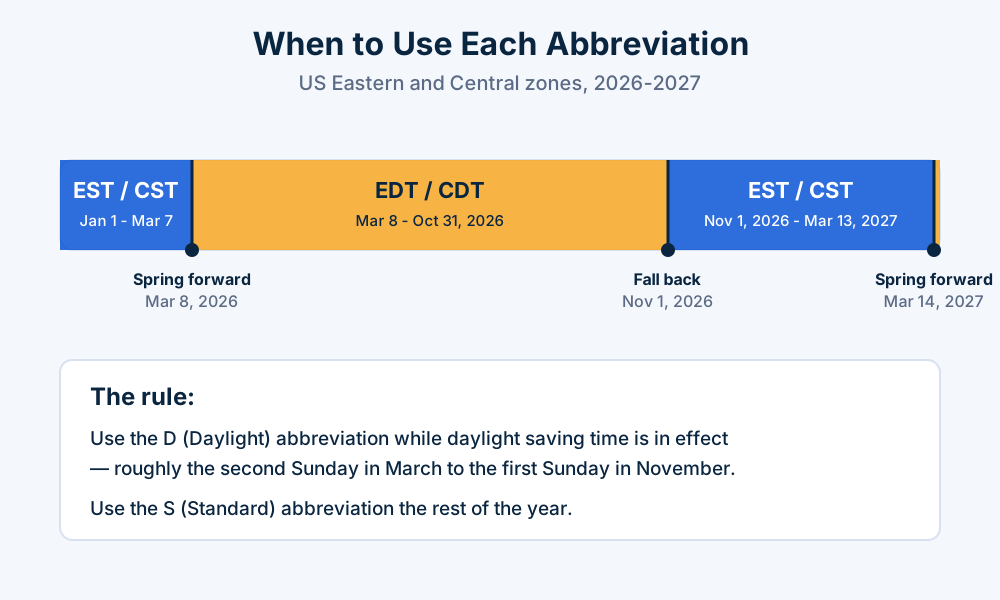
Use EST/CST/MST/PST (Standard):
- Second Sunday in November through second Sunday in March
- 2026-2027: November 1, 2026 to March 14, 2027
Use EDT/CDT/MDT/PDT (Daylight):
- Second Sunday in March through first Sunday in November
- 2026: March 8 to November 1
Right now: The US observes daylight time from March to November (EDT, CDT, MDT, PDT) and standard time from November to March (EST, CST, MST, PST).
Simple rule: If it’s summer (roughly April-October), use the “D” version. If it’s winter (roughly November-March), use the “S” version.
2026-2027 schedule
| Date | Change | Zones affected |
|---|---|---|
| March 8, 2026 | Spring forward (2 AM → 3 AM) | EST→EDT, CST→CDT, MST→MDT, PST→PDT |
| November 1, 2026 | Fall back (2 AM → 1 AM) | EDT→EST, CDT→CST, MDT→MST, PDT→PST |
| March 14, 2027 | Spring forward | EST→EDT, CST→CDT, MST→MDT, PST→PDT |
| November 7, 2027 | Fall back | EDT→EST, CDT→CST, MDT→MST, PDT→PST |
For more, see when DST ends. The US DOT maintains official time zone boundaries.
CDT vs CST: Which Is It Right Now?
As of October 2026, the Central time zone is on CDT (Central Daylight Time, UTC-5). It switches back to CST (Central Standard Time, UTC-6) on Sunday, November 1, 2026, when clocks fall back. The rule is simple: CDT runs from the second Sunday in March to the first Sunday in November; CST covers the rest of the year.
All US zones
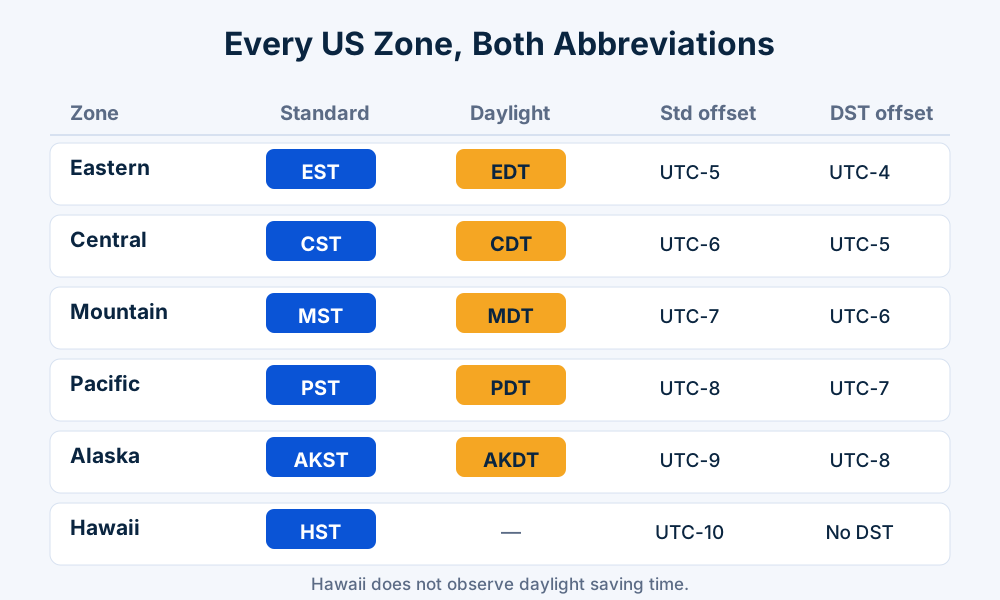
| Zone | Standard (winter) | Daylight (summer) | UTC offset |
|---|---|---|---|
| Eastern | EST | EDT | UTC-5 / UTC-4 |
| Central | CST | CDT | UTC-6 / UTC-5 |
| Mountain | MST | MDT | UTC-7 / UTC-6 |
| Pacific | PST | PDT | UTC-8 / UTC-7 |
| Alaska | AKST | AKDT | UTC-9 / UTC-8 |
| Hawaii | HST | (no DST) | UTC-10 year-round |
Exceptions:
- Arizona (most): MST year-round, no daylight time
- Hawaii: HST year-round, no daylight time
- Navajo Nation (in Arizona): Observes DST (MDT in summer)
Common mistakes
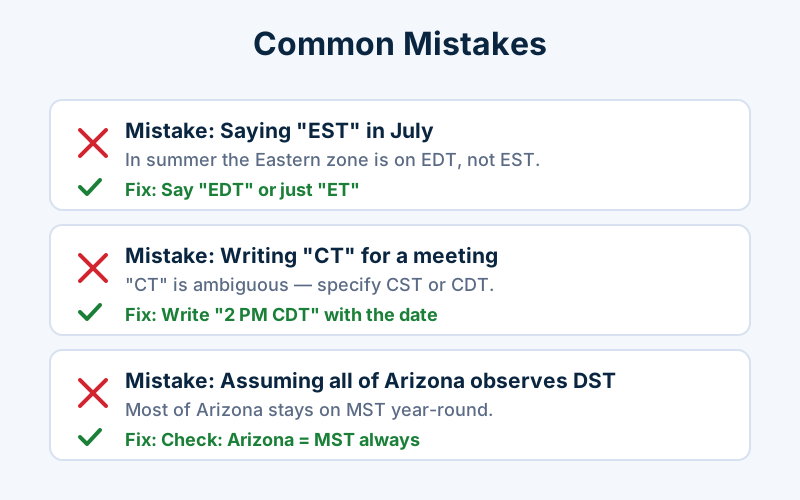
Mistake 1: Using EST in summer
- Wrong: “Meeting at 3 PM EST in July”
- Right: “Meeting at 3 PM EDT in July”
- In July, Eastern Time is EDT, not EST.
Mistake 2: Using EDT in winter
- Wrong: “Call at 10 AM EDT in January”
- Right: “Call at 10 AM EST in January”
Mistake 3: Writing “EST” when you mean “Eastern Time” generally
- If you’re not sure whether it’s standard or daylight, just write “ET” (Eastern Time)
- “ET” is ambiguous but safe. “EST” in summer is wrong.
Mistake 4: Forgetting Arizona
- Don’t assume all of Mountain Time observes DST
- Most of Arizona stays on MST year-round
Mistake 5: Confusing CST (US Central) with CST (China/Cuba)
- CST can mean US Central Standard Time (UTC-6), China Standard Time (UTC+8), or Cuba Standard Time (UTC-5)
- Context matters. In US contexts, CST usually means Central.
More examples
Scheduling a meeting:
- Wrong: “Let’s meet at 2 PM CST on August 15”
- Right: “Let’s meet at 2 PM CDT on August 15” (August is daylight time)
- Or: “Let’s meet at 2 PM CT on August 15” (CT is ambiguous but safe)
Writing a deadline:
- Wrong: “Deadline: 5 PM EST, June 30”
- Right: “Deadline: 5 PM EDT, June 30”
Email signature: Many professionals include their time zone: “John Smith | 3 PM EDT (New York)” This clarifies the offset for recipients in other zones.
History
Daylight saving time was first proposed by Benjamin Franklin (as a joke about saving candles) and later by George Hudson (entomologist who wanted more daylight for insect collecting).
US history:
- 1918: First DST observance (WWI)
- 1942-1945: Year-round DST (“War Time”) in WWII
- 1966: Uniform Time Act standardizes DST
- 2007: Extended to second Sunday March to first Sunday November (Energy Policy Act of 2005)
The abbreviations (EST, EDT, etc.) became standard with the Uniform Time Act.
Practical tips
For travelers:
- Your phone updates automatically. Don’t worry about the abbreviation.
- When booking flights, times are usually in local time. The abbreviation may not be shown.
- If scheduling across zones, use our time zone converter.
For business:
- In emails, specify the date AND time zone: “Meeting Tuesday at 2 PM EDT”
- For recurring meetings, note that the abbreviation changes in March/November
- Consider using UTC for international teams to avoid confusion
For developers:
- Store times in UTC, display in local
- Use IANA time zone names (America/New_York) not abbreviations
- Abbreviations are ambiguous (CST = 3 different zones!)
See our Unix timestamp guide for technical time handling.
The “fall back” transition in detail
On November 1, 2026:
- At 2:00 AM EDT, clocks go back to 1:00 AM EST
- The hour from 1:00 AM to 2:00 AM happens twice
- This is why the abbreviation changes at 2:00 AM, not midnight
If you’re working the night shift, you work an extra hour. If you’re sleeping, you get an extra hour of sleep.
The “spring forward” transition in detail
On March 8, 2026:
- At 2:00 AM EST, clocks jump to 3:00 AM EDT
- The hour from 2:00 AM to 3:00 AM is skipped
- This is why the abbreviation changes at 2:00 AM
If you’re working the night shift, you work one less hour. If you’re sleeping, you lose an hour of sleep.
International equivalents
The US is not the only country with daylight saving:
UK: GMT (winter) / BST - British Summer Time (summer) EU: CET (winter) / CEST - Central European Summer Time (summer) Australia: AEST (winter) / AEDT - Australian Eastern Daylight Time (summer)
The pattern is the same: standard in winter, daylight in summer. The specific dates vary by country.
Countries without DST:
- Most of Asia (China, Japan, India)
- Most of Africa
- Hawaii and most of Arizona (US)
If you’re scheduling internationally, don’t assume DST. Check the specific country’s observance.
Our world clock shows current times worldwide.
Summary
- S = Standard (winter, November-March)
- D = Daylight (summer, March-November)
- 2026: EDT/CDT now, EST/CST after Nov 1
- When in doubt: Use “ET” or “CT” (without S/D) or specify the date
- Arizona/Hawaii: No DST, always standard
The abbreviations are just labels for the UTC offset. EST (UTC-5) vs EDT (UTC-4) tells you whether daylight saving is in effect. Once you know the date, you know which to use.
Quick decision tree
What month is it?
- March (after 2nd Sunday) through October: Use D (EDT, CDT, MDT, PDT)
- November (after 1st Sunday) through February: Use S (EST, CST, MST, PST)
- Early March or early November: Check the exact transition date
Are you in Arizona or Hawaii?
- Yes: Always use S (MST, HST). No daylight time.
- No: Follow the month rule above.
Still unsure?
- Use “ET”, “CT”, “MT”, or “PT” without S/D
- Or write the UTC offset: “2 PM ET (UTC-4)”
- Or just give the date: “Meeting on July 15 at 2 PM Eastern” (everyone knows July is daylight time)
For more time zone help, see EST vs CST, military time, and our time zone converter.
The IANA time zone database is the authoritative source for time zone rules worldwide. For US-specific regulations, see the Department of Transportation.
Final thoughts
Time zone abbreviations seem confusing at first, but the pattern is simple: S in winter, D in summer. The dates (second Sunday in March, first Sunday in November) are the same every year. Once you internalize this, you’ll never mix up EST and EDT again.
When communicating across time zones, clarity matters more than correctness. If you’re not sure whether it’s EST or EDT, just say “Eastern” and give the date. Your recipient can figure out the offset. Better to be clear than technically precise but confusing.
For scheduling, use tools like our meeting planner that handle the conversions automatically. Technology has solved this problem — you don’t need to memorize the abbreviations, just understand the pattern.
Remember:
- March to November: Daylight (D)
- November to March: Standard (S)
- Arizona/Hawaii: Always Standard (no D)
- When in doubt: Just say “Eastern” or “Central” without the letter
This guide covers the US system. Other countries have their own abbreviations and DST rules. The principles are the same, but the dates differ. Always check local rules when scheduling internationally.
Bookmark this page
Keep this guide handy for quick reference. The key dates (March 8 and November 1 for 2026) are the same every year, just on different dates. Once you know the pattern — second Sunday in March, first Sunday in November — you’ll always know which abbreviation to use.
For quick conversions between zones, our time zone converter handles the math automatically, including DST adjustments for the date you select. The world clock shows current times in all major cities around the world in real time every single second of the day.
FAQ
What is the difference between CST and CDT? CST (Central Standard Time, UTC-6) is used in winter. CDT (Central Daylight Time, UTC-5) is used in summer during daylight saving time. They are the same zone, different seasons.
Is it EST or EDT right now? From March to November, Eastern Time is EDT (daylight). From November to March, it is EST (standard). From March to November, it is EDT.
When do clocks change in 2026? Spring forward: March 8, 2026 (EST→EDT, CST→CDT). Fall back: November 1, 2026 (EDT→EST, CDT→CST).
What does the S stand for in EST? Standard. EST = Eastern Standard Time (winter). EDT = Eastern Daylight Time (summer).
Do I write EST or EDT in summer? EDT. Use the daylight abbreviation (EDT, CDT, MDT, PDT) during daylight saving time (March-November). Use the standard abbreviation (EST, CST, MST, PST) in winter.
What about Arizona? Most of Arizona does not observe DST. It stays on MST (UTC-7) year-round.
Is it PST or PDT in California in July? PDT. California observes daylight saving time, so in July it is Pacific Daylight Time (PDT, UTC-7).
Why do we have two names for the same zone? Because the UTC offset changes with DST. EST is UTC-5, EDT is UTC-4. The different names clarify which offset is in effect.
How we verified this
Verified:
- DST dates: US law (second Sunday March, first Sunday November)
- UTC offsets: NIST
- Arizona exception: Well-documented
General knowledge:
- Usage conventions described qualitatively
Sources: NIST, US DOT. See also [EST vs CST](/blog/est-vs-cst/).