

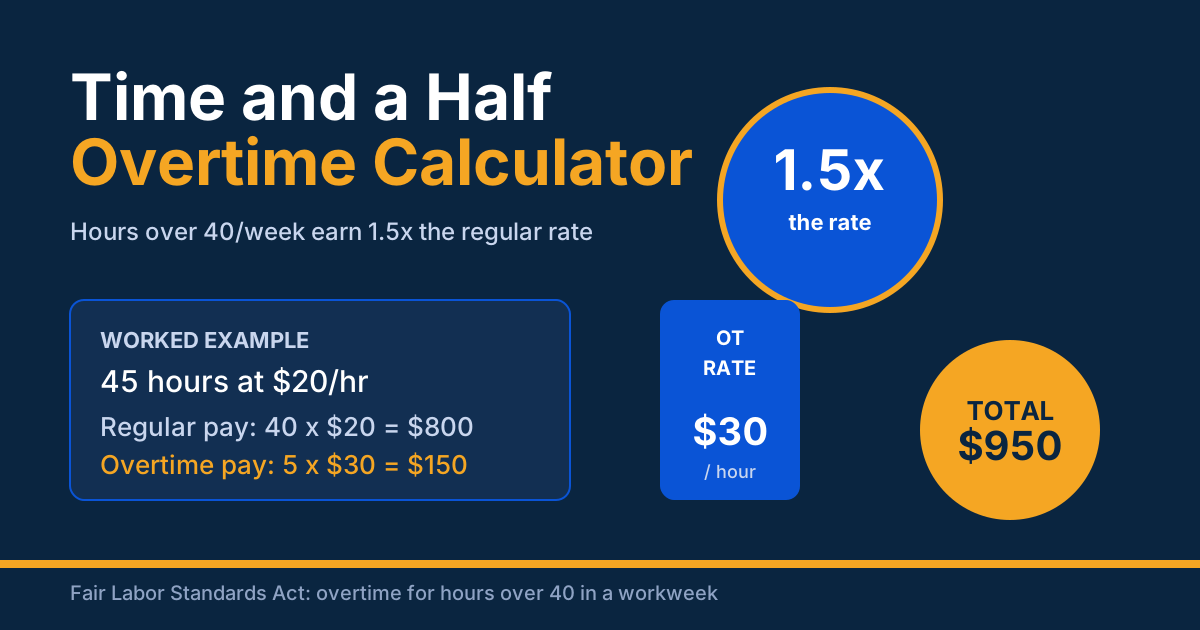
TL;DR: Time and a half means 1.5 times your regular hourly rate. Under the federal Fair Labor Standards Act, covered non-exempt employees earn at least this rate for every hour worked over 40 in a workweek. The formula: overtime pay = (hours − 40) × hourly rate × 1.5. Use the calculator below for an instant breakdown.
Contents
- Quick Answer: What Is Time and a Half?
- Overtime Calculator
- The 1.5x Formula, Step by Step
- Worked Examples
- The 40-Hour Workweek Rule
- What Counts in the “Regular Rate”
- Who Is Exempt
- State Laws That Differ
- Common Myths
- Related Guides
- FAQ
- How We Verified This
Quick Answer: What Is Time and a Half?
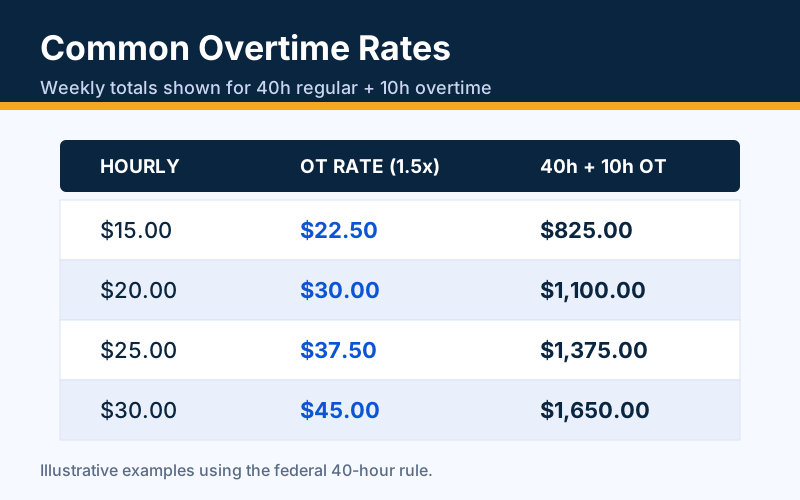
Time and a half is an overtime premium: each qualifying overtime hour is paid at 150% of the regular rate — the normal hourly rate plus half again. If you earn $20 an hour, an overtime hour is worth $30: the $20 you would have earned anyway, plus a $10 premium.
The legal backbone is the Fair Labor Standards Act (FLSA), enforced by the U.S. Department of Labor’s Wage and Hour Division. The DOL’s overtime page states that covered, non-exempt employees “must receive overtime pay for hours worked over 40 in a workweek at a rate not less than time and one-half their regular rates of pay.” That single sentence carries the whole rule: the trigger is 40 hours, the unit is the workweek, and the floor is 1.5 times the regular rate.
Three words do heavy lifting there: “covered” (the FLSA applies), “non-exempt” (no exemption test is met), and “regular rates of pay” — a defined term that is not always the wage on your offer letter (see What Counts in the “Regular Rate”).
Overtime Calculator
Enter your hourly rate and total hours for the week. The calculator splits them at the federal 40-hour threshold, applies the 1.5 multiplier, and runs entirely in your browser — nothing you type is sent anywhere.
Overtime Calculator
Uses the federal standard: 1.5x the regular rate for hours over 40 in a workweek. State rules may differ — see State Laws That Differ.
This calculator is for illustration only and is not legal advice. It applies the federal FLSA baseline (1.5x after 40 hours) and does not account for state daily-overtime rules, the regular-rate adjustments described below, exemptions, or collective bargaining agreements. For your actual situation, check with your employer’s payroll department, your state labor agency, or an employment attorney.
The 1.5x Formula, Step by Step
Calculating time and a half takes three steps. Every step uses plain arithmetic — no special tools required.
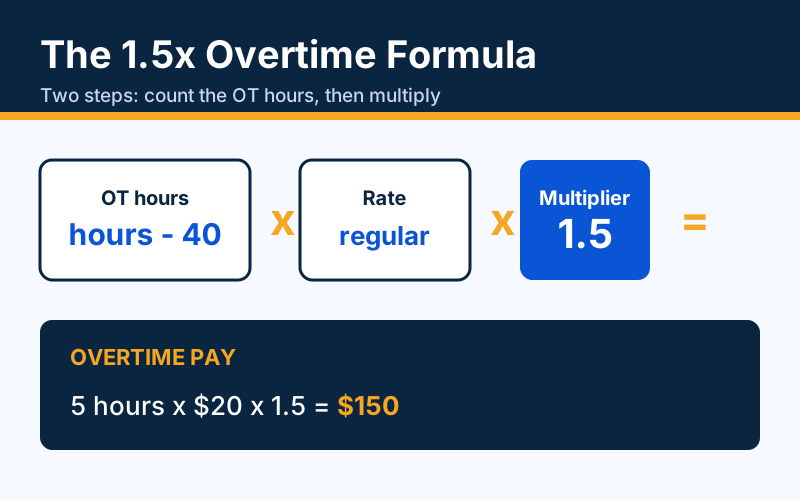
Step 1: Find your overtime rate. Multiply your regular hourly rate by 1.5. At $20 an hour, the overtime rate is $30 an hour. At $22.50, it is $33.75. This is the figure the calculator above labels “Overtime rate (1.5x).”
Step 2: Count your overtime hours. Subtract 40 from your total hours for the workweek. Only hours past 40 count — a 45-hour week yields 5 overtime hours, a 38-hour week none. Counting is per workweek, never averaged (see The 40-Hour Workweek Rule).
Step 3: Multiply and add. Overtime pay equals the overtime rate times the overtime hours. Add that to regular pay (40 hours, or fewer, at the straight rate) for the week’s total.
In formula form:
- Overtime rate = hourly rate × 1.5
- Overtime hours = total hours − 40 (if positive, else 0)
- Overtime pay = overtime rate × overtime hours
- Weekly total = (hours up to 40 × hourly rate) + overtime pay
Worked Examples
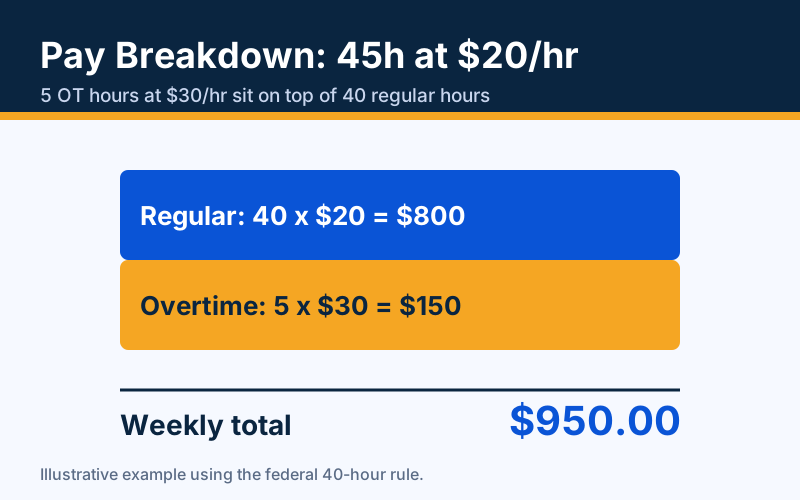
Example 1: Hourly worker, $20/hr, 45 hours. This is the classic case. Overtime rate: $20 × 1.5 = $30/hr. Overtime hours: 45 − 40 = 5. Regular pay: 40 × $20 = $800. Overtime pay: 5 × $30 = $150. Weekly total: $950. Try these numbers in the calculator above — it should return $950.00.
Example 2: Salaried non-exempt worker. Being salaried does not automatically make someone exempt. A non-exempt employee earns a $1,000 weekly salary and works 50 hours. The regular rate is $1,000 ÷ 50 = $20/hr. The salary already pays straight time for all 50 hours, so the employee is owed only the additional half-rate premium on the 10 overtime hours: 10 × $10 = $100 — $1,100 total. Note the regular rate shifts with the hours worked each week.
Example 3: Weekly bonus in the mix. Suppose the Example 1 worker also earned a $100 weekly production bonus that was promised in advance (non-discretionary). Straight-time pay for all 45 hours is 45 × $20 = $900; add the $100 bonus for $1,000 total compensation. The regular rate is $1,000 ÷ 45 hours = $22.22/hr. Each overtime hour earns an extra half-rate premium: 5 × ($22.22 × 0.5) = $55.56. Total: $1,000 + $55.56 = $1,055.56. This is why “the regular rate” matters more than the number on the offer letter — the bonus raised every overtime hour’s value.
The 40-Hour Workweek Rule
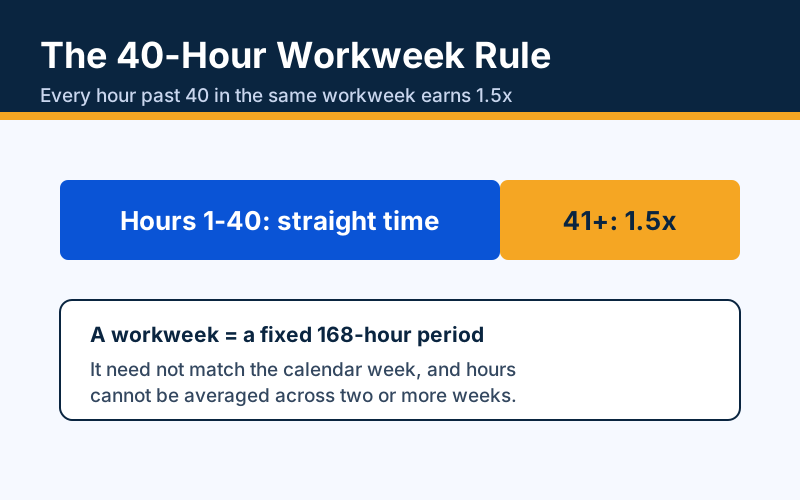
The 40-hour trigger sounds simple until you ask: 40 hours of what, measured when? The DOL’s overtime page answers precisely. The FLSA “applies on a workweek basis,” and a workweek is “a fixed and regularly recurring period of 168 hours — seven consecutive 24-hour periods.” It does not have to match the calendar week; an employer can define the week as Wednesday 6:00 AM to Wednesday 6:00 AM, for example, and may set different workweeks for different employees or groups.
Two consequences follow. First, overtime is earned inside a single workweek — you cannot shift hours from a heavy week into a light one to dodge the premium. The DOL is explicit: “Averaging of hours over two or more weeks is not permitted.” Second, the 40-hour count covers hours actually worked. Paid time off, holidays, and sick leave generally do not count toward the 40 unless the employer chooses to include them.
One more detail from the same page: overtime earned in a particular workweek “must be paid on the regular pay day for the pay period in which the wages were earned.” The premium cannot be deferred indefinitely.
What Counts in the “Regular Rate”
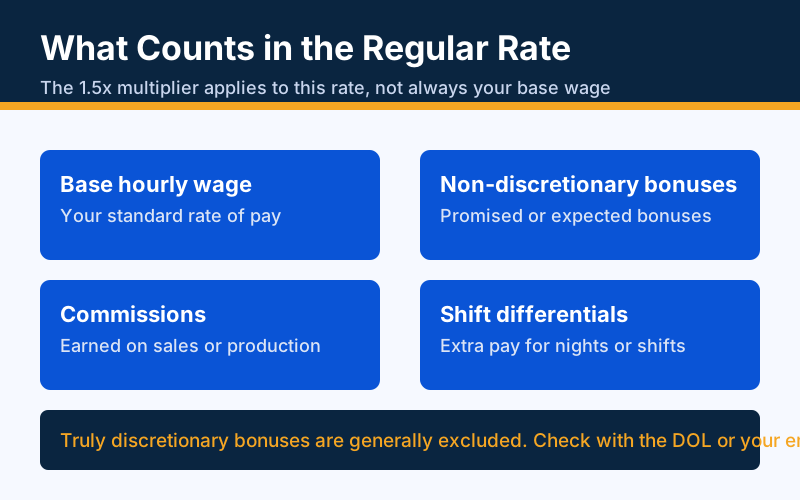
The 1.5 multiplier applies to the regular rate of pay — broader than most people expect. It generally includes the base hourly wage plus most non-discretionary extras, spread across all hours worked:
- Base hourly wage — the starting point.
- Non-discretionary bonuses — bonuses promised or expected, such as production or attendance bonuses, generally count.
- Commissions — earned on sales or output, generally included.
- Shift differentials — extra pay for night or weekend shifts, generally included.
Truly discretionary bonuses — a surprise gift with no prior promise — are generally excluded. “Generally” matters: edge cases turn on the facts, and the DOL’s Wage and Hour Division publishes detailed guidance for them. The practical takeaway: with regular bonuses or differentials, your true overtime rate likely exceeds 1.5 times your base wage.
Who Is Exempt
Not every employee is entitled to overtime. The FLSA carves out exemptions — most famously for certain executive, administrative, and professional employees — but exemption is a facts-and-circumstances test, not a job-title test. Calling someone a “manager” does not make them exempt; the DOL looks at actual duties, salary basis, and salary level.
This post does not classify anyone: exemption turns on detailed criteria applied to actual duties, and the rules have changed over time. If you are unsure, check the DOL’s overtime resources or consult an employment attorney. The safe default remains: covered, non-exempt, over 40 in the workweek, at least time and a half.
State Laws That Differ
Federal law is the floor, not the ceiling. The DOL’s overtime topic page notes that “some states have overtime laws” and that where both apply, “the employee is entitled to overtime according to the higher standard.”
California is the best-known example: 1.5x after 8 hours in a day, double time (2x) after 12, and overtime on the seventh consecutive workday. Alaska also requires daily overtime after 8 hours; Colorado after 12; Nevada has a conditional daily rule below a wage threshold. Several states have no daily-overtime rule at all.
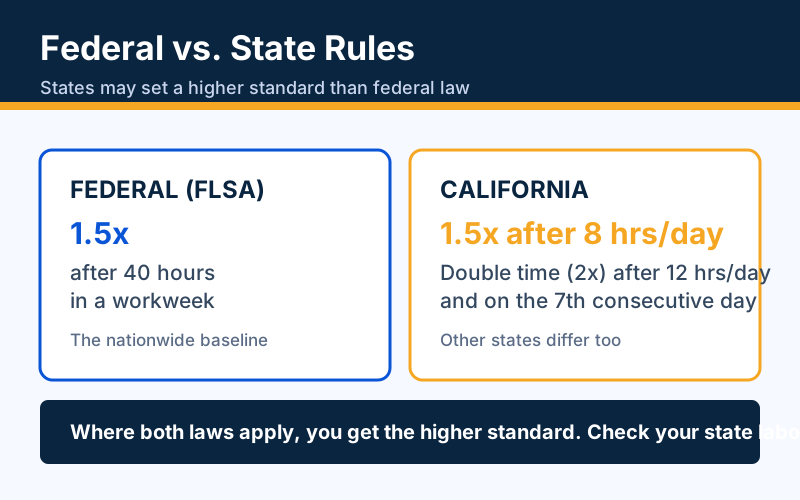
These summaries are simplified starting points. Check your state labor agency for the current rules where you work — it is the authoritative source for daily thresholds, double-time triggers, and industry exceptions. The calculator above applies the federal 40-hour standard only.
Common Myths
Myth 1: “Overtime is paid for weekend or holiday work.” The FLSA requires no premium for a Saturday, Sunday, or holiday as such — only for hours actually worked past 40 in the workweek, per the DOL’s overtime page.
Myth 2: “Salaried workers never get overtime.” Exempt workers do not, but salaried non-exempt workers do. Their regular rate is derived from salary, and hours over 40 still earn the 1.5 premium, as Example 2 above showed.
Myth 3: “My employer can average two weeks to avoid overtime.” No — averaging across weeks is expressly prohibited. A 50-hour week followed by a 30-hour week still owes 10 hours of overtime.
Myth 4: “Time and a half is always 1.5 times my base wage.” It is 1.5 times the regular rate, which generally includes non-discretionary bonuses, commissions, and shift differentials. With those extras, the true overtime rate exceeds 1.5 × base wage.
Myth 5: “Paid time off counts toward the 40.” Generally, no. Vacation, holiday, and sick pay are not hours worked: 32 worked hours plus 8 holiday hours is a 32-hour week for overtime purposes — unless the employer’s policy says otherwise.
Related Guides
Overtime math sits inside a bigger picture of time at work. Our UTC vs GMT explainer untangles the two standards people confuse most when scheduling across zones. Shift workers logging 16:00–00:00 shifts can verify their conversions on the military time chart. And the Pomodoro technique offers one structure for focused work blocks with real breaks during long weeks.
FAQ
What is time and a half?
Time and a half is an overtime pay rate equal to 1.5 times an employee’s regular hourly rate. Under the federal Fair Labor Standards Act (FLSA), covered non-exempt employees must receive at least this rate for hours worked over 40 in a workweek.
How do you calculate time and a half?
Multiply the hourly rate by 1.5 to get the overtime rate, then multiply that by the number of overtime hours. For example, at $20/hour the overtime rate is $30/hour; 5 overtime hours pay $150.
After how many hours do you get overtime pay?
Under federal law, overtime kicks in after 40 hours in a single workweek for covered non-exempt employees. Some states, such as California, also require daily overtime after 8 hours in a day.
Is overtime based on the workweek or the pay period?
The workweek. The FLSA applies on a workweek basis — a fixed, regularly recurring 168-hour period — and averaging hours across two or more weeks is not permitted.
What is the regular rate of pay?
The regular rate is the hourly rate used to compute overtime. It generally includes the base wage plus most non-discretionary bonuses, commissions, and shift differentials, so it can be higher than the base hourly wage.
Do salaried employees get overtime?
Salaried non-exempt employees are still entitled to overtime: their regular rate is derived from their salary, and hours over 40 earn the overtime premium (the salary already pays straight time for those hours, so the FLSA requires the additional half-rate on top). Exempt employees are not entitled to overtime.
Is overtime required on weekends or holidays?
Not automatically. The FLSA does not require overtime pay for work on Saturdays, Sundays, or holidays as such — only for hours actually worked over 40 in the workweek, regardless of which days they fall on.
Do all states follow the 40-hour rule?
Federal law sets 1.5x after 40 hours as the nationwide baseline, but several states add their own rules. California requires daily overtime after 8 hours and double time after 12; Alaska and Colorado have their own daily thresholds. Check your state labor agency.
Can my employer average my hours over two weeks?
No. The FLSA prohibits averaging hours over two or more weeks. Overtime is determined separately for each workweek, and must normally be paid on the regular payday for that pay period.
How We Verified This
We opened the U.S. Department of Labor’s Wage and Hour Division overtime page and its overtime topic page on 2026-10-18 and paraphrased their statements directly: the 40-hour trigger, the 1.5× floor, the 168-hour workweek definition, the ban on averaging hours across weeks, the weekend/holiday rule, and the higher-of-state-or-federal standard. We also opened the Wage and Hour Division homepage to confirm the enforcing agency. We attempted the DOL’s Fact Sheet 23 URL but the page blocked automated access (HTTP 403), so we did not cite it. Every dollar figure in the worked examples and charts is illustrative arithmetic computed for this post, marked as such — none is presented as a sourced statistic. Exemption rules are summarized, not exhaustively stated; readers should consult the DOL or an employment attorney for classification questions. This article is for general information only and is not legal advice.
Related: Military Time Chart · Pomodoro Technique