

TL;DR: The **Pomodoro Technique** breaks work into **25-minute focused sprints** separated by **5-minute breaks**. After four sprints, take a longer **15–30 minute break**. It was invented by Francesco Cirillo in the late 1980s and named after his tomato-shaped kitchen timer. Try it with our [free Pomodoro timer](/timer/25-minutes/).
Contents
- Quick Answer: What Is the Pomodoro Technique?
- The 5 Steps
- The Full Cycle, Visualized
- Why 25 Minutes?
- What to Do on Breaks
- Handling Interruptions
- Variations and Adjustments
- Common Mistakes
- Pomodoro for Different Professions
- Tracking Your Pomodoros
- Combining Pomodoro with Other Methods
- The Science of Breaks
- Pomodoro and Procrastination
- External Resources
- Quick Start Checklist
- Related Guides
- FAQ
- Sources
- How We Verified This
Quick Answer: What Is the Pomodoro Technique?
Work for 25 minutes on one task. Then rest for 5 minutes. Repeat. After four rounds, take a longer break of 15–30 minutes. That is the entire method.
The name comes from the Italian word for tomato — pomodoro — because inventor Francesco Cirillo used a tomato-shaped kitchen timer as a university student in the late 1980s.
The 5 Steps
Step 1: Pick One Task
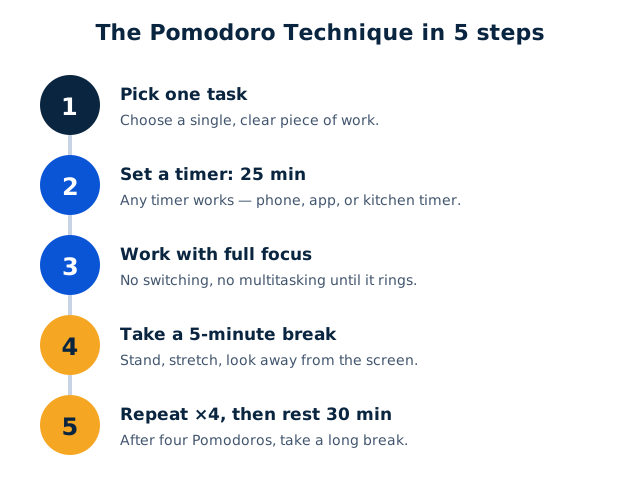
Choose a single task to work on. Not three tasks. One. Write it down. The Pomodoro Technique works because it forces a decision about what matters right now.
Step 2: Set the Timer for 25 Minutes
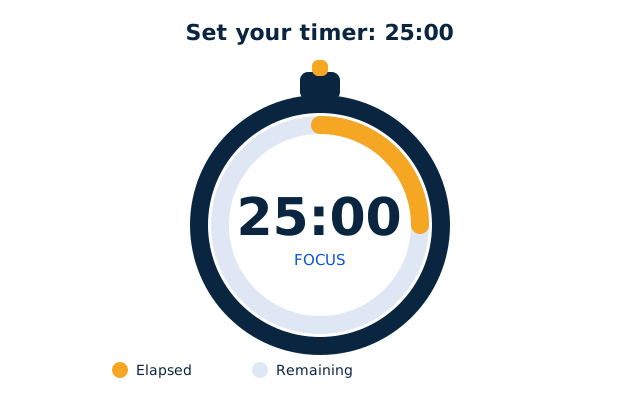
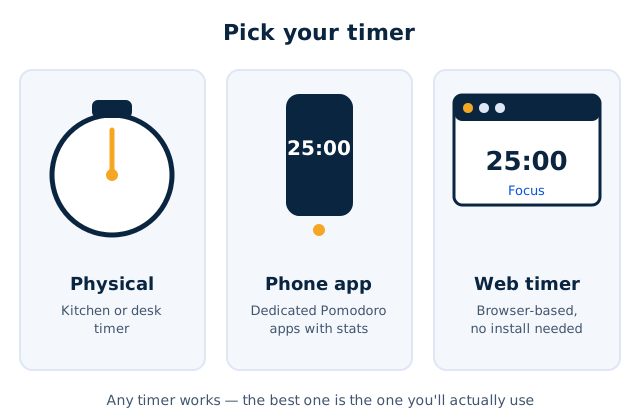
Use a kitchen timer, a phone app, or our free Pomodoro timer — a simple Pomodoro technique clock that counts down 25 minutes, then signals your break. The ticking creates a gentle sense of urgency — this is a sprint, not a marathon.
Step 3: Work with Full Focus
For 25 minutes, the task gets your complete attention. No email. No messages. No “quick checks.” If a distracting thought pops up, jot it down and return to the task.
Step 4: Take a 5-Minute Break
When the timer rings, stop — even mid-sentence. Stand up. The break is not optional; it is part of the technique.
Step 5: Repeat, Then Take a Long Break
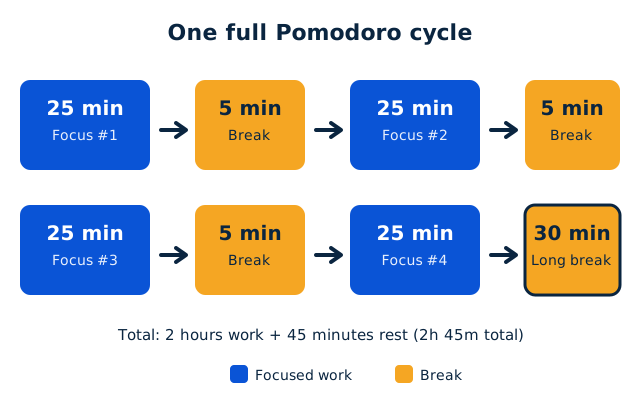
After four pomodoros (about 2 hours), take a 15–30 minute break. Eat something. Go outside. Let your mind fully disengage before the next set.
The Full Cycle, Visualized
One complete set looks like this:
| Block | Duration | Running Total |
|---|---|---|
| Pomodoro 1 | 25 min work | 25 min |
| Break | 5 min | 30 min |
| Pomodoro 2 | 25 min work | 55 min |
| Break | 5 min | 60 min |
| Pomodoro 3 | 25 min work | 85 min |
| Break | 5 min | 90 min |
| Pomodoro 4 | 25 min work | 115 min |
| Long break | 15–30 min | ~2–2.5 hours |
Why 25 Minutes?
Twenty-five minutes hits a sweet spot:
- Short enough to start. “Just 25 minutes” feels doable even for dreaded tasks. Procrastination shrinks when the commitment is small.
- Long enough to make progress. You can write a draft, debug a function, or read a chapter in 25 focused minutes.
- Short enough to sustain. Focus is a depleting resource. Regular breaks prevent the gradual slide into distracted half-work.
That said, 25/5 is a starting point, not a law. The principle — alternating focused work with real rest — matters more than the exact numbers.
What to Do on Breaks
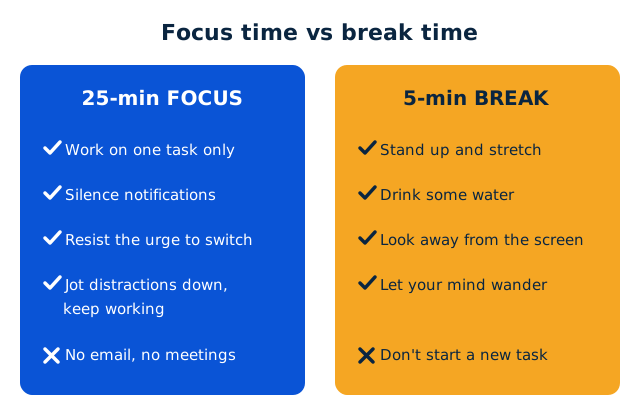
During the 25 Minutes: Do
- Work on the single chosen task
- Jot down intruding thoughts to handle later
- Let the timer hold the boundary
During the 25 Minutes: Don’t
- Check email, messages, or social media
- Start a second task “while you wait”
- Research tangentially related topics
During the 5-Minute Break: Do
- Stand up and move
- Drink water
- Look out a window (rest your eyes)
- Stretch
During the 5-Minute Break: Don’t
- Start a new work task
- Fall into email or news
- Do anything that requires sustained attention
During the Long Break: Do
- Eat a snack or meal
- Take a short walk
- Fully disconnect from the task
Handling Interruptions
Interruptions will happen. The technique has a protocol:
- Internal interruption (a sudden thought: “I need to email Sarah”): Write it down on a notepad. Return to the task. Handle it during a break.
- External interruption (a colleague stops by): If it can wait, say “Give me 10 minutes — I’m in a focus block.” If it truly cannot wait, end the pomodoro, handle it, and start a fresh pomodoro afterward.
- Do not count partial pomodoros. A pomodoro is 25 uninterrupted minutes or it does not count. This strictness is what trains focus.
Variations and Adjustments
Longer Sprints for Deep Work
Many programmers and writers prefer 50 minutes work / 10 minutes break. The rhythm is the same; the blocks are doubled.
Shorter Sprints for Draining Tasks
For emotionally heavy or tedious work, try 15/5. The shorter commitment makes starting easier.
The “Pomodoro” as a Unit
Track how many pomodoros tasks take. “That report took 6 pomodoros” is more honest than “I worked on it all afternoon.” Over time, your estimates improve dramatically.
What the Research Suggests
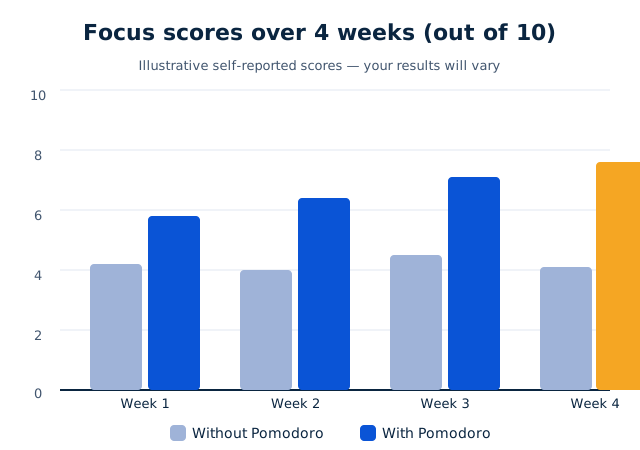
Time-boxing techniques like Pomodoro are widely reported to help with task initiation — the hardest part of procrastination. The evidence for productivity gains is largely anecdotal and self-reported rather than from controlled trials, so treat enthusiastic claims with appropriate skepticism. What is well supported: regular breaks reduce fatigue, and single-tasking beats multitasking for complex work.
Common Mistakes
Mistake 1: Skipping breaks. “I’m on a roll, I’ll skip the break.” The break is what makes the next pomodoro possible. Protect it.
Mistake 2: Multitasking within a pomodoro. One task. If you finish early, use the remaining time to review or plan — do not start task two.
Mistake 3: Counting interrupted pomodoros. If you answered three texts during the 25 minutes, that was not a pomodoro. Restart honestly.
Mistake 4: Using breaks for “productive” scrolling. Checking email during a break is not rest. Your brain needs genuine downtime.
Mistake 5: Rigid adherence. If 25/5 does not fit your work, adjust it. The technique serves you, not the reverse.
Related Guides
- Military Time Chart: Learn more about military time chart.
- UTC vs GMT: Learn more about utc vs gmt.
FAQ
What is the Pomodoro Technique? The Pomodoro Technique is a time management method where you work in focused 25-minute intervals (pomodoros), separated by 5-minute breaks. After four pomodoros, take a longer 15-30 minute break.
How long is a pomodoro? One pomodoro is 25 minutes of focused work, followed by a 5-minute break. The name comes from the tomato-shaped kitchen timer its inventor used.
Who invented the Pomodoro Technique? Francesco Cirillo developed the technique in the late 1980s while a university student. He named it after the tomato-shaped (pomodoro in Italian) kitchen timer he used.
Does the Pomodoro Technique actually work? Many people find it effective for starting difficult tasks and maintaining focus. The short intervals lower the barrier to beginning, and regular breaks prevent burnout. Results vary by person and task type.
How many pomodoros should I do per day? Start with 4-6 pomodoros (2-3 hours of focused work) and build up. Most practitioners aim for 6-12 per day depending on their schedule.
What do you do during pomodoro breaks? Stand up, stretch, get water, look away from the screen. Avoid starting new tasks or checking email — the break is for mental recovery.
Can I change the 25-minute length? Yes. The 25/5 split is a starting point. Some people prefer 50/10 for deep work or 15/5 for draining tasks. Experiment to find what sustains your focus.
What if I get interrupted during a pomodoro? Note the interruption and return to the task. If the interruption is urgent, end the pomodoro early and start fresh afterward. The technique values honest tracking over rigid perfection.
How We Verified This
The technique’s structure (25/5, four rounds, long break) and its origin (Francesco Cirillo, late 1980s, tomato timer) come from Cirillo’s own published description of the method. We describe productivity effects cautiously because controlled-trial evidence is limited; most support is anecdotal and self-reported.
Try it now: Free Pomodoro Timer · Related: Military Time Chart
Pomodoro for Different Professions
For Students
Use pomodoros for study sessions: one pomodoro per textbook section, or two for a problem set. The breaks prevent the “I read the same page three times” fatigue. Track which subjects take more pomodoros — that tells you where to focus.
For Writers
One pomodoro = one draft section. Do not edit during a writing pomodoro; editing is a separate task for a separate pomodoro. Many writers find 25 minutes is exactly enough to get past the blank-page resistance.
For Programmers
Debugging fits pomodoros well: 25 minutes of focused debugging, then a break to let your subconscious work. If you solve it in 10 minutes, use the remaining 15 for code review or documentation — do not start a new feature.
For Managers
Back-to-back meetings destroy focus. Block pomodoros for deep work (strategy, planning, writing) between meetings. Even two pomodoros of uninterrupted thinking can outperform a full day of fragmented attention.
Tracking Your Pomodoros
A simple paper log works:
| Date | Task | Pomodoros | Notes |
|---|---|---|---|
| Oct 18 | Write report | 4 | Needed 5, underestimated |
| Oct 18 | Email triage | 2 | Batched well |
| Oct 19 | Code review | 3 | Interrupted once, restarted |
After two weeks, patterns emerge: which tasks take longer than expected, what time of day you focus best, and how many pomodoros you realistically complete. Use this data to plan — not to punish yourself.
Combining Pomodoro with Other Methods
Time blocking: Assign pomodoros to calendar blocks. “9:00–11:00: 4 pomodoros for the proposal” is more concrete than “work on proposal Monday morning.”
Getting Things Done (GTD): Use pomodoros as the execution engine for your next-actions list. Pick the top next action, pomodoro it, check it off.
Deep Work (Cal Newport): Schedule 2–4 hour deep work blocks composed of pomodoros. The breaks within deep work prevent the quality drop that comes from unbroken multi-hour sessions.
The Pomodoro Technique is not a complete productivity system — it is a focus protocol that plugs into whatever system you already use.
External Resources
For the original description of the method, see Francesco Cirillo’s official Pomodoro Technique page. For research on attention and breaks, see the University of Illinois study on brief diversions vastly improving focus (Lleras & Ariga, published in Cognition).
The Science of Breaks (What We Know)
Research on attention is clear about one thing: sustained focus degrades over time. Studies on vigilance tasks show performance drops significantly after 30–50 minutes of continuous effort.
Brief breaks — even just looking away from the task — partially restore focus. A well-known 2011 study (Ariga & Lleras) found that short diversions during a prolonged task improved performance compared to working straight through. The mechanism is not fully understood, but the effect is consistent: the brain needs reset moments.
What is less clear: whether 25/5 is optimal versus 50/10 or other splits. The honest answer is that individual variation is large. The Pomodoro Technique’s value is less about the specific numbers and more about (1) committing to start, (2) protecting focus from interruption, and (3) enforcing recovery.
Pomodoro and Procrastination
Procrastination is rarely about laziness — it is about emotion regulation. We avoid tasks that trigger boredom, anxiety, or self-doubt. The Pomodoro Technique helps because:
- It shrinks the commitment. “Work for 25 minutes” bypasses the dread of “finish this huge project.”
- It externalizes the start. The timer — not your motivation — initiates the work.
- It makes progress visible. Four pomodoros is tangible proof you worked, countering the “I did nothing today” spiral.
If you procrastinate by perfectionism (“I can’t start until conditions are perfect”), the pomodoro’s time limit helps: you only need to be good enough for 25 minutes.
Quick Start Checklist
Ready to try it right now? Here is the minimum viable setup:
- Pick your single most important task.
- Set a timer for 25 minutes (use ours).
- Work until it rings.
- Take a 5-minute break (stand up, water, window).
- Repeat three more times, then take 30 minutes.
That is four pomodoros — about two hours of genuine focused work. Most people are surprised how much they accomplish.