

TL;DR: On Monday, August 2, 2027, a total solar eclipse sweeps North Africa and the Middle East, with up to about 6 minutes 23 seconds of totality near Luxor, Egypt — one of the longest of the century. It will not be visible from the United States: NASA's maps show only a small partial sliver reaching far northern Maine. 2027's other eclipses: an annular solar eclipse on February 6 and three penumbral lunar eclipses. The next US total solar eclipse is March 30, 2033 (Alaska).
Contents
- Quick Answer: Will the 2027 Eclipse Be Visible in the US?
- The August 2, 2027 Total Solar Eclipse
- Path of Totality
- Timing
- The Full 2027 Eclipse Calendar
- How to Watch Safely
- Traveling to the Eclipse
- The Next US Total Solar Eclipses
- Solar vs Lunar Refresher
- Common Myths
- Related Guides
- FAQ
- How We Verified This
Quick Answer: Will the 2027 Eclipse Be Visible in the US?
No. The August 2, 2027 total solar eclipse crosses southern Spain, North Africa, and the Middle East — the Moon’s shadow never comes near the United States. NASA’s future-eclipses table says the partial reaches only “northern Maine in the U.S.” — a small sliver at the edge of the penumbra. Nobody in the US will see totality.
If you are in the US and want totality, the honest answer is: travel, or wait. The next chances on American soil are March 30, 2033 in Alaska and August 23, 2044 in UTC (August 22 local) over the northern plains — see The Next US Total Solar Eclipses.
The August 2, 2027 Total Solar Eclipse
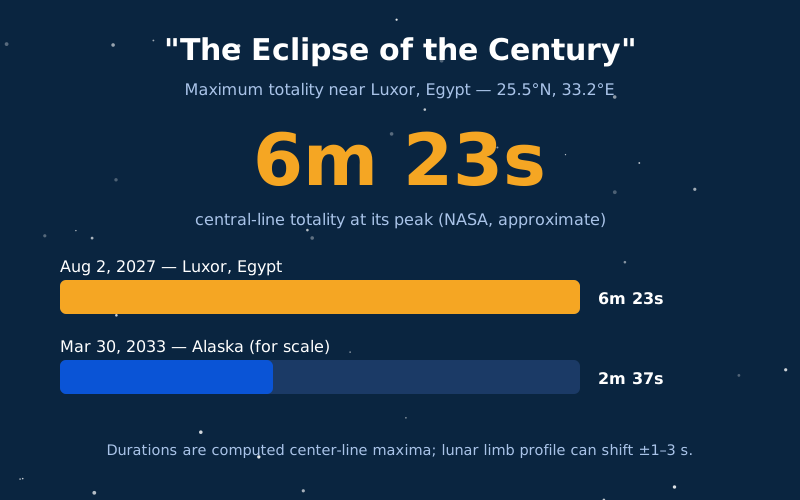
Astronomers call it “the eclipse of the century.” NASA’s headline figures (NASA GSFC): Monday, August 2, 2027; Saros series 136 (member 38 of 71); greatest eclipse 10:06:37 UT (≈ 10:07 UT) at 25.5°N, 33.2°E in southern Egypt; maximum central duration 6 minutes 23 seconds (approximate); path width 258 km; eclipse magnitude 1.07903.
A typical total solar eclipse lasts two to three minutes, so six-plus minutes is roughly double to triple the norm — among the longest totalities of the 21st century. The reason is geometry: at greatest eclipse the Sun stands 82° above the horizon, nearly overhead, so the Moon’s shadow strikes the ground almost perpendicularly and sweeps across it slowly.
Treat every duration as approximate. NASA notes its predictions exclude the Moon’s irregular edge — lunar limb-profile corrections can shift path limits by 1–3 km and local durations by 1–3 seconds.
Path of Totality
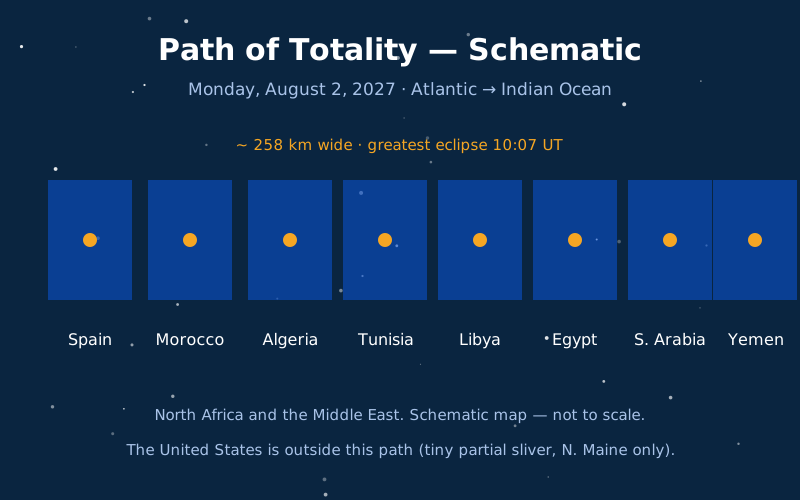
The umbral shadow makes landfall at the southern tip of Spain, crosses the Strait of Gibraltar, and runs eastward across North Africa and the Arabian Peninsula to the Indian Ocean (NASA GSFC path page):
| Region | Notable places in or near the path |
|---|---|
| Southern Spain | Cádiz, Málaga, Gibraltar area |
| Morocco | Tangier and the northern coast |
| Algeria | Long desert stretch |
| Tunisia | Tunis area |
| Libya | Tripoli and Benghazi areas |
| Egypt | Luxor — maximum totality ~6m23s |
| Saudi Arabia | Western Arabia, Red Sea coast |
| Yemen | Southern Arabian Peninsula |
| Somalia | Horn of Africa |
Outside the 258-km band, a partial eclipse covers a much wider area: most of Europe, much of Africa, the Middle East, Southeast Asia, and the Atlantic and Indian oceans. A deep partial is worth seeing through filters — but it is a different experience from totality, which needs the full darkness of the umbra. The schematic map above is not to scale; NASA’s page links an interactive map for exact local circumstances.
Timing
NASA’s catalog uses Universal Time (UT) — effectively GMT — for global milestones. Every local time is computed from UT; see our UTC vs GMT explainer if you want the full breakdown.
Global milestones (UT), from NASA (Eclipses During 2027, path table):
-
Greatest eclipse: 10:06:37 UT (≈ 10:07 UT), southern Egypt
-
Greatest duration: 10:00:21 UT at 26°49′N, 31°08′E — 06m23.2s on the center line
-
NASA’s central-line table spans totality from about 08:26 to 11:48 UT; your exact window depends on your position along the track
-
Local-time examples (computed from UT; approximate): Luxor, Egypt (EEST, UTC+3) — about 1:07 PM, the longest totality; southern Spain (CEST, UTC+2) — about 10:46 AM; central Saudi Arabia (AST, UTC+3, no daylight saving) — about 1:30 PM.
This eclipse happens in broad daylight with the Sun nearly overhead — and that sudden, brief darkness in a bright afternoon is what makes totality so startling. Times are rounded; use NASA’s interactive path map for second-level local circumstances.
The Full 2027 Eclipse Calendar
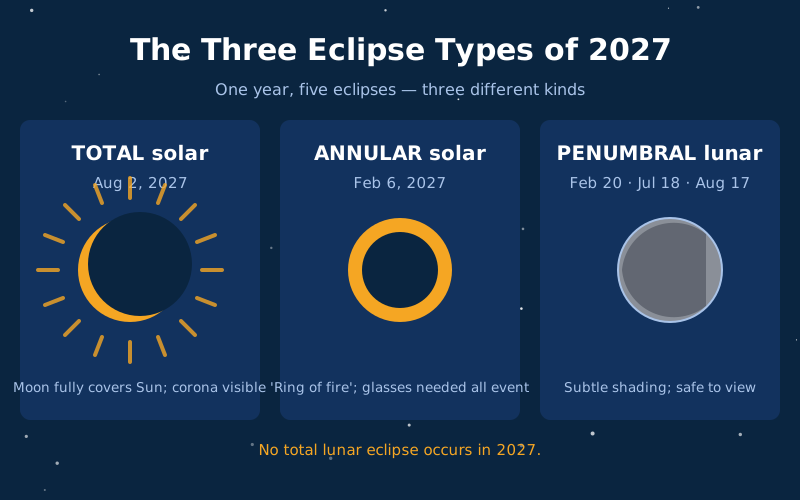
2027 brings two solar eclipses and three lunar eclipses, all confirmed in NASA’s catalog. Correction worth making upfront: there is no total lunar eclipse in 2027 — all three lunar eclipses are penumbral.
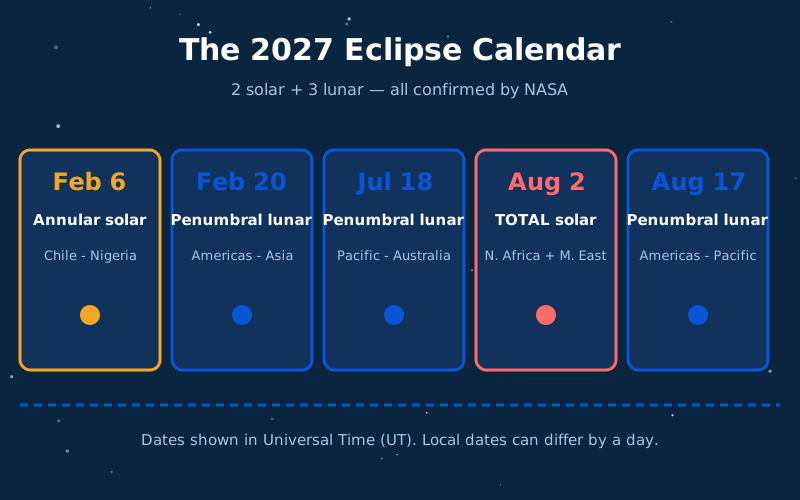
February 6, 2027 — Annular solar eclipse. A “ring of fire” eclipse across South America and Africa (Chile, Argentina, Uruguay, Brazil, Ivory Coast, Ghana, Togo, Benin, Nigeria). Central duration 7m51s, path width 282 km, greatest eclipse 16:00 UT. The Moon never fully covers the Sun — eclipse glasses stay on the whole time.
February 20, 2027 — Penumbral lunar eclipse. Greatest eclipse 23:13 UT (phase roughly 21:12–01:13 UT). Visible across the Americas, Europe, Africa, Asia, Australia, and Antarctica. Subtle dimming; safe with the naked eye.
July 18, 2027 — Penumbral lunar eclipse. Very shallow: greatest eclipse 16:03 UT, phase roughly 15:57–16:09 UT. Barely noticeable; listed for completeness.
August 2, 2027 — Total solar eclipse. The main event (see above). Greatest eclipse 10:07 UT; up to ~6m23s near Luxor.
August 17, 2027 — Penumbral lunar eclipse. Greatest eclipse 07:14 UT (phase roughly 05:24–09:03 UT). The local date is August 16 in parts of the Americas and August 17 elsewhere — NASA lists it as “Aug. 16-17, 2027.”
How to Watch Safely
No nuance to soften here: the Sun can permanently damage your eyes during an eclipse, and you will not feel it happening. NASA’s guidance (science.nasa.gov/eclipses):
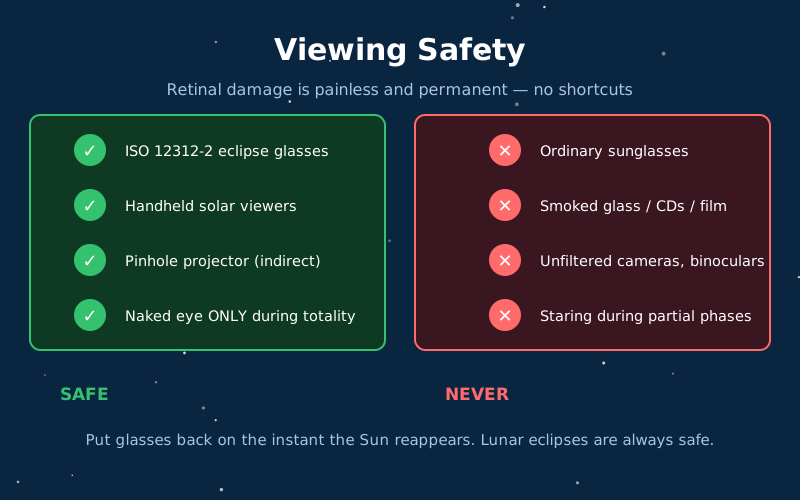
Safe: ISO 12312-2 certified eclipse glasses (check the printed certification; counterfeits exist — buy early); handheld solar viewers to the same standard; a pinhole projector for indirect viewing; and during totality only — the brief minutes of full coverage — the naked eye. Glasses go back on the instant the Sun’s first sliver reappears.
Never safe: ordinary sunglasses (they don’t block the infrared that damages the retina); smoked glass, CDs, exposed camera film; cameras, telescopes, or binoculars without a certified front filter; staring during any partial or annular phase.
Traveling to the Eclipse
Eclipse travel means standing in one narrow band at one exact minute:
- Book early. Eclipse chasers plan years ahead; hotels and transport along the center line in Egypt, Morocco, and southern Spain fill long before August 2027.
- August heat is serious. The path crosses the Sahara and the Arabian Peninsula in high summer — desert daytime temperatures routinely exceed 40°C (104°F). Plan water, shade, and shelter.
- Entry rules vary widely. The path crosses about ten countries with very different visa regimes, from Schengen-area Spain to Egypt, Saudi Arabia, and Yemen. Check official government travel advisories and entry requirements for your specific destination.
- Keep a weather backup plan. Deserts have the best August odds, but nowhere is guaranteed. A rental car and a few hundred kilometers of mobility the day before can rescue a cloudy morning.
The Next US Total Solar Eclipses
For US readers, the honest calendar — the 2027 eclipse skips America entirely:
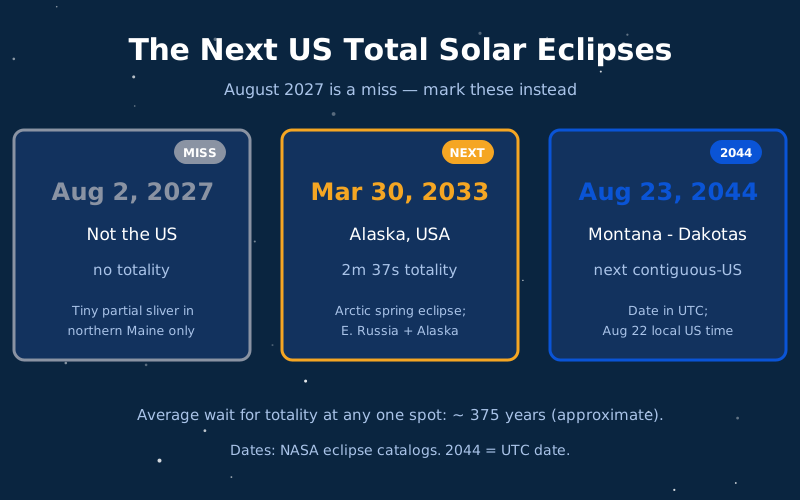
March 30, 2033 — Alaska (and eastern Russia). NASA’s 2031–2040 catalog lists a total solar eclipse, Saros 120, with 2 minutes 37 seconds of central duration over eastern Russia and Alaska (NASA GSFC). A morning eclipse in the late Arctic winter — dramatic, cold, logistically demanding.
August 23, 2044 — Montana and North Dakota. NASA: “The next total solar eclipse visible in the contiguous United States will be on Aug. 23, 2044” (science.nasa.gov/eclipses). August 23 is the UTC date; locally in the US it is August 22 — a short totality over the northern plains.
Perspective: totality returns to the same spot roughly once every 375 years on average — an approximation, not a schedule.
When is the next solar eclipse in Texas? The last total solar eclipse visible in Texas was April 8, 2024. The next total solar eclipses (2033 in Alaska, 2044 in Montana/North Dakota) do not cross Texas. Texas viewers wanting totality will need to travel — either to the northern plains for August 2044 or abroad for the August 2, 2027 event (North Africa/Middle East). Note: “2027 eclipse cruises” advertised online are expedition cruises to the Mediterranean/North Africa totality path.
Solar vs Lunar Refresher
- Solar eclipse (Sun → Moon → Earth): new moon, daytime, narrow path — which is why the 2027 total eclipse requires travel.
- A lunar eclipse (Sun → Earth → Moon): full moon, nighttime, visible from the entire night side of Earth — which is why the February 20, 2027 penumbral lunar eclipse needs no travel at all.
The safety difference is the one that matters: solar eclipses demand certified eye protection; lunar eclipses are safe with the naked eye. For the full version with diagrams — umbra vs penumbra, eclipse seasons, why the Moon turns red — see our solar vs lunar eclipse explainer.
Common Myths
Myth: “A 99% partial eclipse is basically the same as totality.” No. Outside the path, even at 99% coverage, daylight persists and the corona stays hidden. Totality is not a bigger partial eclipse — it is a different phenomenon that only happens inside the umbra.
Myth: “The August 2027 eclipse will be visible from America.” No. The path runs through southern Spain, North Africa, and the Middle East. The US gets no totality and only a faint sliver in far northern Maine. The next US-visible totals are 2033 (Alaska) and 2044 (northern plains).
Myth: “Eclipse glasses are just for comfort.” No. The risk is retinal damage from intense solar radiation, and the retina has no pain receptors. ISO 12312-2 glasses are protection, not fashion.
Myth: “You can take the glasses off during the annular eclipse’s ring phase.” Never. The Sun’s disk is never fully covered during an annular eclipse; the “ring of fire” is still blinding. Glasses stay on for the entire February 6, 2027 event.
Myth: “August 17, 2027 is a total lunar eclipse.” No — it is a penumbral lunar eclipse (greatest eclipse 07:14 UT). There is no total lunar eclipse anywhere in 2027.
Myth: “Missing 2027 is no big deal; eclipses happen all the time.” Solar eclipses of some kind happen 2–5 times a year somewhere on Earth, but six-plus minutes of totality is generational — which is why totality averages once every ~375 years at any given spot.
Related Guides
- Solar vs Lunar Eclipse: the full explainer — eclipse types, umbra vs penumbra, safety, and upcoming dates.
- UTC vs GMT: how to read eclipse times in UT and convert them to local time.
- Military Time Chart: quick reference for reading 24-hour UTC times like 10:06 UT.
FAQ
Will the 2027 eclipse be visible in the US? No. Totality crosses southern Spain, North Africa, and the Middle East; NASA’s maps show only a small partial sliver reaching far northern Maine. The next total solar eclipse on US soil is March 30, 2033 in Alaska.
What is the path of totality for the August 2, 2027 eclipse? From the Atlantic across southern Spain, Morocco, Algeria, Tunisia, Libya, Egypt, Saudi Arabia, Yemen, and Somalia — about 258 km wide at maximum, with greatest eclipse at 10:06:37 UT near 25.5°N, 33.2°E in southern Egypt (NASA).
How long will totality last in 2027? Up to about 6 minutes 23 seconds on the center line near Luxor, Egypt — one of the longest totalities of the century. Treat all durations as approximate: NASA notes the Moon’s irregular edge can shift local durations by 1–3 seconds.
What time is the August 2, 2027 eclipse? Greatest eclipse is 10:06:37 UT (about 10:07 UT). NASA’s central-line table spans roughly 08:26–11:48 UT; local times vary — about 1:07 PM in Luxor, Egypt (EEST, UTC+3) and about 10:46 AM in southern Spain (CEST, UTC+2).
Is there a total lunar eclipse in 2027? No. NASA’s 2027 calendar lists two solar eclipses and three lunar eclipses — and all three lunar eclipses are penumbral (February 20, July 18, August 17). There is no total lunar eclipse in 2027.
When is the next total solar eclipse visible from the US? March 30, 2033, in Alaska (and eastern Russia) — 2 minutes 37 seconds of totality. The next one in the contiguous US is August 23, 2044 (UTC date; August 22 local time) over Montana and North Dakota.
Is it safe to look at the 2027 eclipse without glasses? Only during the brief period of totality, and only if you are inside the path. For every partial phase, wear ISO 12312-2 certified eclipse glasses — ordinary sunglasses are never safe. Indirect viewing with a pinhole projector is a safe alternative.
Why is the 2027 eclipse called the eclipse of the century? Its maximum totality of about 6 minutes 23 seconds is among the longest of the 21st century. At greatest eclipse the Sun stands 82 degrees above the horizon in southern Egypt, so the Moon’s shadow strikes the ground nearly head-on and sweeps slowly.
What is the difference between a total and an annular solar eclipse? In a total solar eclipse the Moon completely covers the Sun, revealing the corona; in an annular eclipse the Moon is slightly too far away, leaving a bright ring of fire — and there is no safe moment to look without glasses. See our solar vs lunar eclipse explainer for diagrams.
How We Verified This
Every date, time, path, and duration here comes from a NASA page opened and read during research. The August 2, 2027 figures (10:07 UT greatest eclipse, 6m23s, 258 km, magnitude 1.07903, Saros 136) are from NASA GSFC’s Eclipses During 2027; the country-by-country track and the 1–3 second lunar-limb caveat are from the path table. The full 2027 calendar (Feb 6 annular; Feb 20, Jul 18, Aug 17 penumbral lunars; no total lunar eclipse) is from that same 2027 page. US non-visibility (“northern Maine” partial only) and the August 23, 2044 next-contiguous-US date come from NASA’s Future Eclipses and Eclipses pages; the March 30, 2033 Alaska eclipse (2m37s) from the 2031–2040 table. Safety follows NASA’s ISO 12312-2 guidance. Local times were computed from UT with standard offsets (EEST UTC+3, CEST UTC+2, AST UTC+3) and are approximate. The ~375-year figure is NASA’s standard approximation.
Related: Solar vs Lunar Eclipse · UTC vs GMT