

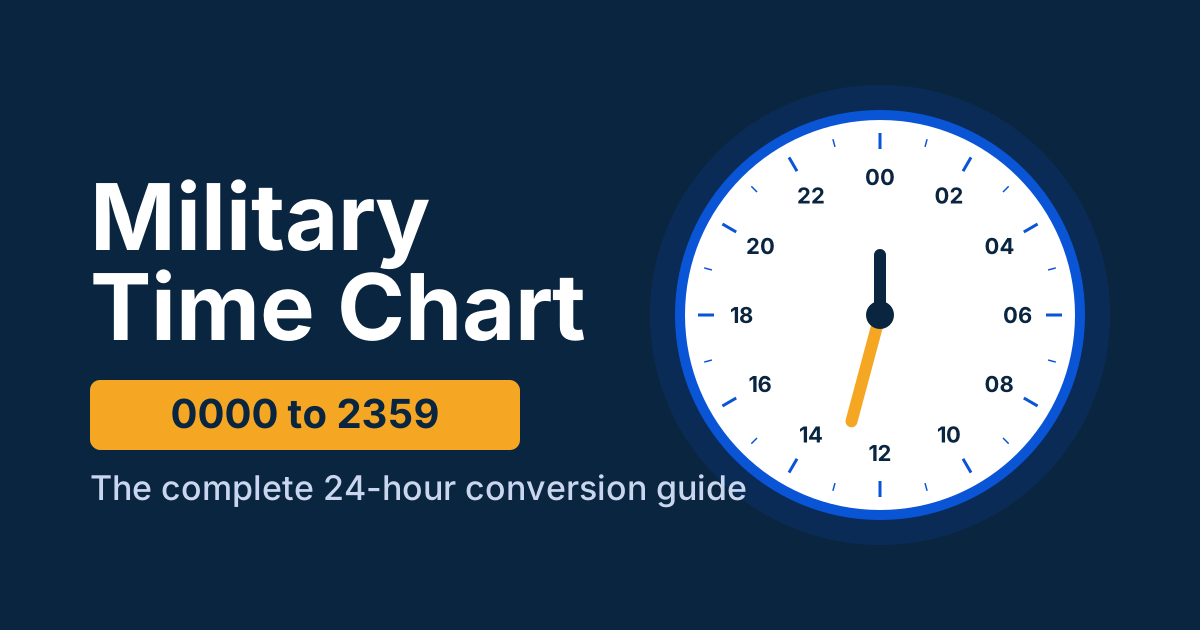
TL;DR: Military time is the 24-hour clock. 1:00 AM = 0100, 12:00 PM (noon) = 1200, 1:00 PM = 1300, 11:00 PM = 2300, 12:00 AM (midnight) = 0000. Add 12 to PM hours to convert.
Contents
- Quick conversion chart
- How to read military time
- How to pronounce it
- Midnight and noon
- Where it’s used
- Practice examples
- Common mistakes
- History of military time
- Military time in different branches
- Converting in your head
- Military time around the world
- Technology and 24-hour time
- When to use which format
- Advanced: seconds and fractions
- Military time and time zones
- Summary
- FAQ
- How we verified this
Quick conversion chart
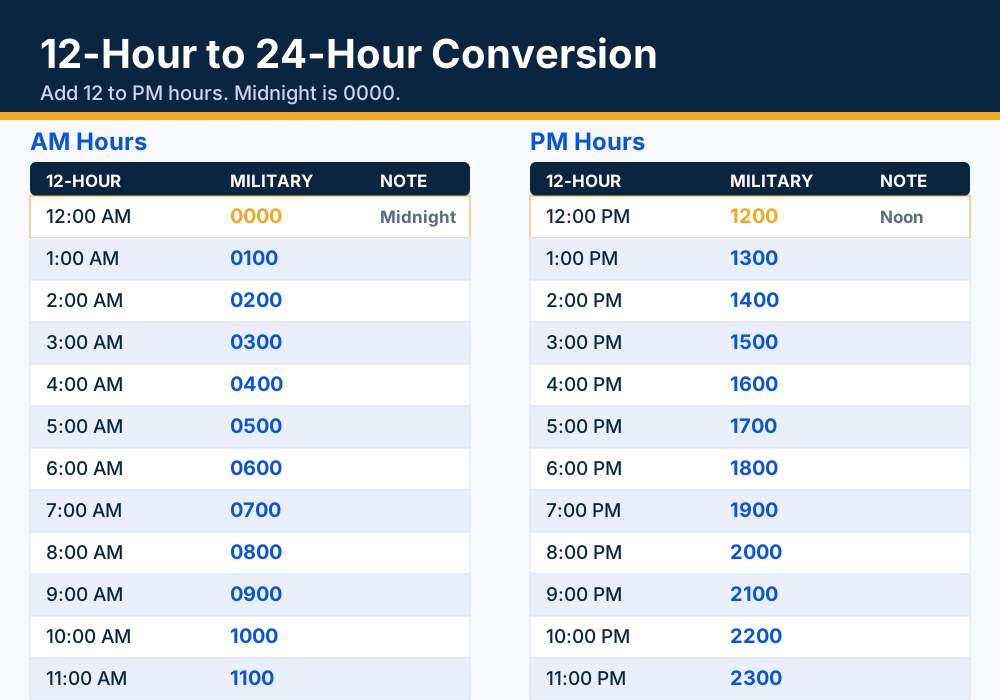
| Standard (12h) | Military (24h) | Pronounced |
|---|---|---|
| 12:00 AM (midnight) | 0000 | “Zero-hundred” |
| 1:00 AM | 0100 | “Oh-one-hundred” |
| 2:00 AM | 0200 | “Oh-two-hundred” |
| 3:00 AM | 0300 | “Oh-three-hundred” |
| 4:00 AM | 0400 | “Oh-four-hundred” |
| 5:00 AM | 0500 | “Oh-five-hundred” |
| 6:00 AM | 0600 | “Oh-six-hundred” |
| 7:00 AM | 0700 | “Oh-seven-hundred” |
| 8:00 AM | 0800 | “Oh-eight-hundred” |
| 9:00 AM | 0900 | “Oh-nine-hundred” |
| 10:00 AM | 1000 | “Ten-hundred” |
| 11:00 AM | 1100 | “Eleven-hundred” |
| 12:00 PM (noon) | 1200 | “Twelve-hundred” |
| 1:00 PM | 1300 | “Thirteen-hundred” |
| 2:00 PM | 1400 | “Fourteen-hundred” |
| 3:00 PM | 1500 | “Fifteen-hundred” |
| 4:00 PM | 1600 | “Sixteen-hundred” |
| 5:00 PM | 1700 | “Seventeen-hundred” |
| 6:00 PM | 1800 | “Eighteen-hundred” |
| 7:00 PM | 1900 | “Nineteen-hundred” |
| 8:00 PM | 2000 | “Twenty-hundred” |
| 9:00 PM | 2100 | “Twenty-one-hundred” |
| 10:00 PM | 2200 | “Twenty-two-hundred” |
| 11:00 PM | 2300 | “Twenty-three-hundred” |
For minutes, just append them: 3:30 PM = 1530 (“fifteen-thirty”).
How to read military time
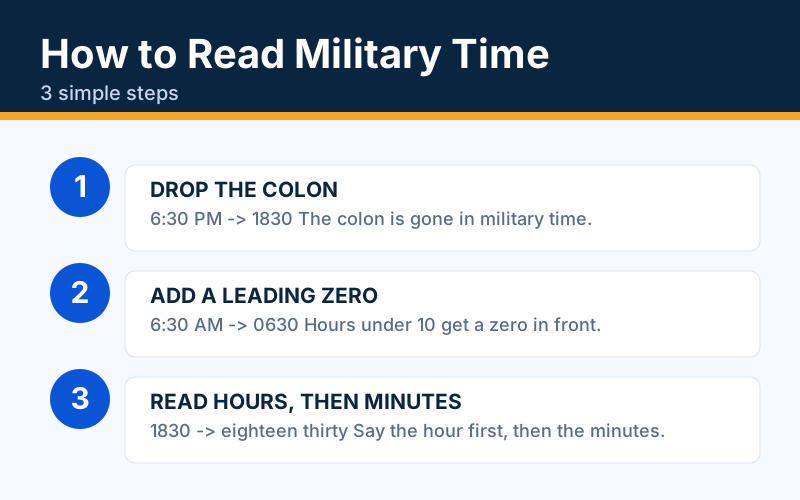
Step 1: Look at the first two digits (the hour).
- If 00-11: It’s AM. (00 = midnight, 01-11 = 1 AM to 11 AM)
- If 12: It’s noon.
- If 13-23: It’s PM. Subtract 12 to get the PM hour.
Step 2: Look at the last two digits (the minutes).
- These are the same as standard time. 30 = :30, 45 = :45.
Step 3: Combine them.
- 1430 = 14 (2 PM) + 30 minutes = 2:30 PM
- 0715 = 07 (7 AM) + 15 minutes = 7:15 AM
- 0000 = midnight
- 1200 = noon
Quick rule:
- AM (except midnight): Add a leading zero. 9 AM = 0900.
- PM: Add 12. 9 PM = 2100.
- Midnight: 0000 (not 2400, though you may see 2400 for end-of-day).
How to pronounce it
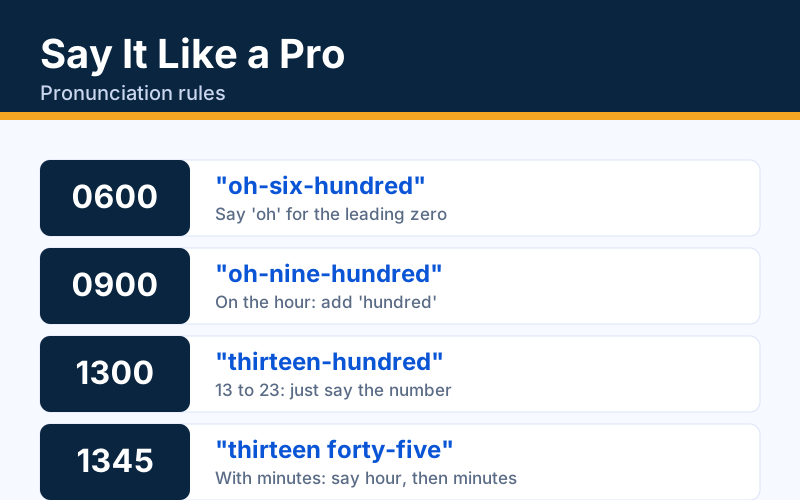
Military time is spoken differently than written:
On the hour:
- 0600 = “Oh-six-hundred” (not “six hundred”)
- 1200 = “Twelve-hundred”
- 1800 = “Eighteen-hundred”
With minutes:
- 0630 = “Oh-six-thirty”
- 1445 = “Fourteen-forty-five”
- 2315 = “Twenty-three-fifteen”
The word “hours”:
- In formal military communication, add “hours”: “Meet at oh-six-hundred hours.”
- In casual use, just the numbers are fine.
“Oh” vs “Zero”:
- 0600 can be “oh-six-hundred” or “zero-six-hundred”
- “Oh” is more common in US military usage
Midnight and noon
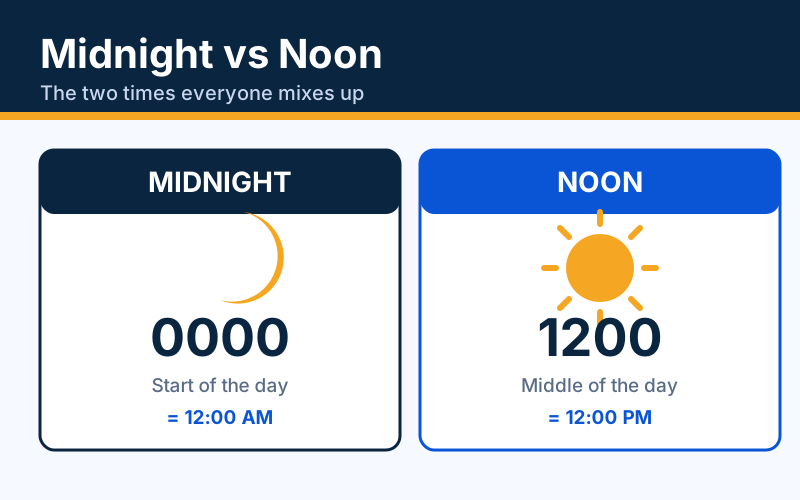
These two cause the most confusion:
Midnight (12:00 AM):
- Military: 0000
- Pronounced: “Zero-hundred”
- This is the START of a new day
Noon (12:00 PM):
- Military: 1200
- Pronounced: “Twelve-hundred”
- This is the MIDDLE of the day
Memory trick: 0000 looks like the day “resetting” to zero. 1200 is halfway through the 24 hours.
2400 vs 0000:
- 0000 = start of day (midnight)
- 2400 = end of day (midnight)
- They refer to the same moment, but 0000 is standard
- You may see 2400 in schedules to mean “end of operations for the day”
Where it’s used
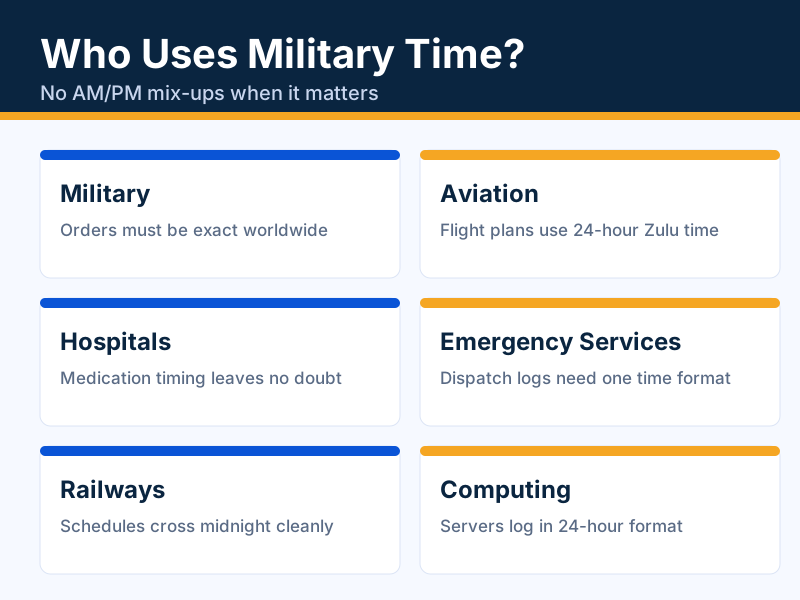
Military: All branches use 24-hour time for operations, to avoid AM/PM confusion.
Aviation: Pilots and air traffic controllers use 24-hour “Zulu time” (UTC) for flight plans.
Healthcare: Hospitals use 24-hour time for medication schedules and shift changes. A 3 AM vs 3 PM medication error could be fatal.
Emergency services: Police, fire, and EMS use 24-hour time for dispatch logs.
International: Most of the world uses 24-hour time in daily life. The 12-hour AM/PM system is primarily a US custom.
Computing: Programmers and systems use 24-hour time (often in UTC) for logs and timestamps.
Our military time converter can convert instantly.
Practice examples
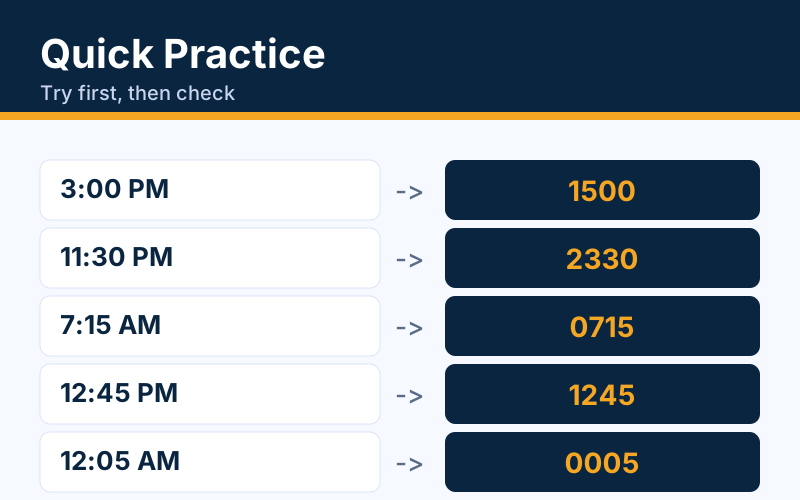
Try converting these (answers below):
- 7:00 AM = ?
- 3:30 PM = ?
- 11:45 PM = ?
- 12:00 AM = ?
- 12:00 PM = ?
Answers:
- 7:00 AM = 0700 (“oh-seven-hundred”)
- 3:30 PM = 1530 (“fifteen-thirty”)
- 11:45 PM = 2345 (“twenty-three-forty-five”)
- 12:00 AM = 0000 (“zero-hundred”)
- 12:00 PM = 1200 (“twelve-hundred”)
More practice
Convert these:
- 8:15 AM = 0815
- 1:00 PM = 1300
- 6:45 PM = 1845
- 10:30 PM = 2230
- 5:00 AM = 0500
Now reverse (military to standard):
- 0900 = 9:00 AM
- 1330 = 1:30 PM
- 2000 = 8:00 PM
- 0030 = 12:30 AM
- 1200 = 12:00 PM (noon)
Common mistakes
Mistake 1: Forgetting the leading zero
- Wrong: 900 (ambiguous)
- Right: 0900
The leading zero is important. It signals that you’re using 24-hour time.
Mistake 2: Using 2400 for midnight
- 0000 is standard for midnight (start of day)
- 2400 is sometimes used but can cause confusion
Mistake 3: Adding 12 to 12 PM
- 12:00 PM = 1200 (NOT 2400)
- 12:00 AM = 0000 (NOT 1200)
The 12s are special cases. Memorize them.
Mistake 4: Using a colon
- Military: 1430
- Civilian 24-hour: 14:30
- Both are correct in context, but military omits the colon
Mistake 5: Saying “hundred” for times with minutes
- 1400 = “fourteen-hundred” (correct)
- 1430 = “fourteen-thirty” (correct, NOT “fourteen-hundred-thirty”)
History of military time
The 24-hour clock is ancient:
- Egyptians used a 24-hour system (12 day + 12 night hours)
- Modern military adopted it in the early 20th century
The British Army adopted 24-hour time in 1915 during WWI, with full implementation by 1918. The US Navy followed in 1920, and the US Army standardized it on July 1, 1942, during WWII to coordinate with Allied forces.
Today, 24-hour time is standard in military operations worldwide. The “Zulu time” (UTC) system ensures that forces worldwide are synchronized.
For more on time zones, see EST vs CST and our time zone converter.
Military time in different branches
While all US military branches use 24-hour time, there are slight variations in pronunciation:
Army: “Oh-six-hundred hours” (formal), “oh-six-hundred” (casual)
Navy: Similar to Army, but often uses “hours” in formal settings
Air Force: Uses “Zulu time” (UTC) for flight operations. “Takeoff at one-four-zero-zero Zulu.”
Marines: Follows Army conventions
The differences are minor. The core system (0000-2359, no colon, leading zeros) is universal.
Zulu time
“Zulu” is the NATO phonetic alphabet word for “Z.” It refers to UTC (Coordinated Universal Time).
Example: “The operation begins at 0600 Zulu” means 6:00 AM UTC.
To convert Zulu to your local time:
- EST (winter): Zulu - 5 hours. 1200Z = 7:00 AM EST
- EDT (summer): Zulu - 4 hours. 1200Z = 8:00 AM EDT
- CST (winter): Zulu - 6 hours. 1200Z = 6:00 AM CST
Our UTC page shows current Zulu time.
Converting in your head
Quick method for PM times:
- Take the military hour (e.g., 17)
- Subtract 12 (17 - 12 = 5)
- That’s your PM hour (5 PM)
For AM times:
- Take the military hour (e.g., 08)
- Drop the leading zero (8)
- That’s your AM hour (8 AM)
Special cases to memorize:
- 00 = 12 AM (midnight)
- 12 = 12 PM (noon)
With practice, this becomes automatic. Many people who work with military time report that they stop “converting” and just think in 24-hour time.
Tips for learning
- Set a clock to 24-hour mode. Your phone, computer, or watch likely has this option. Immersion helps.
- Practice with real times. When you see 3:00 PM, think “1500.”
- Use the chart. Keep the conversion chart handy until it clicks.
- Start with the hours. Master the hours (0100-2300) before worrying about minutes.
Military time around the world
The US is unusual in using 12-hour time for daily life. Most of the world uses 24-hour time:
Europe: 24-hour time is standard. “The meeting is at 14:30” (not “2:30 PM”).
Asia: 24-hour time is common in business and transportation.
Latin America: Mix of 12-hour (spoken) and 24-hour (written).
If you travel internationally, you’ll encounter 24-hour time on:
- Train and bus schedules
- Flight information
- Business hours
- Official documents
Learning military/24-hour time is useful even if you’re not in the military.
Digital vs analog
Digital clocks can display 24-hour time easily. Analog clocks (with hands) are inherently 12-hour — the hour hand circles twice per day.
This is why:
- Digital devices often offer 24-hour mode
- Analog watches are 12-hour (though some have 24-hour markings)
- Military operations use digital displays for clarity
Technology and 24-hour time
Computers: Most systems use 24-hour time internally (often in UTC). Logs show “14:30:22” not “2:30:22 PM.”
Programming: Code libraries handle 24-hour time natively. The 12-hour AM/PM system requires extra logic.
Databases: Timestamps are stored in 24-hour format (e.g., “2026-10-18 14:30:00”).
If you work in tech, you’re already using 24-hour time — you just might not realize it.
Our Unix timestamp converter shows both formats.
When to use which format
Use military/24-hour time when:
- Communicating with military or aviation personnel
- Working in healthcare (medication timing)
- Scheduling across time zones (avoids AM/PM confusion)
- Writing technical documentation
- Traveling internationally
Use 12-hour time when:
- Casual conversation in the US (“Meet at 3 PM”)
- Most US business contexts (though 24-hour is gaining ground)
- When your audience expects AM/PM
In writing:
- Formal military: “Report at 0600 hours”
- Aviation: “Departure 1430 Zulu”
- Healthcare: “Administer at 2200”
- Civilian: “3:00 PM” or “15:00” (both acceptable, know your audience)
The key is consistency. Don’t mix formats in the same document.
Quick reference
- 0000-1159: AM hours (0000 = midnight)
- 1200: Noon
- 1300-2359: PM hours (subtract 12)
- No colon in military format
- Leading zero for hours 0000-0959
- “Hundred” for on-the-hour times
- “Hours” optional in formal contexts
Print the chart above or bookmark this page for quick reference.
Advanced: seconds and fractions
Military time can include seconds:
- 143022 = 14:30:22 (2:30:22 PM)
- Format: HHMMSS (no colons)
In practice, seconds are rarely used in spoken communication. They’re mainly for:
- Computer timestamps
- Scientific measurements
- Precise coordination (“Execute at 060000”)
Fractions of a minute: In some contexts, you’ll see decimal minutes:
- 1430.5 = 14:30:30 (2:30:30 PM)
- This is rare outside technical fields
For most purposes, HHMM (hours and minutes) is sufficient.
Military time and time zones
When military operations span time zones, they use Zulu time (UTC) as the reference.
Example: A joint operation involves units in:
- Washington DC (EST, UTC-5)
- London (GMT, UTC+0)
- Tokyo (JST, UTC+9)
The order says “Execute at 1200 Zulu.”
- Washington: 1200Z - 5 = 0700 EST (7:00 AM)
- London: 1200Z = 1200 GMT (noon)
- Tokyo: 1200Z + 9 = 2100 JST (9:00 PM)
Everyone knows exactly when to act, regardless of local time.
This is why Zulu time is critical for:
- International military operations
- Aviation (flight plans use Zulu)
- Emergency coordination across regions
Our time zone converter can convert Zulu to local time.
Local vs Zulu
In garrison (non-deployed) settings, military units often use local time:
- “Physical training at 0600” (6:00 AM local)
- This is simpler for daily routines
In deployed or joint operations, Zulu is standard:
- “Briefing at 1400 Zulu” (2:00 PM UTC)
- Everyone converts to their local time
The context usually makes it clear which is being used. When in doubt, ask: “Is that local or Zulu?”
Example conversation:
- Sergeant: “Formation at 1700.”
- Private: “Local or Zulu, Sergeant?”
- Sergeant: “Local. 1700 local.”
- (This means 5:00 PM local time)
This clarification takes two seconds and prevents confusion.
Summary
Military time is simple once you learn the pattern:
- 0000-1159: Morning (AM), with leading zero
- 1200: Noon
- 1300-2359: Afternoon/evening (PM), subtract 12
- No colon, no AM/PM — the numbers say it all
The 24-hour system eliminates ambiguity. There’s no “Is that 3 AM or 3 PM?” — 0300 is always morning, 1500 is always afternoon.
Whether you’re joining the military, working in healthcare or aviation, traveling internationally, or just want to understand 24-hour clocks, the chart at the top of this page has everything you need.
Bookmark this page, practice with the examples, and soon you’ll read military time as naturally as standard time.
Additional resources
- Our military time converter tool for instant conversions
- Time zone converter for Zulu/local conversions
- World clock to see 24-hour time worldwide
- EST vs CST guide for US time zone differences
- Time abbreviations guide for EST/EDT, CST/CDT explained
Final tip: The best way to learn is to use it. Change your phone to 24-hour time for a week. By day 3, you’ll be converting automatically. By day 7, you’ll wonder why anyone uses AM/PM.
Military time isn’t just for the military — it’s a clearer, more logical way to tell time. Once you learn it, you might never go back.
For official time standards, see NIST time and frequency. The IANA time zone database is the authoritative source for time zone data. For US time zone boundaries, see the Department of Transportation.
Learning military time opens doors. It’s used in aviation, healthcare, emergency services, and international business. The 24-hour clock is the global standard — the US is the outlier with AM/PM. By mastering military time, you’re speaking the world’s time language. Start with the comprehensive conversion chart above, practice with real times every single day consistently, and soon reading and understanding military time will feel completely natural and automatic for you in all of your daily life activities every single day now.
FAQ
What is military time? Military time is the 24-hour clock system (NIST) used by the military, aviation, and healthcare. It runs from 0000 (midnight) to 2359 (11:59 PM).
How do you convert 3 PM to military time? Add 12 to the hour: 3 PM = 1500 hours. For AM times (except 12 AM), keep the same number with a leading zero: 3 AM = 0300.
What is 0000 in military time? 0000 is midnight (12:00 AM). It is pronounced “zero-hundred” or “midnight.”
What is 1200 in military time? 1200 is noon (12:00 PM). It is pronounced “twelve-hundred.”
How do you say 1830 in military time? 1830 is pronounced “eighteen-thirty” or “eighteen-thirty hours.” It equals 6:30 PM.
Why does the military use 24-hour time? To avoid confusion between AM and PM. In critical operations, misreading 3 AM vs 3 PM could be dangerous. The 24-hour system is unambiguous.
What is 2400 in military time? 2400 is sometimes used to mean end-of-day midnight, but 0000 (start of day) is more standard. Both refer to midnight.
Do I need the colon in military time? No. Military time is typically written without a colon: 1430, not 14:30. The colon is used in civilian 24-hour time. In spoken military communication, times are pronounced digit by digit — 1430 is “fourteen thirty hours” — which avoids any ambiguity about whether a colon was intended.
How we verified this
Verified:
- 24-hour clock structure: Standard timekeeping (ISO 8601)
- Pronunciation conventions: US military usage (DVIDS)
- Conversion math: Arithmetic (add 12 for PM)
General knowledge:
- Usage contexts (military, aviation, healthcare) — widely documented
- No invented statistics
Sources: NIST, US Naval Observatory. Try our [military time converter](/tools/military-time/).