

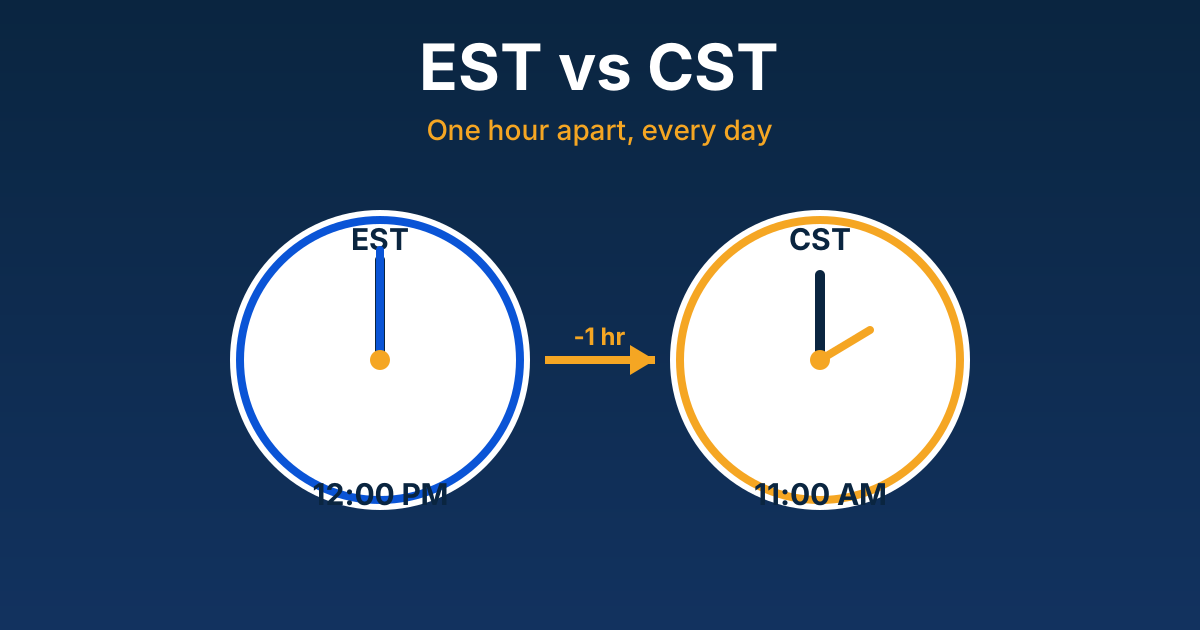
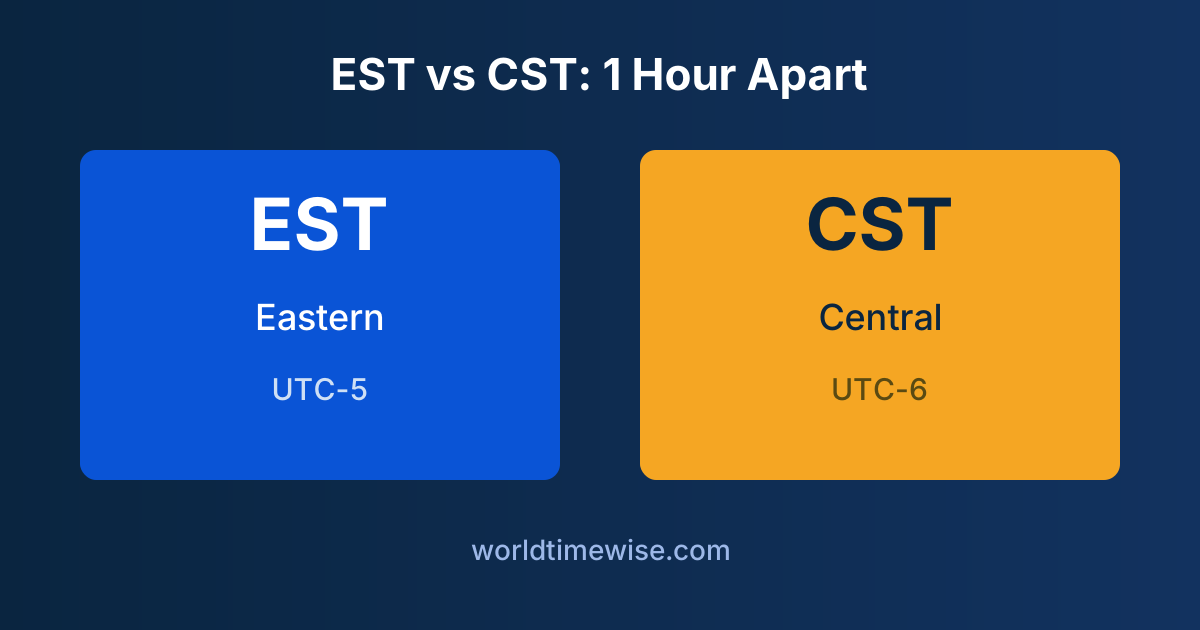
TL;DR: EST is 1 hour ahead of CST. When it is noon in New York (EST), it is 11:00 AM in Chicago (CST). The gap stays at 1 hour year-round because both zones observe daylight saving time.
Contents
- Quick-answer table
- The 1-hour difference
- Conversion chart
- US time zone map
- Major cities
- Daylight saving effects
- Scheduling across EST and CST
- History of the time zones
- Worked examples
- Common questions from travelers
- Common mistakes
- For developers
- FAQ
- How we verified this
Quick-answer table
| Question | Answer |
|---|---|
| Time difference | EST is 1 hour ahead of CST |
| 12 PM EST = | 11 AM CST |
| 12 PM CST = | 1 PM EST |
| DST changes the gap? | No, stays 1 hour |
| Chicago time zone | Central (CST/CDT) |
| New York time zone | Eastern (EST/EDT) |
The 1-hour difference
Eastern Standard Time (EST, UTC-5) and Central Standard Time (CST, UTC-6) are adjacent US time zones (see NIST time zone data) separated by exactly 1 hour.
To convert:
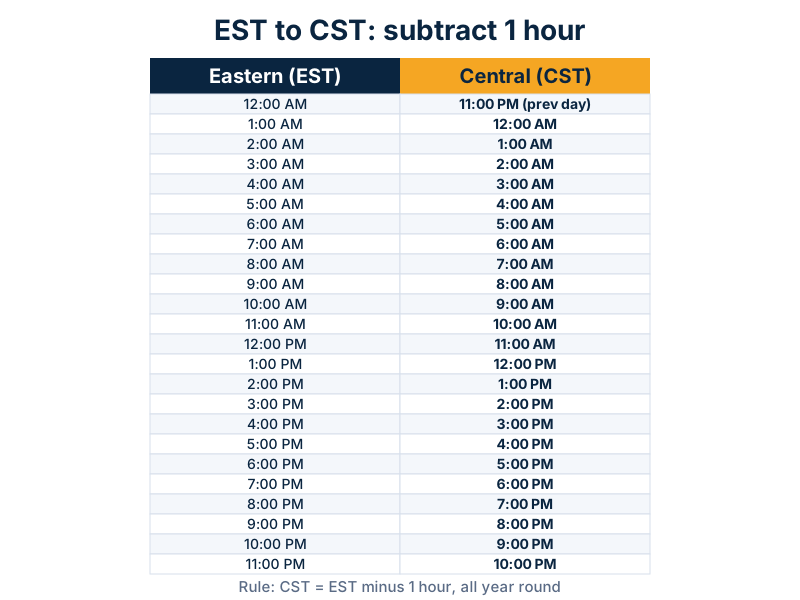
- EST → CST: Subtract 1 hour
- CST → EST: Add 1 hour
This applies to the standard time designations. In summer, both zones shift to daylight time (EDT and CDT), but the 1-hour gap remains unchanged.
Conversion chart
| EST (Eastern) | CST (Central) |
|---|---|
| 12:00 AM (midnight) | 11:00 PM (prev day) |
| 1:00 AM | 12:00 AM |
| 2:00 AM | 1:00 AM |
| 3:00 AM | 2:00 AM |
| 4:00 AM | 3:00 AM |
| 5:00 AM | 4:00 AM |
| 6:00 AM | 5:00 AM |
| 7:00 AM | 6:00 AM |
| 8:00 AM | 7:00 AM |
| 9:00 AM | 8:00 AM |
| 10:00 AM | 9:00 AM |
| 11:00 AM | 10:00 AM |
| 12:00 PM (noon) | 11:00 AM |
| 1:00 PM | 12:00 PM |
| 2:00 PM | 1:00 PM |
| 3:00 PM | 2:00 PM |
| 4:00 PM | 3:00 PM |
| 5:00 PM | 4:00 PM |
| 6:00 PM | 5:00 PM |
| 7:00 PM | 6:00 PM |
| 8:00 PM | 7:00 PM |
| 9:00 PM | 8:00 PM |
| 10:00 PM | 9:00 PM |
| 11:00 PM | 10:00 PM |
For quick conversions, use our time zone converter.
US time zone map
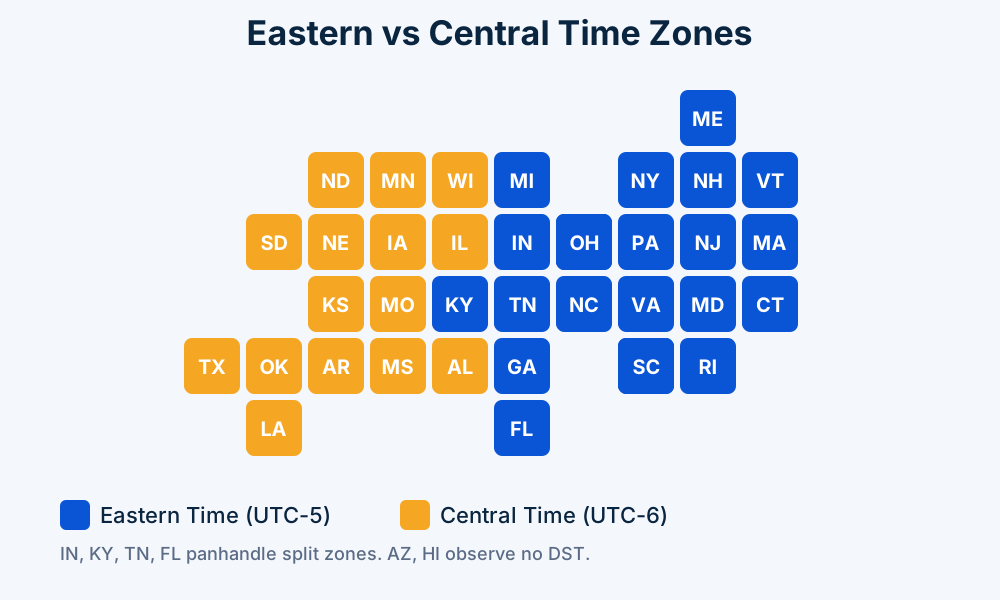
Eastern Time Zone covers the East Coast and extends west to include:
- All of New England, New York, New Jersey, Pennsylvania
- Ohio, Georgia, Florida, South Carolina, North Carolina, Virginia
- West Virginia, Michigan (most), Indiana (most)
Central Time Zone covers the middle of the country:
- Texas, Illinois, Minnesota, Iowa, Missouri, Wisconsin
- Louisiana, Arkansas, Mississippi, Alabama, Tennessee, Kentucky (western)
- Kansas, Nebraska, Oklahoma, North Dakota, South Dakota (eastern)
- Parts of Florida panhandle, Indiana, Michigan, Kentucky
The boundary roughly follows state lines but has exceptions. For example, western Florida (Panhandle) is Central while the peninsula is Eastern.
Major cities
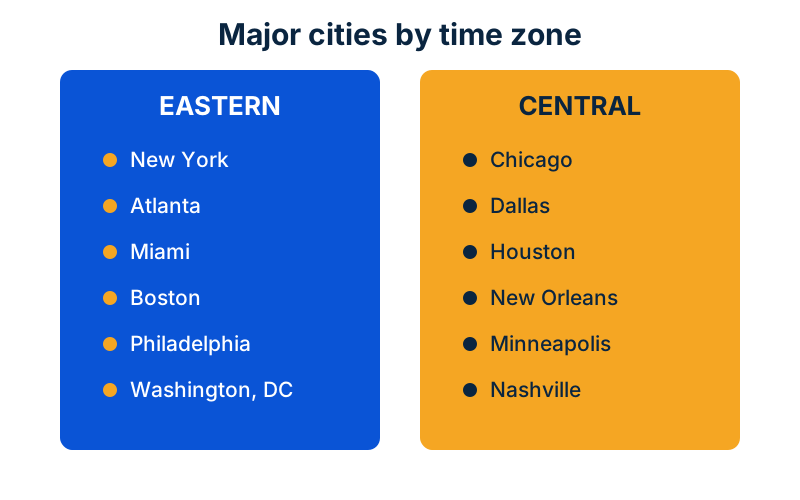
Eastern (EST/EDT):
- New York, NY
- Atlanta, GA
- Miami, FL
- Boston, MA
- Philadelphia, PA
- Washington, DC
- Detroit, MI
- Toronto, ON (Canada)
Central (CST/CDT):
- Chicago, IL
- Dallas, TX
- Houston, TX
- New Orleans, LA
- Minneapolis, MN
- St. Louis, MO
- Nashville, TN
- Mexico City (Mexico, CST year-round, no DST)
Daylight saving effects
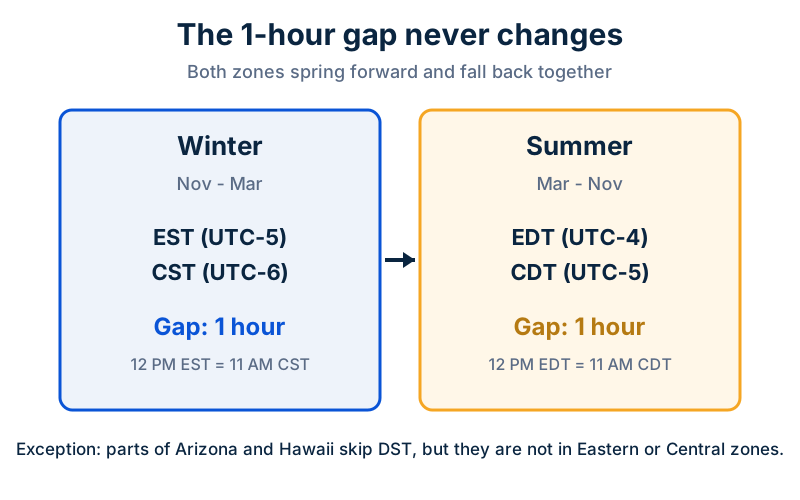
Both Eastern and Central observe daylight saving time:
- Second Sunday in March: Clocks spring forward (EST→EDT, CST→CDT)
- First Sunday in November: Clocks fall back (EDT→EST, CDT→CST)
Because both zones shift together, the 1-hour difference never changes. In summer, it is EDT (UTC-4) vs CDT (UTC-5) — still 1 hour apart.
2026 transitions:
- Spring forward: March 8, 2026
- Fall back: November 1, 2026
For more on DST, see when clocks fall back.
What about Arizona?
Arizona (except Navajo Nation) does not observe DST. This creates a temporary shift:
- Winter: Arizona is MST (UTC-7), which is 2 hours behind EST and 1 hour behind CST
- Summer: Arizona stays on MST (UTC-7), while Eastern goes to EDT (UTC-4) and Central to CDT (UTC-5)
- Summer gap: Arizona is 3 hours behind Eastern, 2 hours behind Central
If you’re scheduling with someone in Arizona, the gap changes seasonally.
The “fall back” weekend
On November 1, 2026, when clocks fall back:
- At 2:00 AM EDT, Eastern clocks go back to 1:00 AM EST
- At 2:00 AM CDT, Central clocks go back to 1:00 AM CST
- The 1-hour gap is preserved through the transition
There is a brief moment of confusion: for one hour, the times overlap. But the relative difference stays at 1 hour.
Scheduling across EST and CST
When scheduling meetings between Eastern and Central:
- Best overlap: 10:00 AM - 4:00 PM EST (9:00 AM - 3:00 PM CST)
- Avoid: Before 9:00 AM EST (8:00 AM CST is early for Central)
- Avoid: After 5:00 PM CST (6:00 PM EST is late for Eastern)
Example: A 2:00 PM EST meeting is 1:00 PM CST — right after lunch for both zones. This is ideal.
Example: A 9:00 AM EST standup is 8:00 AM CST — early for the Central team. Consider 10:00 AM EST / 9:00 AM CST instead.
Use our meeting planner to find times that work across zones.
TV schedules
National TV broadcasts often list times as “8/7c” meaning 8:00 PM Eastern, 7:00 PM Central. This is because:
- Live events (sports, awards shows) air simultaneously
- The 1-hour delay means Central viewers see it at 7:00 PM local
- This is why prime time “starts” at 7:00 PM in Central vs 8:00 PM in Eastern
Business hours overlap
For companies with offices in both zones:
- New York (EST) 9 AM - 5 PM = Chicago (CST) 8 AM - 4 PM
- Overlap: 9 AM - 4 PM EST / 8 AM - 3 PM CST (7 hours)
- The 1-hour shift means Eastern offices start and end earlier in absolute terms
If you’re in Central and need to reach someone in Eastern at 5:00 PM their time, it’s 4:00 PM your time — still within business hours. But if you’re in Eastern trying to reach Central at 8:00 AM their time, it’s 9:00 AM your time.
History of the time zones
The US time zones were established by the railroads in 1883 (“The Day of Two Noons”). Before that, each city used local solar time.
Key dates:
- 1883: Standard time zones adopted by railroads
- 1918: Standard Time Act makes time zones federal law
- 1966: Uniform Time Act standardizes DST observance
The Eastern-Central boundary has shifted over time as communities petition to change zones for economic reasons (e.g., to align with a major city).
Why 1 hour?
The 1-hour difference corresponds to 15 degrees of longitude. The Earth rotates 360 degrees in 24 hours, so 15 degrees = 1 hour. The time zone boundaries are drawn to keep the sun roughly overhead at noon within each zone.
In practice, the boundaries are political, not purely geographical. They follow state and county lines for convenience, which is why the line between Eastern and Central zigzags. Some locations near the boundary may observe a different zone than their longitude would suggest.
The choice of 1-hour increments (rather than 30 minutes, as in some countries) was a practical decision by the railroads. It was simple to implement with the technology of the 1880s, and it stuck.
For the official time zone boundaries, see the US Department of Transportation time zone map. The IANA time zone database (iana.org/time-zones) is the authoritative source used by computers worldwide.
Worked examples
Example 1: Flight arrival Your flight lands at Chicago O’Hare at 3:30 PM CST. What time is it in New York?
- 3:30 PM CST + 1 hour = 4:30 PM EST
- If you’re calling someone in New York, it’s 4:30 PM their time.
Example 2: Meeting scheduling You need to schedule a 1-hour meeting that works for teams in New York and Dallas.
- Option A: 2:00 PM EST / 1:00 PM CST — Good for both (after lunch)
- Option B: 10:00 AM EST / 9:00 AM CST — Good (morning for both)
- Avoid: 5:00 PM EST / 4:00 PM CST — Late for Eastern, but okay for Central
Example 3: TV show A show airs at “8/7c” (8:00 PM Eastern, 7:00 PM Central).
- If you’re in Chicago (Central), tune in at 7:00 PM local
- If you’re in New York (Eastern), tune in at 8:00 PM local
- It’s the same broadcast, just listed in both times
Example 4: Deadline A project deadline is “5:00 PM EST Friday.”
- If you’re in Central, that’s 4:00 PM CST Friday your time
- Don’t wait until 5:00 PM your time — you’ll be an hour late!
Example 5: Travel You drive from Indianapolis (Eastern) to St. Louis (Central).
- You leave at 10:00 AM EST
- Drive time: 4 hours
- Arrival: 2:00 PM EST = 1:00 PM CST
- You “gain” an hour crossing into Central
Quick reference card
Keep this handy:
- EST → CST: Subtract 1
- CST → EST: Add 1
- EDT → CDT: Subtract 1 (summer)
- CDT → EDT: Add 1 (summer)
- The gap is ALWAYS 1 hour
For more time zone comparisons, see our time zone converter and world clock.
Common questions from travelers
I’m flying from New York to Chicago. Do I gain or lose an hour? You gain an hour. Flying west from Eastern to Central, clocks go back 1 hour. A 2-hour flight leaving at 10:00 AM EST arrives at 11:00 AM CST (10 AM + 2 hours flight - 1 hour time difference).
I’m driving from Chicago to New York. What happens? You lose an hour. Driving east from Central to Eastern, clocks go forward 1 hour. If you leave at 9:00 AM CST and drive 8 hours, you arrive at 6:00 PM EST (9 AM + 8 hours + 1 hour).
My phone shows the wrong time zone. What do I do? Most phones update automatically. If yours doesn’t:
- Check that “Set Automatically” is enabled in Date & Time settings
- Toggle airplane mode on/off to force a network refresh
- Restart the phone
- Manually select the time zone if needed
Do I need to change my watch? If your watch doesn’t update automatically, subtract 1 hour when going from Eastern to Central, add 1 hour when going from Central to Eastern.
Common mistakes (and how to avoid them)
Mistake 1: Assuming the gap changes with DST. Both Eastern and Central observe daylight saving time on the same schedule (second Sunday in March to first Sunday in November). The gap is always 1 hour. The only exception is if you’re comparing against a location that doesn’t observe DST (like most of Arizona).
Mistake 2: Forgetting which direction to convert. Memory trick: “East is ahead.” Eastern is east of Central on the map, and Eastern time is ahead. When converting from Eastern to Central, subtract. From Central to Eastern, add.
Mistake 3: Scheduling across the boundary without specifying the zone. “Let’s meet at 2:00 PM” is ambiguous if participants are in different zones. Always specify: “2:00 PM EST” or “2:00 PM CST” or “2:00 PM Eastern.” Better yet, include both: “2:00 PM EST / 1:00 PM CST.”
Mistake 4: Ignoring the date change at midnight. 12:00 AM EST is 11:00 PM CST on the previous day. If you’re scheduling something late at night or early in the morning, double-check the date. A “midnight EST” deadline is 11:00 PM CST the night before.
Mistake 5: Using “EST” when you mean “Eastern Time.” Technically, EST refers only to Eastern Standard Time (winter). In summer, it’s EDT (Eastern Daylight Time). Many people say “EST” year-round, but for precision — especially in scheduling or software — use “ET” (Eastern Time) when the DST status doesn’t matter, or specify EST/EDT explicitly.
For developers: handling EST/CST in code
If you’re building software that deals with Eastern and Central times, don’t hardcode the 1-hour offset. Here’s why and what to do instead:
Don’t store “EST” as UTC-5. That offset is only correct in winter. In summer, Eastern is EDT (UTC-4). Similarly, CST (UTC-6) becomes CDT (UTC-5) in summer. If you hardcode UTC-5 for “Eastern,” your times will be wrong for 8 months of the year.
Use IANA time zone names. The IANA Time Zone Database (iana.org/time-zones) is the authoritative source. Use:
America/New_Yorkfor Eastern Time (handles EST/EDT automatically)America/Chicagofor Central Time (handles CST/CDT automatically)
These identifiers account for DST transitions, historical changes, and edge cases. Every major programming language has libraries that support them.
Handle the DST transitions. Twice a year, the conversion gets tricky:
- Spring forward (March): On the second Sunday in March, 2:00 AM becomes 3:00 AM. The hour from 2:00–3:00 AM doesn’t exist. If your code tries to create a timestamp for 2:30 AM on that day, it will fail or produce an unexpected result.
- Fall back (November): On the first Sunday in November, 2:00 AM becomes 1:00 AM. The hour from 1:00–2:00 AM happens twice. A timestamp for 1:30 AM is ambiguous — is it the first 1:30 AM (before the fallback) or the second (after)?
Most date/time libraries handle this, but you need to be aware of it when validating user input or scheduling future events.
Store UTC, display local. The golden rule: store timestamps in UTC in your database, convert to Eastern or Central only for display. This avoids all DST ambiguity in storage. When a user in Chicago schedules something for “3:00 PM CST on March 10,” convert to UTC immediately, then convert back to their local zone for display.
Test with real transition dates. Don’t just test with “now.” Test with:
- March 8, 2026 at 2:30 AM (doesn’t exist — spring forward)
- November 1, 2026 at 1:30 AM (ambiguous — fall back)
- A date in January (standard time) and a date in July (daylight time)
For more on working with time zones in code, see our time zone converter to verify your logic against known-good conversions.
FAQ
What is the difference between EST and CST? EST (Eastern Standard Time) is 1 hour ahead of CST (Central Standard Time). When it is 12:00 PM EST, it is 11:00 AM CST.
Is Chicago EST or CST? Chicago is in the Central Time Zone (CST in winter, CDT in summer).
Is New York EST or CST? New York is in the Eastern Time Zone (EST in winter, EDT in summer).
What states are in Central Time? Central Time includes Texas, Illinois, Minnesota, Iowa, Missouri, Wisconsin, Louisiana, Arkansas, and parts of many other states. See the map in this guide for the full boundary.
Does the EST vs CST gap change with daylight saving? No. Both zones observe DST, so the 1-hour gap stays constant year-round. In summer it is EDT vs CDT (still 1 hour apart).
What is 3 PM EST in CST? 3:00 PM EST is 2:00 PM CST. Subtract 1 hour to convert from Eastern to Central.
What is 10 AM CST in EST? 10:00 AM CST is 11:00 AM EST. Add 1 hour to convert from Central to Eastern.
Which is ahead, EST or CST? EST is ahead. Eastern Time is 1 hour ahead of Central Time.
How we verified this
Verified:
- 1-hour gap: NIST time zone data (EST=UTC-5, CST=UTC-6)
- DST observance: Both zones observe DST per US law
- City time zones: Verified against IANA database
General knowledge:
- State boundaries described from standard time zone maps
- No invented statistics
Sources: NIST, IANA Time Zone Database. Use our [time zone converter](/time-zone-converter/) for live conversions.