

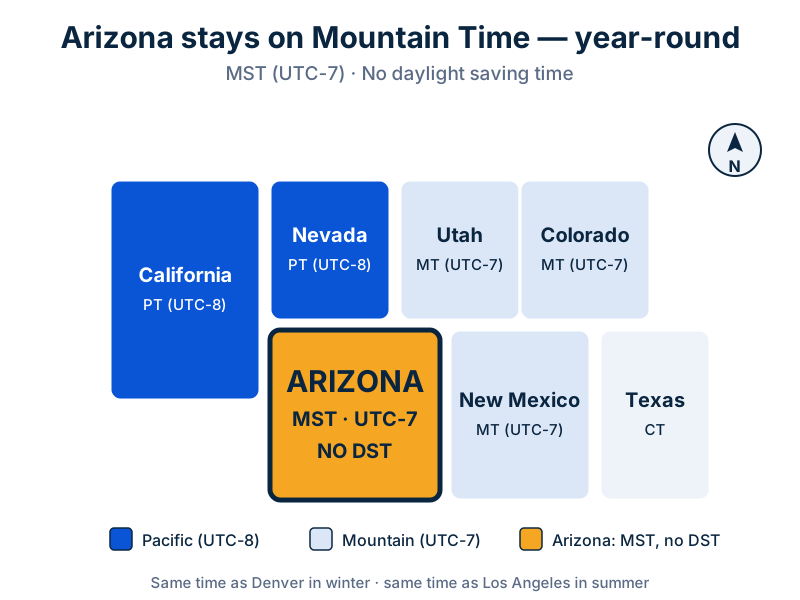
TL;DR: Arizona is in the **Mountain Time Zone** and stays on **Mountain Standard Time (MST, UTC-7) all year**. It does not observe daylight saving time (except the Navajo Nation). In winter, Arizona matches Denver time. In summer, Arizona matches Los Angeles time.
Contents
- Quick Answer: What Time Zone Is Arizona In?
- Does Arizona Observe Daylight Saving Time?
- Arizona vs. Neighboring States: The Seasonal Shift
- The Navajo Nation Exception
- Why Arizona Opted Out of DST
- Practical Scheduling Guide
- Common Myths
- FAQ
- Sources
- Summary
- How We Verified This
Quick Answer: What Time Zone Is Arizona In?
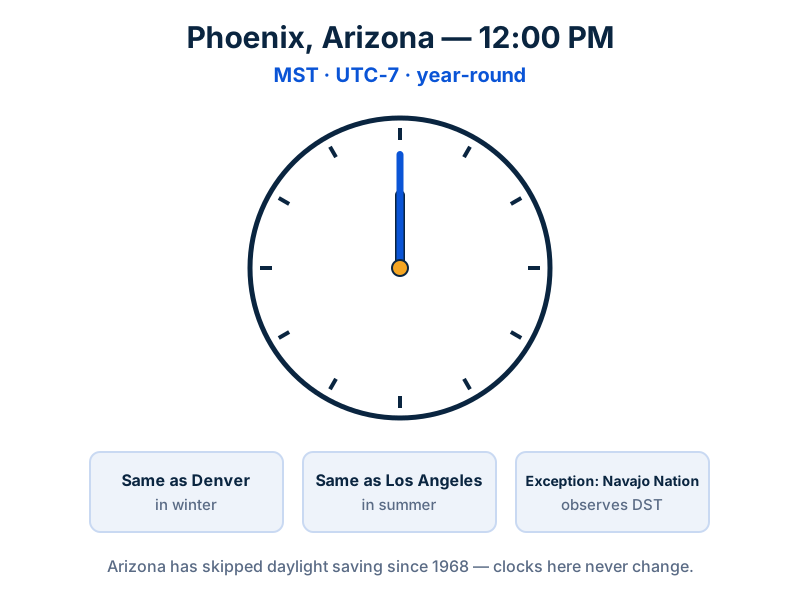
Arizona is in the Mountain Time Zone (MST, UTC-7), year-round. Unlike most of the United States, Arizona does not spring forward in March or fall back in November. When the rest of the Mountain Time Zone shifts to MDT (UTC-6) for the summer, Arizona stays put at UTC-7. For background on how Eastern and Central time compare, see our EST vs CST Chart.
| Fact | Detail |
|---|---|
| Time zone | Mountain Time |
| Standard abbreviation | MST |
| UTC offset | UTC-7 (all year) |
| Daylight saving | No (except Navajo Nation) |
| IANA identifier | America/Phoenix |
This creates a seasonal quirk: for half the year Arizona shares its clock with Denver, and for the other half it shares its clock with Los Angeles.
Does Arizona Observe Daylight Saving Time?
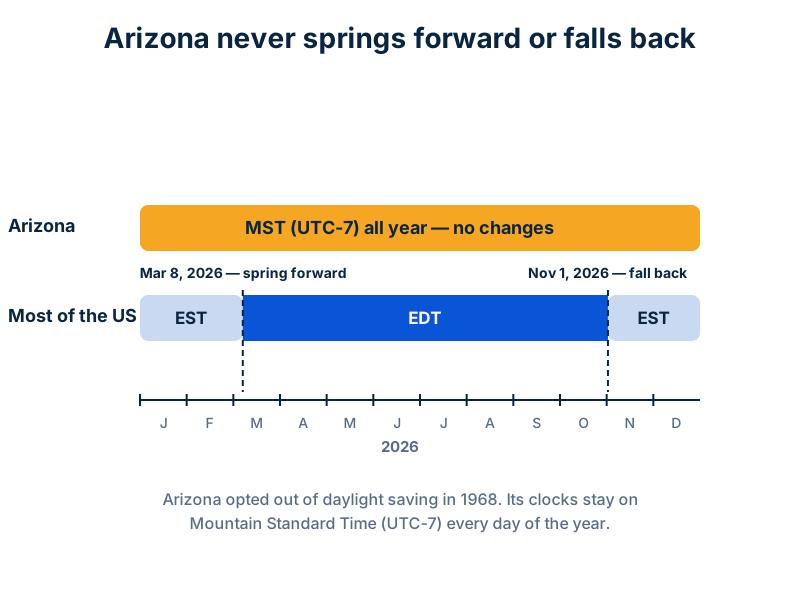
No. Arizona is one of two U.S. states that do not observe daylight saving time. (The other is Hawaii.) Arizona has skipped DST since 1968.
The legal basis is the federal Uniform Time Act of 1966, which allows states to opt out of daylight saving time entirely. Arizona exercised that option, and the exemption remains in state law (A.R.S. 1-242). To understand the standard/daylight abbreviations, see CST vs CDT, EST vs EDT.
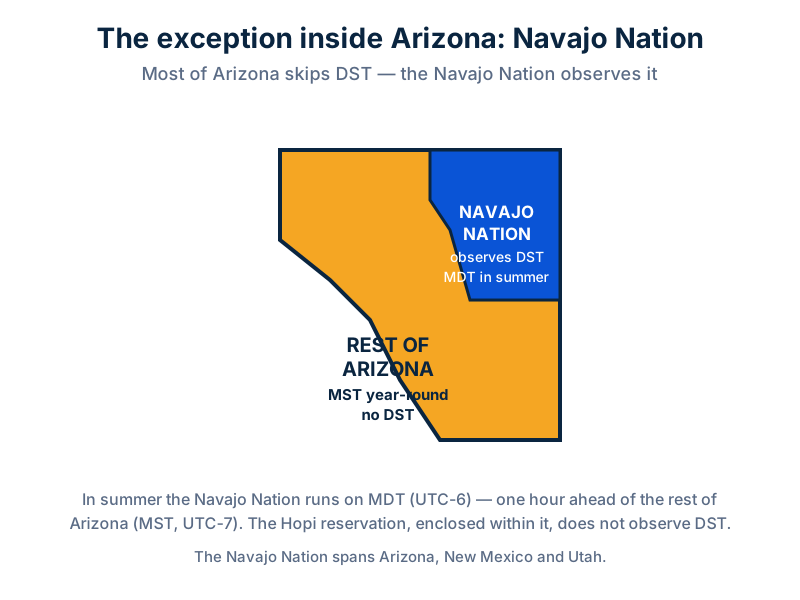
The one exception: the Navajo Nation, which spans northeastern Arizona plus parts of New Mexico and Utah, does observe daylight saving time. This is because the Navajo Nation operates across three states and chose uniformity across its territory.
The Hopi Wrinkle
Inside the Navajo Nation sits the Hopi Reservation — and the Hopi Tribe does not observe DST. So within a few miles you can cross from MST (Hopi) to MDT (Navajo) and back to MST (rest of Arizona) during the summer. It is one of the most unusual time zone situations in the United States.
Arizona vs. Neighboring States: The Seasonal Shift
Here is where it gets practical. Because Arizona never changes its clocks, its relationship to neighboring states flips twice a year.
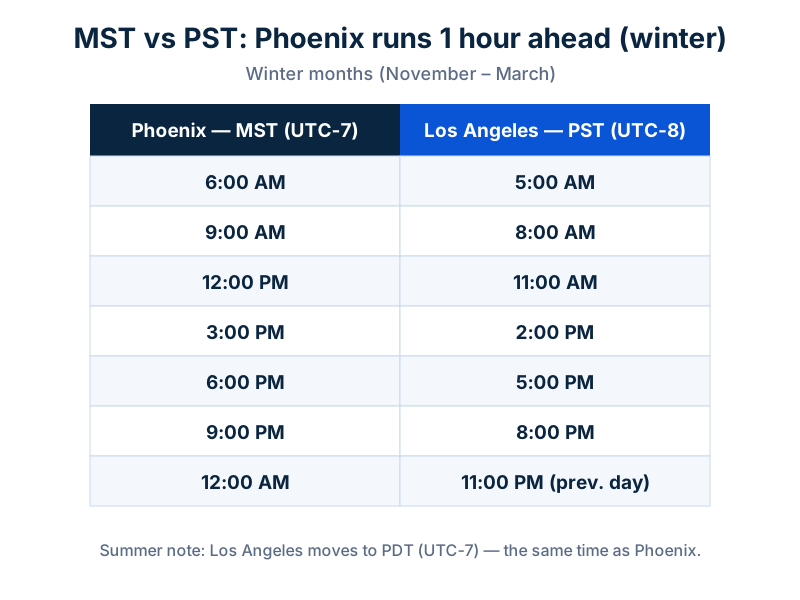
Winter (November to March): Arizona = Mountain Time
From the first Sunday in November to the second Sunday in March, everyone is on standard time:
| City | Zone | Offset | vs. Phoenix (winter) |
|---|---|---|---|
| Phoenix | MST | UTC-7 | — |
| Denver | MST | UTC-7 | Same time |
| Los Angeles | PST | UTC-8 | 1 hour behind |
| Chicago | CST | UTC-6 | 1 hour ahead |
| New York | EST | UTC-5 | 2 hours ahead |
Summer (March to November): Arizona = Pacific Time (Effectively)
From the second Sunday in March to the first Sunday in November, most of the country springs forward — but Arizona does not:
| City | Zone | Offset | vs. Phoenix (summer) |
|---|---|---|---|
| Phoenix | MST | UTC-7 | — |
| Los Angeles | PDT | UTC-7 | Same time |
| Denver | MDT | UTC-6 | 1 hour ahead |
| Chicago | CDT | UTC-5 | 2 hours ahead |
| New York | EDT | UTC-4 | 3 hours ahead |
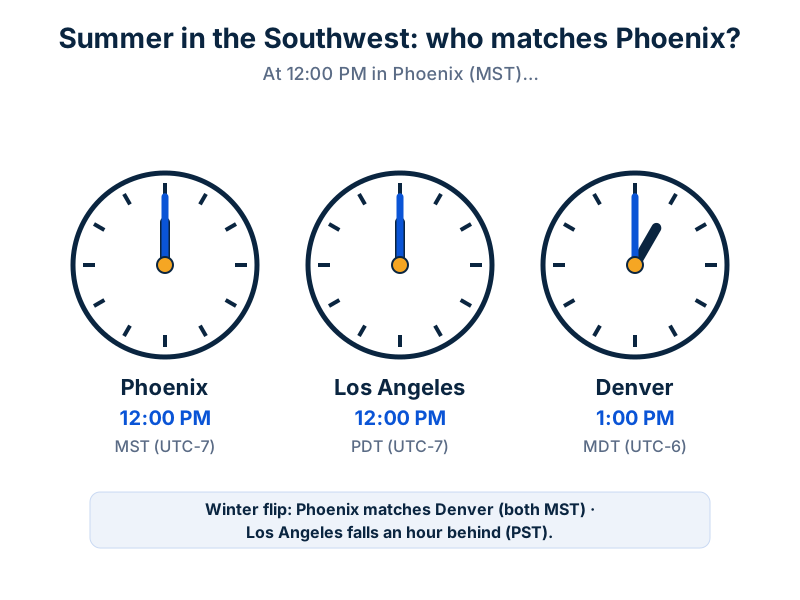
The simple rule: In winter, think of Phoenix as Denver time. In summer, think of Phoenix as Los Angeles time.
2026 Transition Dates
- March 8, 2026: Most of the U.S. springs forward. Arizona does not. From this date, Phoenix matches Los Angeles.
- November 1, 2026: Most of the U.S. falls back. Arizona does not. From this date, Phoenix matches Denver again.
The Navajo Nation Exception
The Navajo Nation covers about 27,000 square miles across Arizona, New Mexico, and Utah. Because it spans state lines, the tribal government decided to observe DST for consistency.
What this means in practice:
- Summer: The Navajo Nation is on MDT (UTC-6), one hour ahead of Phoenix.
- Winter: The Navajo Nation is on MST (UTC-7), the same as Phoenix.
- The Hopi Reservation (entirely surrounded by Navajo land) stays on MST year-round, like the rest of Arizona.
If you are driving through northeastern Arizona in summer — say from Flagstaff to Monument Valley — your phone may jump forward an hour and back as you cross tribal boundaries. It is not a glitch.
Why Arizona Opted Out of DST
The reason is simple: heat.
Arizona summers are extremely hot, with Phoenix regularly seeing temperatures well above 100°F (38°C). Daylight saving time shifts an hour of daylight from the morning to the evening. In most states, that means pleasant summer evenings. In Arizona, it would mean an extra hour of intense afternoon heat.
When the Uniform Time Act gave states the opt-out in 1966, Arizona exercised it. The commonly cited reason — that an extra hour of evening daylight would increase air-conditioning use during Arizona’s extreme summer heat — reflects the state’s climate reality, though the specific legislative deliberations from 1968 are not detailed in the statute itself (A.R.S. 1-242 simply establishes the exemption).
Hawaii is the other state that does not observe DST.
Practical Scheduling Guide
Scheduling a Call with Someone in Arizona
Step 1: Check whether DST is currently in effect where you are (not in Arizona — Arizona never changes).
Step 2: Apply the seasonal rule:
- November–March: Arizona = your Mountain Time equivalent.
- March–November: Arizona = your Pacific Time equivalent.
Step 3: Worked examples (2026):
- New York to Phoenix in January: New York is EST (UTC-5), Phoenix is MST (UTC-7). 3:00 PM in New York = 1:00 PM in Phoenix.
- New York to Phoenix in July: New York is EDT (UTC-4), Phoenix is still MST (UTC-7). 3:00 PM in New York = 12:00 PM in Phoenix. The gap widens to 3 hours.
- Chicago to Phoenix in January: 2:00 PM CST = 1:00 PM MST (1-hour gap).
- Chicago to Phoenix in July: 2:00 PM CDT = 12:00 PM MST (2-hour gap).
For Remote Workers
If your team spans Arizona and other states, the meeting time that works in January may not work in July. A 9:00 AM Phoenix standup is:
- 11:00 AM Eastern in winter, 12:00 PM Eastern in summer
- 10:00 AM Central in winter, 11:00 AM Central in summer
- 8:00 AM Pacific in winter, 9:00 AM Pacific in summer
Travel Tips
- Flying to Phoenix: Your phone will update automatically, but double-check meeting times against the seasonal shift above.
- Driving through the Navajo Nation in summer: Expect your clock to change. Do not panic.
- Booking flights: Airlines use local times. A 6:00 AM departure from Phoenix is 6:00 AM MST whether it is January or July.
Business Hours Across the Shift
Arizona businesses keep the same local hours year-round, but their relationship to out-of-state partners changes. A Phoenix company open 9 AM–5 PM MST is:
- Winter: 11 AM–7 PM Eastern, 10 AM–6 PM Central, 9 AM–5 PM Mountain, 8 AM–4 PM Pacific
- Summer: 12 PM–8 PM Eastern, 11 AM–7 PM Central, 10 AM–6 PM Mountain, 9 AM–5 PM Pacific
If you schedule recurring cross-time-zone meetings with Arizona participants, pick a time that works in both seasons — or plan to shift the meeting by an hour in March and November. The World Clock tool can help you visualize the overlap.
Worked Example: Planning a Conference
Suppose you are organizing a virtual conference with attendees in New York, Chicago, Denver, Los Angeles, and Phoenix, scheduled for July 2026:
- List each city’s summer offset: New York EDT (UTC-4), Chicago CDT (UTC-5), Denver MDT (UTC-6), Los Angeles PDT (UTC-7), Phoenix MST (UTC-7).
- Find the overlap: A 10:00 AM Phoenix start is 1:00 PM New York, 12:00 PM Chicago, 11:00 AM Denver, 10:00 AM Los Angeles. Everyone is within business hours.
- Check winter: The same 10:00 AM Phoenix start in January is 12:00 PM New York, 11:00 AM Chicago, 10:00 AM Denver, 9:00 AM Los Angeles. Still workable, but the Eastern attendees start later relative to Phoenix.
The key insight: Phoenix is the anchor. Because Arizona never shifts, you can always calculate from MST (UTC-7) and adjust the other cities seasonally.
Common Myths
Myth: “Arizona is on Pacific Time.” Reality: Arizona is on Mountain Standard Time year-round. It only matches Pacific Time in summer because California shifts to PDT (UTC-7). For more on time zone comparisons, see our UTC vs GMT guide.
Myth: “All of Arizona skips DST.” Reality: The Navajo Nation observes DST. Most travelers will not notice, but it matters in northeastern Arizona.
Myth: “Arizona will start observing DST soon.” Reality: There have been occasional legislative proposals, but the opt-out remains firmly in place. The heat argument has not changed.
Myth: “Daylight saving time saves energy in Arizona.” Reality: Arizona’s legislature concluded the opposite — shifting daylight into the hottest part of the evening would increase air conditioning use. The state has maintained its opt-out since 1968 partly on energy grounds.
FAQ
What time zone is Arizona in? Arizona is in the Mountain Time Zone. It stays on Mountain Standard Time (MST, UTC-7) year-round and does not observe daylight saving time.
Does Arizona observe daylight saving time? No, with one exception. Most of Arizona does not observe DST. The Navajo Nation in northeastern Arizona does observe DST.
Why doesn’t Arizona do daylight saving? Arizona opted out under the Uniform Time Act because summer evenings are already extremely hot. An extra hour of daylight would mean more heat and higher cooling costs.
Is Arizona on MST or PST? Arizona is on MST (UTC-7) year-round. In winter it matches other Mountain states. In summer, when neighbors spring forward, Arizona time matches Pacific Daylight Time (PDT, also UTC-7).
What time is it in Phoenix compared to Los Angeles? In winter, Phoenix (MST) is 1 hour ahead of Los Angeles (PST). In summer, Phoenix and Los Angeles show the same time because LA is on PDT (UTC-7), matching Arizona’s MST.
Does the Navajo Nation observe daylight saving? Yes. The Navajo Nation observes DST, switching to MDT (UTC-6) in summer. The Hopi Reservation, which sits inside Navajo land, does not observe DST.
When did Arizona stop observing daylight saving? Arizona has not observed DST since 1968, when the state legislature opted out under the federal Uniform Time Act of 1966.
Is Flagstaff on the same time as Phoenix? Yes. All of Arizona except the Navajo Nation stays on MST year-round, so Flagstaff and Phoenix always show the same time.
What is Colorado’s time zone? Colorado is in the Mountain Time Zone (MT). In winter, Colorado (MST, UTC-7) matches Arizona time. In summer, Colorado shifts to MDT (UTC-6) while Arizona stays on MST — so Colorado is one hour ahead of Arizona from March to November.
How We Verified This
We verified Arizona’s UTC offset (UTC-7) against the IANA Time Zone Database entry for America/Phoenix, which shows no DST transitions. A.R.S. 1-242 establishes Arizona’s exemption from daylight saving time (the statute text itself does not state a date; the 1968 opt-out is the historically documented year the exemption took effect). The Navajo Nation DST observance is widely documented including by the tribe. The 2026 DST transition dates (March 8, November 1) are set by federal law under the Uniform Time Act. Neighbor-state time comparisons were computed from standard UTC offsets. General statements about Arizona’s heat are common knowledge, not sourced claims.
Related: EST vs CST Chart · CST vs CDT, EST vs EDT · Military Time Chart
Summary
Arizona’s time zone situation is simple once you know the rule: MST (UTC-7) all year, no daylight saving. In winter, Arizona matches Mountain Time. In summer, it matches Pacific Time. The Navajo Nation is the exception that proves the rule.