

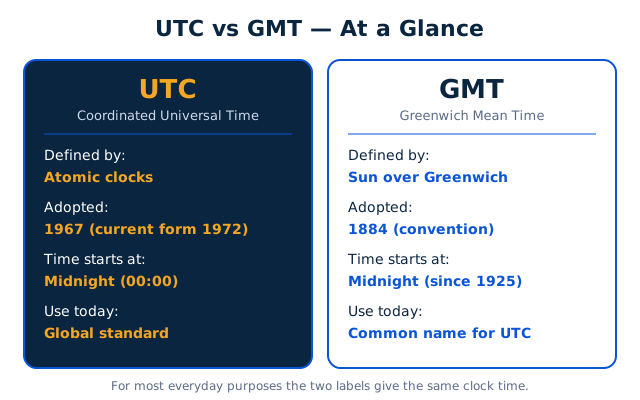
TL;DR: **UTC and GMT show the same time** for all practical purposes. The difference is technical: UTC is measured by atomic clocks (precise, modern standard), while GMT is based on the sun's position at Greenwich, London (historical standard). Use **UTC** for technical and international contexts; **GMT** is fine casually.
Contents
- Quick Answer: UTC vs GMT
- What Is GMT?
- What Is UTC?
- The Technical Difference
- Leap Seconds Explained
- When to Use Each
- What Is Zulu Time?
- Common Myths
- UTC in Computing and the Internet
- UTC Offsets Around the World
- The Future of UTC
- Worked Example: Scheduling Across Zones
- GMT in British Law
- Summary
- Related Guides
- FAQ
- Sources
- How We Verified This
Quick Answer: UTC vs GMT
| Aspect | UTC | GMT |
|---|---|---|
| Full name | Coordinated Universal Time | Greenwich Mean Time |
| Based on | Atomic clocks (400+ worldwide) | Sun’s position at Greenwich |
| Precision | Extremely precise | Less precise (Earth’s rotation varies) |
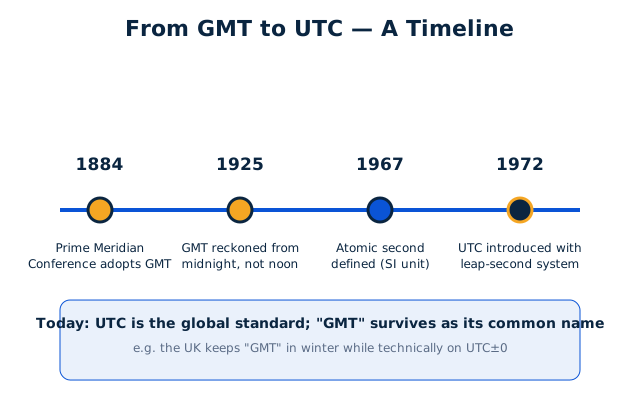
| Introduced | 1972 (concept from 1960s) | 1884 (as world standard) |
| Current time | Same as GMT (within 1 second) | Same as UTC (within 1 second) |
Bottom line: If you set your watch to either one, you will read the same time. The distinction matters for scientists, engineers, and anyone running precise systems — not for scheduling a meeting.
What Is GMT?
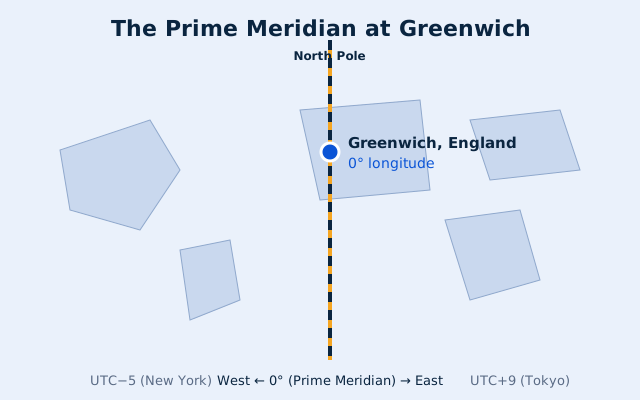
Greenwich Mean Time is the mean solar time at the Royal Observatory in Greenwich, London. In 1884, the International Meridian Conference chose Greenwich as the Prime Meridian (0° longitude), making GMT the world’s reference time.
For over 80 years, GMT was the global time standard. Ships set their chronometers by it. Radio stations broadcast it. It was simple: noon GMT was when the sun was highest over Greenwich.
The problem: Earth’s rotation is not perfectly uniform. It wobbles, slows down (tidal friction), and speeds up slightly with geological events. A “second” defined by Earth’s rotation is not always the same length. For 19th-century navigation, this did not matter. For atomic-age technology, it did.
GMT Today
The UK still uses the term GMT legally — British winter time is GMT (UTC+0), and summer time is BST (British Summer Time, UTC+1). But the scientific world moved on.
What Is UTC?
Coordinated Universal Time is the modern global time standard. It is not based on the sun at all — it is based on atomic clocks.
Over 400 atomic clocks in laboratories around the world (coordinated by the BIPM in Paris) measure time by counting the vibrations of cesium atoms. These vibrations are extraordinarily stable: an atomic clock loses less than a second in millions of years.
Why “UTC” and Not “CUT”?
The abbreviation is a compromise. English speakers wanted CUT (Coordinated Universal Time). French speakers wanted TUC (Temps Universel Coordonné). They settled on UTC — the same in every language.
TAI vs. UTC
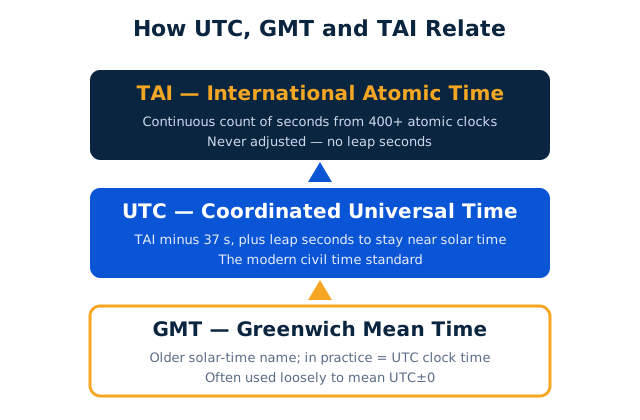
There is an even more precise time scale called TAI (International Atomic Time) — pure atomic time with no adjustments. UTC is TAI minus leap seconds (currently TAI is 37 seconds ahead of UTC). For almost everyone, UTC is the one that matters.
The Technical Difference
Here is the precise distinction:
- GMT tracks Earth’s rotation. When Earth slows down, GMT (if strictly observed) would drift relative to atomic time.
- UTC tracks atomic clocks. It is perfectly uniform.
- To keep UTC aligned with Earth’s rotation (within 0.9 seconds), leap seconds are occasionally added.
The result: UTC and GMT never differ by more than about one second. For any human purpose — catching a train, scheduling a Zoom call, knowing when the store opens — they are identical.
Time Zone Offsets
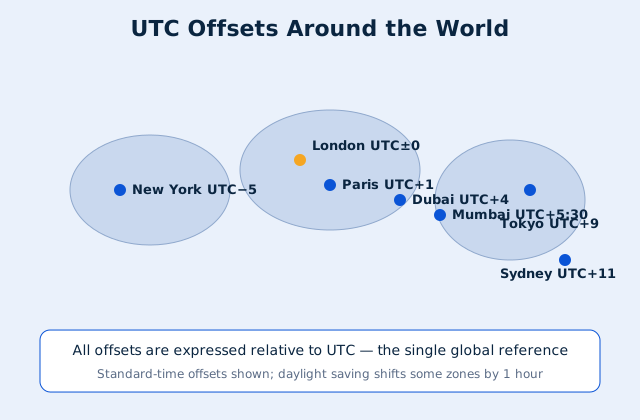
All time zones are defined as offsets from UTC:
| City | Offset | Standard | Daylight |
|---|---|---|---|
| London | UTC+0 / UTC+1 | GMT | BST |
| New York | UTC-5 / UTC-4 | EST | EDT |
| Chicago | UTC-6 / UTC-5 | CST | CDT |
| Los Angeles | UTC-8 / UTC-7 | PST | PDT |
| Tokyo | UTC+9 | JST | (no DST) |
| Sydney | UTC+10 / UTC+11 | AEST | AEDT |
Leap Seconds Explained
Because Earth’s rotation is gradually slowing (the Moon’s gravity acts as a brake), atomic time and solar time drift apart. To prevent UTC from drifting away from the sun, a leap second is added when needed — typically on June 30 or December 31.
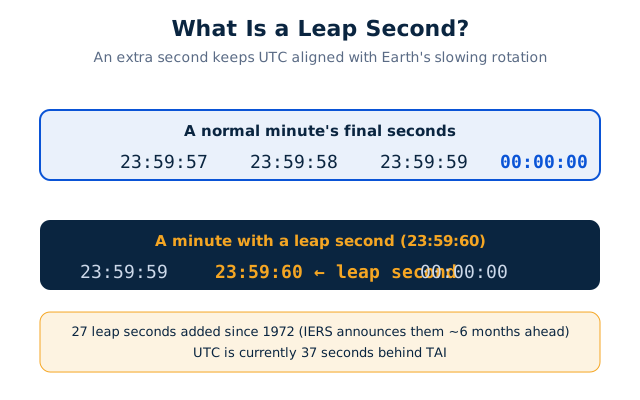
During a leap second, clocks show 23:59:60 — a 61-second minute. Since 1972, 27 leap seconds have been added.
Do leap seconds affect you? Almost certainly not. They matter for GPS satellites, financial trading systems, and scientific instruments. Your phone handles them invisibly.
The future: On October 15, 2026, the CGPM (General Conference on Weights and Measures) voted to end leap seconds, effective May 20, 2027. UTC will be allowed to drift from solar time, with the accumulated difference addressed by future adjustments. This resolves decades of debate among metrology bodies.
When to Use Each
Use UTC when:
- Writing software or configuring servers
- Scheduling international meetings (unambiguous)
- Aviation, maritime, or military contexts (often called “Zulu”)
- Scientific or engineering documentation
- Anywhere precision matters
GMT is fine when:
- Casual conversation (“The meeting is at 3 PM GMT”)
- Referring to UK winter time
- Historical contexts
- You just need everyone to understand the time
What to avoid:
- Do not write “UTC/GMT” — pick one.
- In code and APIs, always use UTC (ISO 8601 format:
2026-10-18T15:30:00Z). - Do not assume “GMT” accounts for British Summer Time — in summer the UK is on BST (UTC+1), not GMT.
What Is Zulu Time?
Zulu time is the military and aviation name for UTC. The “Z” comes from:
- The NATO phonetic alphabet: Z = “Zulu”
- Time notation: UTC times are written with a “Z” suffix (e.g.,
1400Zmeans 2:00 PM UTC)
Pilots, air traffic controllers, and military operators worldwide use Zulu time so there is zero ambiguity about which time zone is meant. When a pilot says “takeoff at 1430 Zulu,” everyone on every continent knows exactly when that is.
Common Myths
Myth: “UTC and GMT are exactly the same thing.” Reality: They show the same time (within a second), but they are defined differently — atomic clocks vs. solar observation.
Myth: “GMT is outdated and wrong to use.” Reality: GMT is still the legal term for UK winter time and is perfectly fine for everyday use.
Myth: “Zulu time is a different time zone.” Reality: Zulu is just another name for UTC (UTC+0).
Myth: “Leap seconds happen every year.” Reality: They are irregular — 27 since 1972, with gaps of several years between them.
Related Guides
- EST vs CST Chart: Learn more about est vs cst chart.
- Arizona Time Zone: Learn more about arizona time zone.
FAQ
What does GMT mean? GMT stands for Greenwich Mean Time. It is the solar time at the Royal Observatory in Greenwich, London, and was historically the world’s time standard.
Is UTC the same as GMT? For everyday purposes, yes — they show the same time. Technically, UTC is based on atomic clocks while GMT is based on Earth’s rotation. The difference is less than a second.
What is the difference between UTC and GMT? UTC (Coordinated Universal Time) is measured by atomic clocks and adjusted with leap seconds. GMT (Greenwich Mean Time) is based on the sun’s position. UTC is the modern precision standard.
Which should I use, UTC or GMT? Use UTC for technical, scientific, and international contexts. GMT is fine for casual use and is still the legal term in the UK during winter.
What is Zulu time? Zulu time is another name for UTC, used in aviation and the military. The ‘Z’ comes from the NATO phonetic alphabet (Z = Zulu) and the ‘Z’ suffix in time notation (e.g., 1400Z).
Does the UK use GMT or UTC? The UK uses GMT in winter and BST (British Summer Time, UTC+1) in summer. Legally, UK time is still defined with reference to GMT.
What are leap seconds? Leap seconds are extra seconds added to UTC to keep it aligned with Earth’s slowing rotation. 27 leap seconds have been added since 1972.
Is UTC a time zone? Strictly, UTC is a time standard, not a time zone. But it functions as the reference point (UTC+0) from which all time zones are defined.
Where is the UTC time zone? UTC isn’t tied to a single location — it’s the global reference. Places that observe UTC+0 year-round include the UK (in winter), Ireland (in winter), Portugal (in winter), Ghana, and Iceland (which stays on UTC year-round with no daylight saving).
How We Verified This
We verified the UTC/GMT relationship against NIST’s time services documentation and the BIPM’s definition of Coordinated Universal Time. The 27 leap seconds figure comes from NIST’s published leap second history. The 1884 Meridian Conference date is established history. The “UTC as compromise abbreviation” story is documented by the BIPM. Time zone offsets were cross-checked against the IANA database.
Related: Military Time Chart · EST vs CST Chart · Arizona Time Zone
UTC in Computing and the Internet
Every server, database, and API that handles time across borders uses UTC. When you see a timestamp like 2026-10-18T20:30:00Z, the Z stands for Zulu — meaning UTC.
Why Developers Choose UTC
- No ambiguity: UTC never observes daylight saving. A timestamp in UTC means the same instant everywhere, always.
- Easy conversion: Every time zone is a fixed offset from UTC (plus DST rules). Convert once, display locally.
- Sorting works: UTC timestamps sort chronologically as plain text. Local times do not (because of DST fall-back duplicates).
ISO 8601 Format
The international standard for writing UTC times:
2026-10-18T15:30:00Z— 3:30 PM UTC on October 18, 20262026-10-18T21:00:00+05:30— Same instant, written with Mumbai offset (9:00 PM IST)2026-10-18— Date only
If you build software, store times in UTC and convert to local time only for display. This avoids an entire category of bugs.
UTC Offsets Around the World
Not every offset is a whole hour. Some regions use 30- or 45-minute offsets:
| Offset | Regions |
|---|---|
| UTC+5:30 | India, Sri Lanka |
| UTC+5:45 | Nepal |
| UTC+9:30 | Central Australia (Adelaide) |
| UTC+3:30 | Iran |
| UTC-3:30 | Newfoundland, Canada |
These unusual offsets are historical — often chosen to split the difference between neighboring zones or to align with solar noon.
The Future of UTC
The leap second system is under review. In 2022, international metrology bodies voted to abolish leap seconds by 2035, allowing UTC to drift from Earth’s rotation instead. The reasoning: leap seconds cause more problems (for computers) than they solve.
If leap seconds end, UTC and solar time will gradually diverge — by about a minute per century. For human purposes, this is negligible. For astronomers, new corrections will be needed.
What will not change: UTC remains the world’s time standard. GMT remains the historical name. And for everyday life, they will continue to show the same time on your clock.
Worked Example: Scheduling Across Zones
Suppose you are in Chicago and need to schedule a call with colleagues in London and Tokyo:
- Chicago (CDT, UTC-5): You propose 9:00 AM local.
- Convert to UTC: 9:00 AM CDT = 2:00 PM UTC (add 5 hours).
- London (BST, UTC+1): 2:00 PM UTC = 3:00 PM BST.
- Tokyo (JST, UTC+9): 2:00 PM UTC = 11:00 PM JST.
The Tokyo colleague faces a late night. Shifting to 7:00 AM Chicago time gives 9:00 PM Tokyo — still late but more reasonable. This is why UTC is the universal intermediate: convert everything to UTC first, then to local.
GMT in British Law
The UK’s legal time is still defined by reference to GMT, not UTC. The Interpretation Act 1978 and subsequent legislation use “Greenwich mean time” as the baseline. In practice, the UK’s time signals are UTC-based, but the statute books say GMT.
This is one reason GMT persists: changing legal terminology across centuries of statutes would be a massive undertaking for no practical benefit. When a British lawyer says “GMT,” they mean the same instant a scientist calls “UTC.”
Summary
UTC and GMT are two names for the same practical time, with different technical definitions. UTC is the modern atomic standard; GMT is the historical solar standard. For everyday use, they are interchangeable. For technical work, use UTC.