

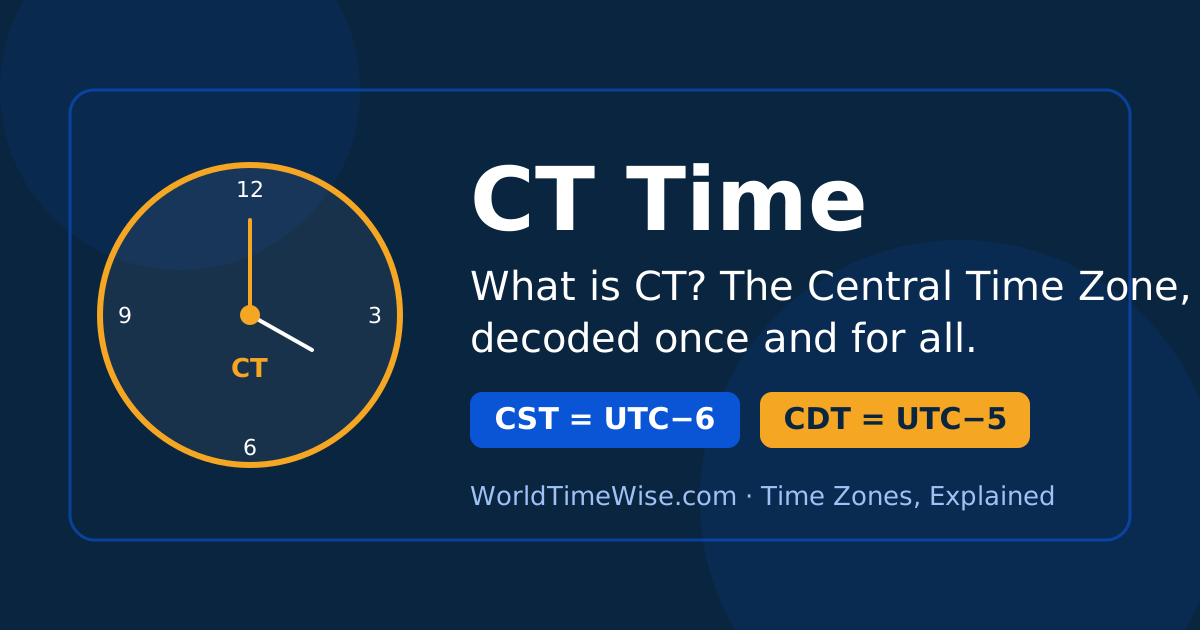
TL;DR: CT means Central Time, the North American zone between Eastern and Mountain Time. It keeps UTC-6 (CST) from November to March and UTC-5 (CDT) from March to November. When a schedule says "3 PM CT," you read the clock as-is — the label already includes daylight saving.
Contents
- Quick Answer: What Is CT Time?
- CST vs CDT: When Each Applies
- The Four US Mainland Zones
- ET, MT, PT Explained
- Alaska and Hawaii
- The Arizona Exception
- Why Abbreviations Are Ambiguous
- CT vs CET: Don’t Confuse Them
- IANA Names: The Unambiguous Alternative
- Converting Between Zones
- Common Myths
- Practical Tips
- Related Guides
- FAQ
- How We Verified This
Quick Answer: What Is CT Time?
CT is Central Time — the North American time zone sitting one hour behind Eastern and one hour ahead of Mountain. If you spotted “CT” on a game listing, a meeting invite, or a broadcast schedule, it simply names the Central zone: Chicago, Dallas, Houston, Minneapolis, New Orleans, Nashville, and St. Louis all keep it.
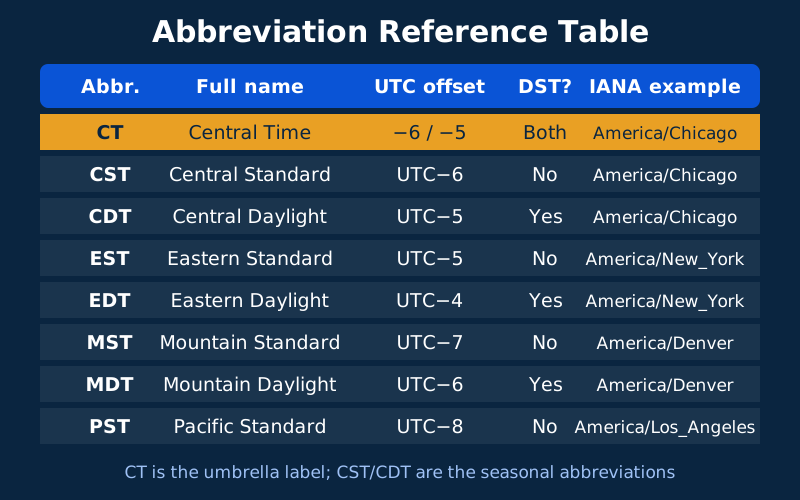
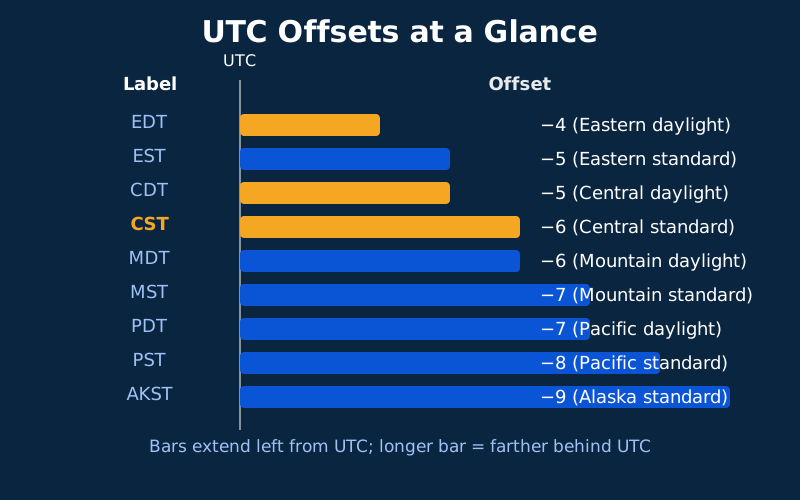
The wrinkle is that “Central Time” is really two abbreviations in a trench coat. In the colder months the zone runs on CST (Central Standard Time), six hours behind Coordinated Universal Time (UTC-6). When daylight saving begins, it shifts to CDT (Central Daylight Time), five hours behind UTC (UTC-5). Writers and broadcasters use “CT” as the safe umbrella label when the date is unspecified, because CT is correct in both seasons.
| Abbreviation | Full name | UTC offset | Observes DST | IANA example |
|---|---|---|---|---|
| CT | Central Time | −6 / −5 | Umbrella label | America/Chicago |
| CST | Central Standard Time | UTC−6 | Standard half | America/Chicago |
| CDT | Central Daylight Time | UTC−5 | Daylight half | America/Chicago |
| EST | Eastern Standard Time | UTC−5 | Standard half | America/New_York |
| EDT | Eastern Daylight Time | UTC−4 | Daylight half | America/New_York |
| MST | Mountain Standard Time | UTC−7 | Standard half | America/Denver |
| MDT | Mountain Daylight Time | UTC−6 | Daylight half | America/Denver |
| PST | Pacific Standard Time | UTC−8 | Standard half | America/Los_Angeles |
| PDT | Pacific Daylight Time | UTC−7 | Daylight half | America/Los_Angeles |
For the full companion piece on just the Eastern/Central pair, see our EST vs CST comparison, which includes a complete 24-hour conversion chart.
CST vs CDT: When Each Applies
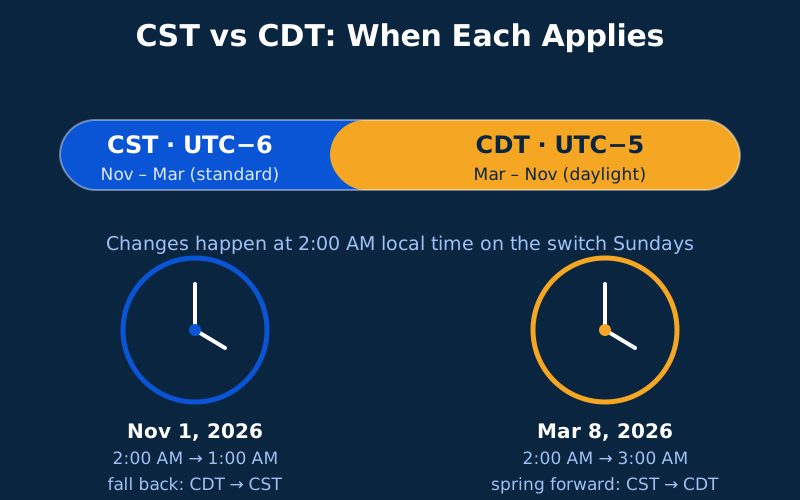
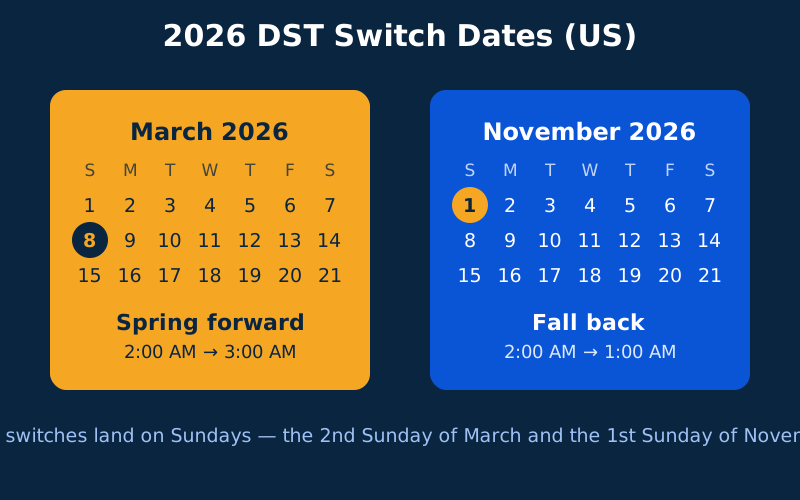
The United States springs forward on the second Sunday of March and falls back on the first Sunday of November. At 2:00 AM local time on the March Sunday, clocks jump to 3:00 AM and the zone switches from CST to CDT. At 2:00 AM on the November Sunday, clocks drop back to 1:00 AM and the zone returns to CST.
The switch dates for the next two years, confirmed against the IANA database in code:
- 2026: spring forward March 8, fall back November 1
- 2027: spring forward March 14, fall back November 7
That means from early March through early November — roughly two-thirds of the year — the correct label in Chicago or Dallas is CDT, not CST. Calling it “CST” in July is one of the most common mistakes in American scheduling, and it matters: some older calendar systems interpret a July “10 AM CST” literally as UTC-6 instead of the intended UTC-5, landing the meeting an hour off. This is exactly why “CT” became the default in broadcast listings — it sidesteps the seasonal label entirely. If you want the deeper mechanics of the switch, our guide to time zone abbreviations walks through every US abbreviation and when each applies.
The Four US Mainland Zones
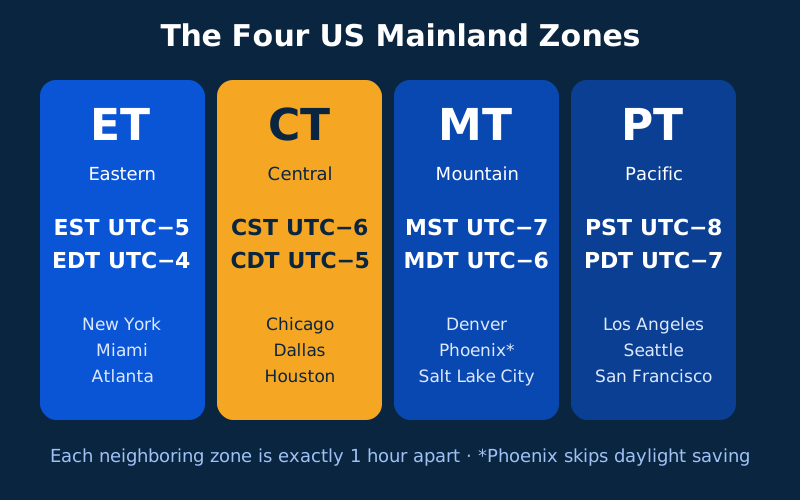
The mainland United States divides into four zones, each exactly one hour apart. From east to west:
- ET — Eastern Time (EST UTC−5 / EDT UTC−4): New York, Washington DC, Miami, Atlanta, Boston.
- CT — Central Time (CST UTC−6 / CDT UTC−5): Chicago, Dallas, Houston, New Orleans, Minneapolis.
- MT — Mountain Time (MST UTC−7 / MDT UTC−6): Denver, Salt Lake City, Albuquerque, Boise.
- PT — Pacific Time (PST UTC−8 / PDT UTC−7): Los Angeles, San Francisco, Seattle, Portland, Las Vegas.
The one-hour staircase is what makes the famous “8/7c” TV listing work: a show at 8 PM Eastern airs at 7 PM Central, the same broadcast instant. Several states straddle a boundary — Tennessee, Kentucky, Florida, Indiana, Michigan, Kansas, Nebraska, and the Dakotas are each split between two zones — so the state name alone does not settle the question. When a boundary runs through your county, the IANA zone name (next section on ambiguity explains why) is the only label that cannot be misread.
ET, MT, PT Explained
ET (Eastern Time) is America’s easternmost mainland zone and the reference most schedules are written against. EST sits at UTC−5 in winter; EDT moves to UTC−4 in summer. Its IANA anchor is America/New_York. National broadcast schedules conventionally list Eastern time first — the “8/7c” listing always starts from ET.
MT (Mountain Time) sits one hour west of Central. MST is UTC−7 in winter and MDT is UTC−6 in summer, anchored at America/Denver. Denver, Salt Lake City, and Albuquerque observe both halves — but Phoenix does not, which gets its own section below because it trips up everyone.
PT (Pacific Time) is the westernmost mainland zone: PST at UTC−8, PDT at UTC−7, anchored at America/Los_Angeles. Los Angeles, San Francisco, Seattle, and Portland keep it, making Pacific three hours behind Eastern year-round (the gap never changes because both zones shift together).
Notice the ladder pattern: every neighboring pair differs by exactly one hour, winter and summer alike. That constancy is the key insight for conversions — you only need to memorize the winter offsets, because daylight saving moves every observing zone by the same hour. Our UTC vs GMT guide explains the UTC reference itself if the “minus six” notation is new to you.
Alaska and Hawaii
Alaska keeps its own zone: AKST (Alaska Standard Time, UTC−9) in winter and AKDT (Alaska Daylight Time, UTC−8) in summer, anchored at America/Anchorage. That puts Anchorage four hours behind Eastern in winter (EST UTC−5 vs AKST UTC−9) and four hours behind in summer too (EDT UTC−4 vs AKDT UTC−8).
Hawaii is simpler and stranger: HST (Hawaii Standard Time, UTC−10) all year, anchored at Pacific/Honolulu, with no daylight saving at all. So Hawaii’s distance from the mainland breathes with the seasons — it trails Pacific Time by two hours in winter (PST UTC−8) and three hours in summer (PDT UTC−7). If you are scheduling with Honolulu from the West Coast, always check the month: “two hours behind us” is only true half the year.
The Arizona Exception
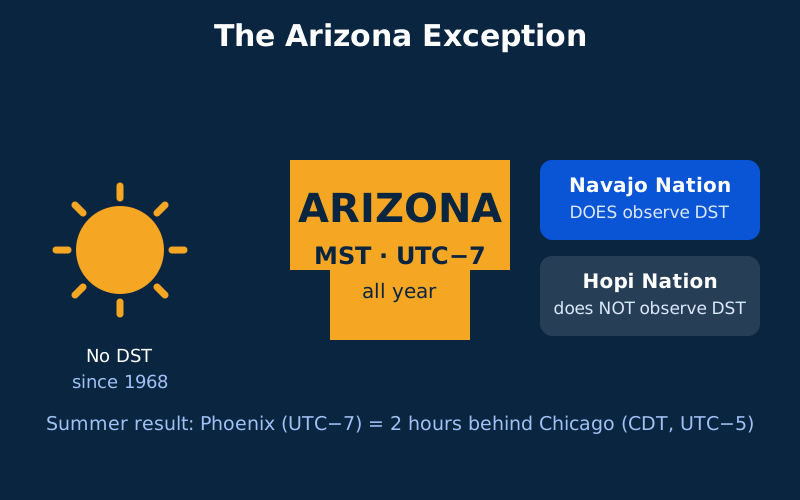
Arizona breaks the Mountain Time mold. Most of the state stays on MST (UTC−7) all year and has skipped daylight saving since 1968, under Arizona law A.R.S. 1-242. In winter, Phoenix matches Denver’s clock (MST vs MST). In summer, when Denver springs forward to MDT (UTC−6), Phoenix stays put — and suddenly reads the same as Los Angeles on PDT (UTC−7) instead.
There is one carve-out inside the carve-out: the Navajo Nation, whose land stretches across northeastern Arizona into Utah and New Mexico, does observe daylight saving to stay in sync with the rest of the reservation. The Hopi Reservation, which sits entirely inside Navajo land, does not observe it. So a summer drive across northern Arizona can cross the DST boundary twice within a few dozen miles. For the full story, see our dedicated Arizona time zone guide.
Why Abbreviations Are Ambiguous
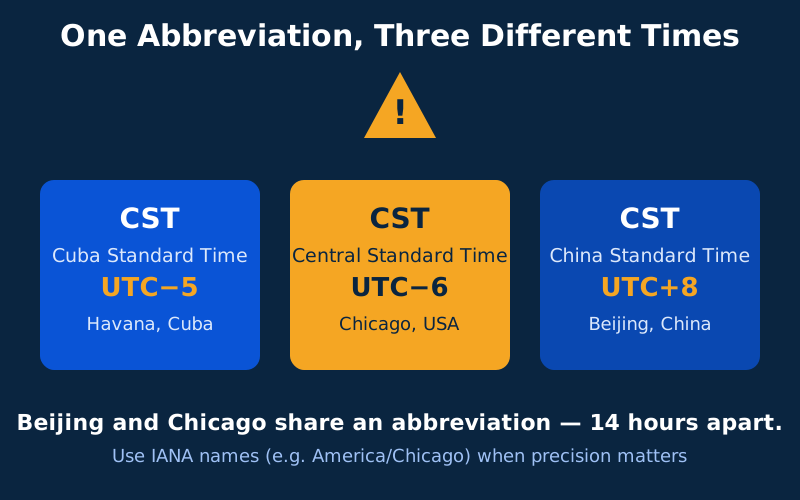
Here is the uncomfortable truth about abbreviations: CST does not belong to the United States alone. The same three letters mean:
- Central Standard Time (UTC−6) — Chicago, Dallas, Mexico City
- Cuba Standard Time (UTC−5) — Havana
- China Standard Time (UTC+8) — Beijing, Shanghai
Beijing and Chicago share an abbreviation while sitting 14 hours apart. A timestamp labeled “3 PM CST” with no other context could be mid-afternoon in Texas or 5 AM the next day in Beijing. This is not a rare edge case — global scheduling tools, flight itineraries, and news wires all hit it. Abbreviations were designed for local newspapers and radio stations, not a planet where three continents reuse the same letters.
The fix is mechanical: whenever precision matters — calendar invites, server logs, flight plans, code — use the UTC offset or the IANA zone name instead of the abbreviation. “15:00 America/Chicago” cannot be confused with Beijing; “3 PM CST” can. NIST’s Time and Frequency Division and the IANA time zone database are the authoritative references for these definitions.
CT vs CET: Don’t Confuse Them
“Central” exists in Europe too, and the abbreviations look dangerously alike. CET is Central European Time (UTC+1), kept by Berlin, Paris, Madrid, and Rome in winter. CT is Central Time (UTC−6/−5), kept by Chicago and Dallas.
The names differ by one letter; the clocks differ by seven hours in winter (CET at UTC+1 vs CST at UTC−6). In summer the European zone becomes CEST (UTC+2) while the American zone becomes CDT (UTC−5) — still seven hours apart, but now you need two abbreviations memorized instead of one. If a European colleague writes “let’s meet at 3 PM CT,” confirm which continent they mean before you commit: a Berlin “CT” is almost certainly a typo for CET. Our military time chart can help you convert the 24-hour times Europeans favor into the 12-hour style common in the US.
IANA Names: The Unambiguous Alternative
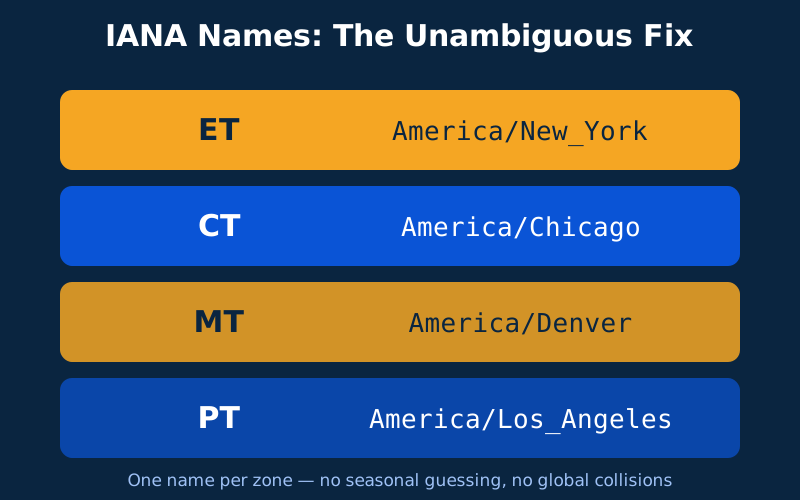
The IANA time zone database gives every region a unique identifier in Continent/City form. These names never collide globally and never change meaning with the seasons:
- Eastern → America/New_York
- Central → America/Chicago
- Mountain → America/Denver
- Pacific → America/Los_Angeles
- Alaska → America/Anchorage
- Hawaii → Pacific/Honolulu
An IANA name bundles the full rulebook: standard offset, daylight offset, and every historical switch date. Software that stores “America/Chicago” computes CST vs CDT automatically for any date, past or future; software that stores “CST” has to guess. If you are building anything — an app, a booking system, a shared calendar — store the IANA name and render the abbreviation only for display. Humans can keep saying “CT”; machines should say “America/Chicago.”
Converting Between Zones
Because every observing zone shifts together, the gaps are beautifully constant. The ladder: CT is 1 hour behind ET, 1 hour ahead of MT, and 2 hours ahead of PT — in January and in July alike. Worked examples, both verified against the IANA database:
- 9:00 AM CT in winter (CST) → 10:00 AM ET (EST), 8:00 AM MT (MST), 7:00 AM PT (PST)
- 9:00 AM CT in summer (CDT) → 10:00 AM ET (EDT), 8:00 AM MT (MDT), 7:00 AM PT (PDT)
- 3:00 PM ET → 2:00 PM CT, in either season
- What is 2 PM CST in EST? 3:00 PM — CST is UTC-6 and EST is UTC-5, so add one hour.
- What is 2 PM EST in CST? 1:00 PM — subtract one hour going west.
The one case where the math moves is Arizona. In winter, Phoenix (MST, UTC−7) sits one hour behind Chicago (CST, UTC−6). In summer, Phoenix still shows UTC−7 while Chicago moves to CDT (UTC−5), so the gap doubles to two hours. If your meeting involves Arizona, pin the season first.
The other trap is the two switch Sundays themselves. On the March Sunday, 2:30 AM CT simply does not exist (the clock jumps 2:00 → 3:00); on the November Sunday, 1:30 AM happens twice. Never schedule anything critical in those windows — and if you must, attach the UTC offset explicitly, e.g. “1:30 AM CST (UTC−6)” vs “1:30 AM CDT (UTC−5).”
Common Myths
“CT and CST are the same thing.” Close but not exact. CT is the zone’s umbrella name; CST is only its November-to-March form. Saying “CST” in August is technically wrong — you mean CDT.
“Arizona is basically on Pacific Time in summer.” The clock reading matches (both UTC−7), but the zone is Mountain Standard Time year-round. The distinction matters the moment Arizona does not move and a Pacific state does — or vice versa.
“The hour gaps change with daylight saving.” For the mainland four, they never do. ET, CT, MT, and PT all spring forward on the same Sunday, so the 1-hour staircase is identical in July and January. Only exceptions like Arizona and Hawaii shift the math.
“You can tell the zone from the state name.” Eight-plus states are split by a zone boundary. “Texas time” is Central except in El Paso; “Florida time” is Eastern except in the Panhandle. County, not state, is the unit that counts.
Practical Tips
- Writing an invite with no specific date? Use CT, ET, MT, PT — the umbrella labels stay correct in both seasons.
- Writing an invite for a specific date? Use the seasonal abbreviation or, better, the UTC offset: “2 PM CDT (UTC−5).”
- Building software? Store America/Chicago, never “CST.” Let the IANA database derive the abbreviation.
- Scheduling with Arizona or the Navajo Nation? Check the season and the reservation boundary — northern Arizona is a DST patchwork in summer.
- Crossing a switch Sunday? Keep the morning clear. The spring Sunday loses an hour; the fall Sunday repeats one.
- Reading a European schedule? Confirm CET vs CT. One letter, seven hours.
Related Guides
- EST vs CST: Time Difference Explained — the full 1-hour pair with a 24-hour conversion chart
- Time Zone Abbreviations — every US abbreviation and when each applies
- UTC vs GMT — what the “UTC−6” part actually means
- Arizona Time Zone — the no-DST exception in full detail
- Military Time Chart — 24-hour conversions for schedules and travel
FAQ
What is CT time? CT is Central Time, the North American zone between Eastern and Mountain. It runs at UTC−6 (CST) from November to March and UTC−5 (CDT) from March to November, with Chicago as its best-known city.
Is CT the same as CST? Not exactly. CT is the umbrella name for the whole zone in both seasons, while CST (Central Standard Time, UTC−6) is only the winter half. From March to November the same zone runs on CDT.
What does CT mean in time? It means Central Time. When you see it on a meeting invite, a sports listing, or a broadcast schedule, it refers to the zone observed in Chicago, Dallas, Houston, Minneapolis, New Orleans, and Nashville.
Is CT the same as Chicago time? For practical purposes, yes. Chicago’s IANA identifier, America/Chicago, is the representative zone name for the entire Central region, so Chicago local time and CT always agree.
What is the difference between CST and CDT? CST (Central Standard Time) is UTC−6 and applies roughly November to March. CDT (Central Daylight Time) is UTC−5 and applies roughly March to November. The switch happens at 2:00 AM on the second Sunday of March and the first Sunday of November.
What states are in Central Time? Alabama, Arkansas, Illinois, Iowa, Louisiana, Minnesota, Missouri, Mississippi, Oklahoma, and Wisconsin are entirely in Central Time. Florida, Indiana, Kansas, Kentucky, Michigan, Nebraska, North Dakota, South Dakota, Tennessee, and Texas are each split between Central and a neighboring zone.
Is CT one hour behind ET? Yes, always. Central Time sits exactly one hour behind Eastern Time in winter (CST vs EST) and in summer (CDT vs EDT), because both zones observe daylight saving on the same dates.
Does Arizona observe CT? No. Arizona keeps Mountain Standard Time (UTC−7) all year and does not observe daylight saving, so it trails CT by one hour in winter and two hours in summer. The Navajo Nation inside Arizona is the exception — it does observe DST.
Is CT the same as CET? No. CET is Central European Time (UTC+1), used in Berlin, Paris, and Rome. Despite the similar name, CET runs seven hours ahead of CT in winter. Confirm the continent before scheduling across the Atlantic.
How We Verified This
Every offset in this guide was computed in code with Node.js Intl.DateTimeFormat against the IANA time zone database: America/Chicago, America/New_York, America/Denver, America/Los_Angeles, America/Anchorage, Pacific/Honolulu, and America/Phoenix were each sampled in January and July 2026, and the 2026 and 2027 DST transitions were found by scanning daily for offset changes (March 8 / November 1, 2026; March 14 / November 7, 2027). Arizona’s 1968 daylight-saving exemption comes from Arizona Revised Statutes 1-242, and the Navajo/Hopi distinction is documented in our Arizona guide. Abbreviation definitions were cross-checked against NIST’s Time and Frequency Division and the USNO’s U.S. time zone table.
Related: EST vs CST · Time Zone Abbreviations · UTC vs GMT · Arizona Time