

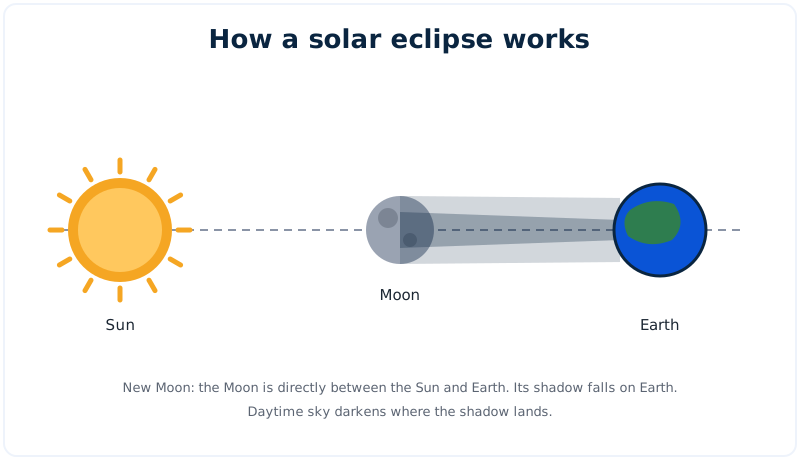
TL;DR: A **solar eclipse** happens when the Moon blocks the Sun (Moon between Sun and Earth, daytime). A **lunar eclipse** happens when Earth's shadow falls on the Moon (Earth between Sun and Moon, nighttime). Solar eclipses require certified eye protection; lunar eclipses are safe to watch with the naked eye. The last total lunar eclipse visible from the US was **March 3, 2026**; the next lunar eclipse is **February 20, 2027** (penumbral). Next **total** lunar eclipse: **December 31, 2028** (NASA). Next total solar eclipse: **August 2, 2027** (not visible from the US).
Contents
- Quick Answer: Solar vs Lunar Eclipse
- How a Solar Eclipse Works
- How a Lunar Eclipse Works
- Types of Solar Eclipses
- Types of Lunar Eclipses
- Side-by-Side Comparison
- Umbra vs Penumbra: The Shadow Geometry
- How Often Do Eclipses Happen?
- Viewing Safety: The Critical Difference
- Upcoming Eclipses (NASA Data)
- Why the Moon Turns Red
- Common Myths
- Related Guides
- FAQ
- Sources
- How We Verified This
Quick Answer: Solar vs Lunar Eclipse
Eclipse meaning: An eclipse occurs when one celestial body moves into the shadow of another, blocking light from the Sun. To be “eclipsed” means to be obscured or overshadowed — in astronomy, it specifically describes the Sun, Moon, or a planet being hidden by an intervening body.
| Solar Eclipse | Lunar Eclipse | |
|---|---|---|
| Alignment | Sun → Moon → Earth | Sun → Earth → Moon |
| What happens | Moon blocks the Sun | Earth’s shadow falls on the Moon |
| Time of day | Daytime | Nighttime |
| What you see | Sun darkened or ringed | Moon darkened or red |
| Eye safety | Glasses required (except totality) | Safe with naked eye |
| How rare (your location) | Very (~375 yrs for total) | Occasional (every few years) |
How a Solar Eclipse Works
A solar eclipse occurs when the Moon passes directly between the Sun and Earth, casting its shadow onto Earth’s surface. You must be inside the Moon’s shadow to see it — which is why a solar eclipse is visible only along a narrow path.
The cosmic coincidence: The Sun is about 400 times wider than the Moon, but it is also about 400 times farther away. From Earth, they appear almost exactly the same size in the sky. This is why the Moon can precisely cover the Sun’s disk — a coincidence not known to occur anywhere else in the solar system.
What you see (total solar eclipse):
- Partial phase: The Moon takes an increasingly large “bite” out of the Sun (1+ hours).
- Totality: The Sun is fully covered. The sky goes dark, stars appear, and the Sun’s outer atmosphere (the corona) becomes visible as a pearly halo. This lasts seconds to a few minutes.
- Partial phase again: The Sun re-emerges (1+ hours).
How a Lunar Eclipse Works
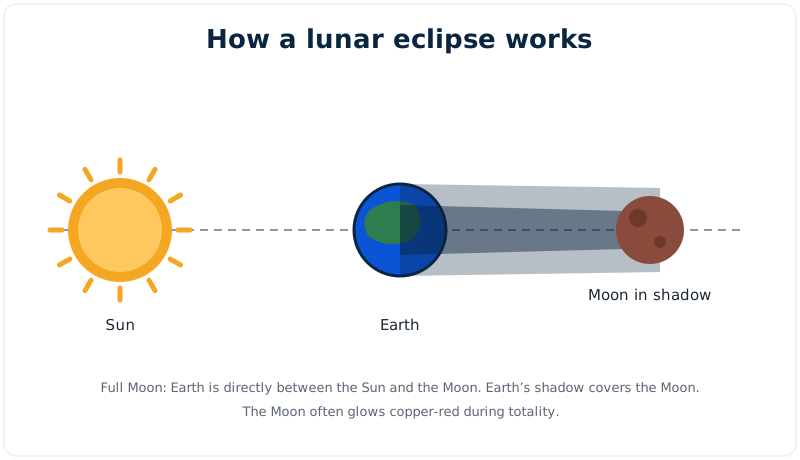
A lunar eclipse occurs when Earth passes directly between the Sun and the Moon, casting Earth’s shadow onto the Moon’s surface. Anyone on Earth’s night side can see it — no narrow path required.
What you see (total lunar eclipse):
- Penumbral phase: The Moon dims subtly as it enters Earth’s faint outer shadow.
- Partial phase: A dark “bite” grows across the Moon.
- Totality: The Moon is fully inside Earth’s shadow — and turns a deep copper red (see “Why the Moon Turns Red” below). This can last over an hour.
- The sequence reverses.
A total lunar eclipse can last several hours from start to finish, with totality alone lasting up to about 100 minutes — far longer than the few minutes of a total solar eclipse.
Types of Solar Eclipses
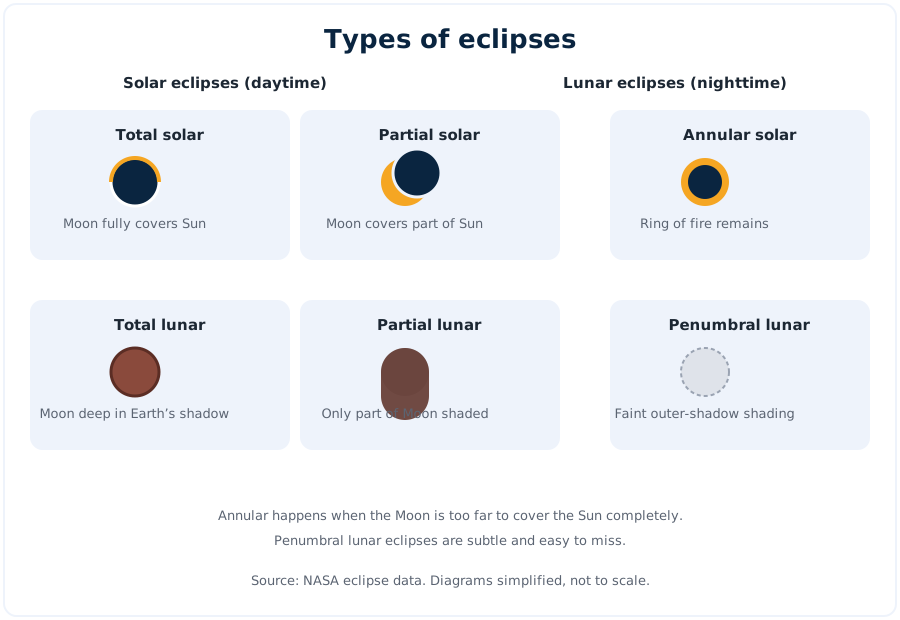
Total Solar Eclipse
The Moon completely covers the Sun. Visible only along a narrow path (~100 km wide). The sky darkens dramatically. This is the only time it is safe to look without protection — and only during totality.
Partial Solar Eclipse
The Moon covers only part of the Sun. Visible over a much wider area than the total path. Eye protection required for the entire event.
Annular Solar Eclipse
The Moon is slightly too far from Earth to fully cover the Sun, leaving a bright “ring of fire” around the dark Moon. Eye protection required for the entire event — there is no safe totality phase.
Hybrid Solar Eclipse
Rare: the eclipse shifts between total and annular along its path as Earth’s curvature changes the distance. Very uncommon.
Types of Lunar Eclipses
Total Lunar Eclipse
The Moon passes fully through Earth’s dark inner shadow (umbra). The Moon turns red. Visible from anywhere on Earth’s night side.
Partial Lunar Eclipse
Only part of the Moon enters the umbra. A dark shadow visibly “bites” the Moon.
Penumbral Lunar Eclipse
The Moon passes only through Earth’s faint outer shadow (penumbra). The dimming is subtle — many casual observers barely notice it.
Side-by-Side Comparison
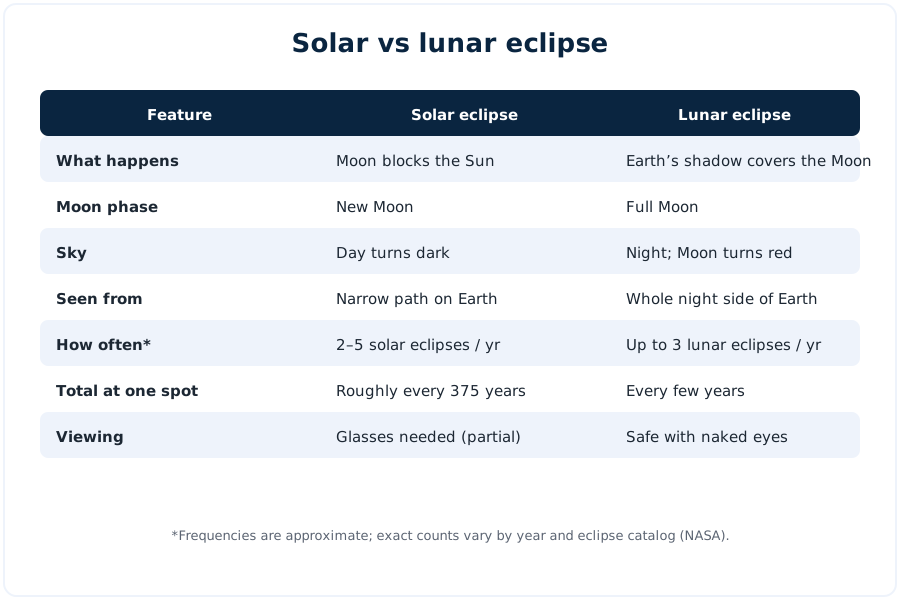
| Feature | Solar Eclipse | Lunar Eclipse |
|---|---|---|
| Alignment | Sun–Moon–Earth | Sun–Earth–Moon |
| Shadow cast by | Moon | Earth |
| Shadow falls on | Earth | Moon |
| Occurs during | New moon | Full moon |
| Time | Daytime | Nighttime |
| Visibility | Narrow path (~100 km) | Entire night side of Earth |
| Duration of totality | Seconds to ~7.5 min | Up to ~100 min |
| Frequency (global) | 2–5 per year | Up to 3 per year |
| Frequency (your town, total) | ~once per 375 years | Every few years |
| Naked-eye safe? | No (except totality) | Yes, always |
Umbra vs Penumbra: The Shadow Geometry
Every shadow has two parts:
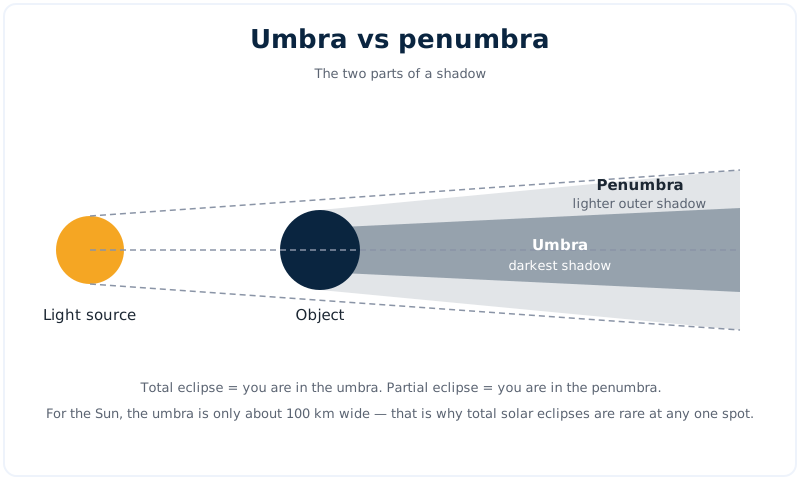
- Umbra: The dark inner cone where the light source is completely blocked. Standing in the umbra during a solar eclipse = total eclipse. The Moon in Earth’s umbra = total lunar eclipse.
- Penumbra: The lighter outer region where the light source is only partially blocked. Standing in the penumbra = partial eclipse.
This geometry explains why total eclipses are rare at any given spot (the umbra is narrow) while partial eclipses cover wider areas (the penumbra is broad).
How Often Do Eclipses Happen?
Eclipses do not happen every month because the Moon’s orbit is tilted about 5° relative to Earth’s orbit around the Sun. Most months, the Moon passes above or below the perfect alignment.
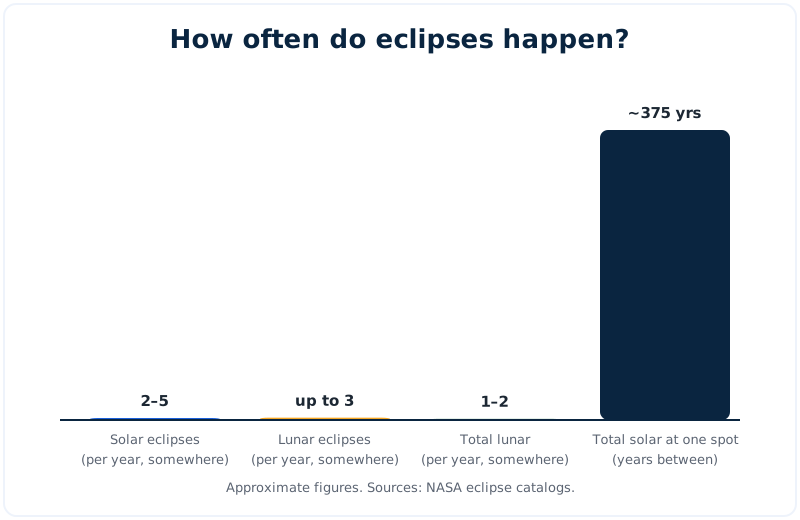
Approximate frequencies (NASA eclipse catalogs):
- Solar eclipses: 2–5 per year somewhere on Earth. At least 2 per year; 5 is rare.
- Total solar eclipses: Roughly every 18 months somewhere on Earth.
- Total solar at YOUR location: About once every 375 years on average.
- Lunar eclipses: Up to 3 per year.
- Total lunar eclipses: Typically 1–2 per year; some years have none.
Eclipse seasons: Eclipses cluster in roughly 34-day “eclipse seasons” that occur about every 6 months, when the Moon’s orbit crosses the ecliptic plane.
Viewing Safety: The Critical Difference
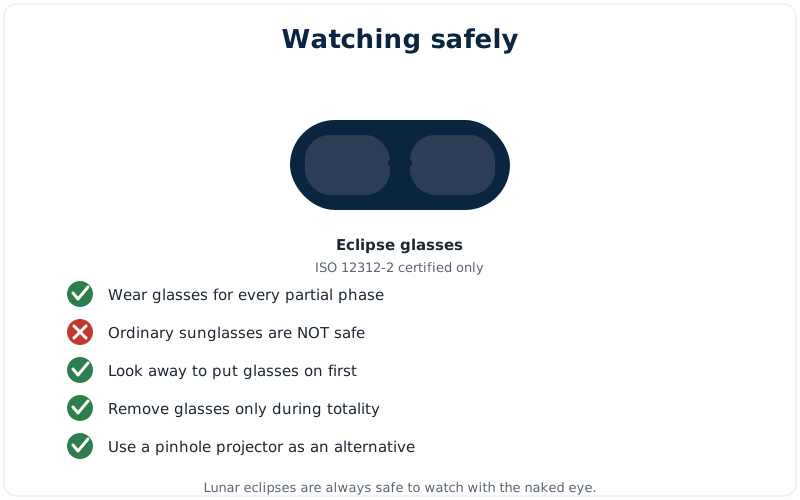
Solar Eclipses: Protect Your Eyes
NEVER look directly at a partial or annular solar eclipse without certified protection. The Sun’s visible and invisible radiation can cause permanent retinal damage — and because the retina has no pain receptors, you will not feel it happening.
Safe:
- ISO 12312-2 certified eclipse glasses (check for the printed certification; beware counterfeits)
- Handheld solar viewers meeting the same standard
- Pinhole projectors (indirect viewing)
- During totality only of a total solar eclipse: naked-eye viewing is safe, but put glasses back on the instant the Sun reappears
Unsafe:
- Ordinary sunglasses (even very dark ones)
- Smoked glass, CDs, photographic film
- Looking through a camera, telescope, or binoculars without a proper solar filter
Lunar Eclipses: Completely Safe
Lunar eclipses are safe to watch with the naked eye, binoculars, or a telescope. The Moon is only reflecting dimmed sunlight — there is no intense radiation risk. No glasses needed.
Upcoming Eclipses (NASA Data)
Next Lunar Eclipse: February 20, 2027 (Penumbral)
A penumbral lunar eclipse on February 20, 2027. Penumbral eclipses are subtle — the Moon passes through Earth’s outer shadow, causing only a slight dimming. (The most recent total lunar eclipse seen from the US occurred on March 3, 2026.)
Next Total Lunar Eclipse: December 31, 2028
The next total lunar eclipse — when the Moon turns red — occurs on December 31, 2028, visible from Europe, Africa, Asia, Australia, and the Pacific (NASA). The six lunar eclipses between March 2026 and December 2028 are all partial or penumbral.
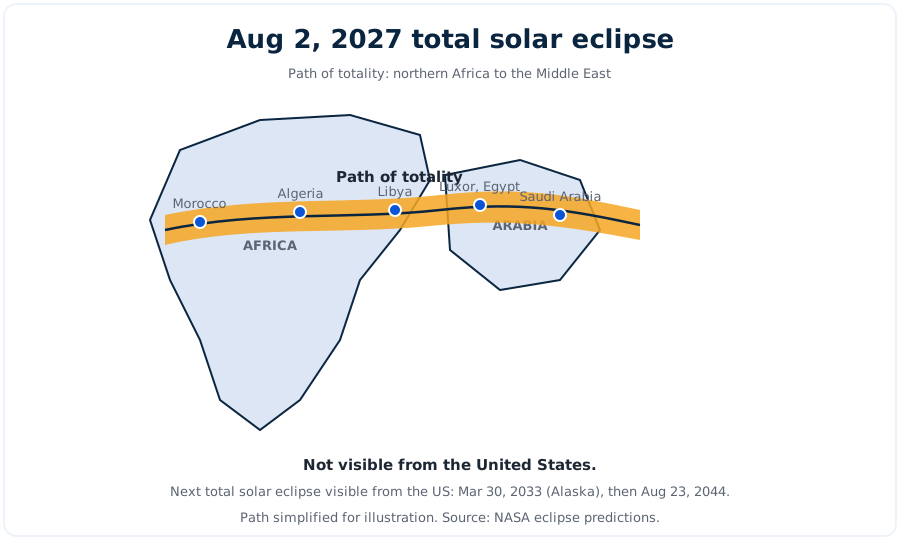
Next Total Solar Eclipse: August 2, 2027
The August 2, 2027 total solar eclipse crosses northern Africa and the Middle East (Morocco, Algeria, Tunisia, Libya, Egypt, Saudi Arabia, and others). Totality will not be visible from the United States — only a small partial eclipse grazes far-eastern Maine.
The next total solar eclipses visible from the US:
- March 30, 2033 — Alaska
- August 22, 2044 — Montana, North Dakota, South Dakota (northern plains)
All dates and paths from NASA’s eclipse predictions. Eclipse paths are computed years in advance with high precision.
Why the Moon Turns Red
During a total lunar eclipse, the Moon does not go black — it glows copper red. Here is why:
- Sunlight skims through Earth’s atmosphere on its way to the shadowed Moon.
- The atmosphere scatters blue light away (the same reason sunsets are red).
- Red and orange light bends (refracts) through the atmosphere and into Earth’s shadow.
- This reddened light illuminates the Moon.
The exact shade — from bright orange to deep blood red — depends on how much dust and cloud is in Earth’s atmosphere at the time. After major volcanic eruptions, lunar eclipses can be especially dark.
Common Myths
Myth: “A solar eclipse is more dangerous than normal sunlight.” Reality: The Sun is no brighter during an eclipse. The danger is that people stare at it — something they would never do on a normal day.
Myth: “Eclipses happen every month.” Reality: The Moon’s 5° orbital tilt means most new/full moons miss perfect alignment. Eclipses cluster in ~34-day seasons twice a year.
Myth: “You can’t see a lunar eclipse without a telescope.” Reality: Lunar eclipses are easily visible with the naked eye from anywhere on Earth’s night side.
Myth: “The August 2027 eclipse will be visible from America.” Reality: No. The path of totality runs through northern Africa and the Middle East. The next US-visible total solar eclipse is 2033 (Alaska).
Myth: “Animals behave strangely because of mystical forces during eclipses.” Reality: Animals react to the sudden darkness — birds roost, crickets chirp. It is a normal response to unexpected nightfall, not supernatural.
Related Guides
- Federal Holidays 2027: Learn more about federal holidays 2027.
- UTC vs GMT: Learn more about utc vs gmt.
- Arizona Time Zone: Learn more about arizona time zone.
FAQ
What is the difference between a solar and lunar eclipse? In a solar eclipse, the Moon passes between the Sun and Earth, casting its shadow on Earth (daytime). In a lunar eclipse, Earth passes between the Sun and Moon, casting its shadow on the Moon (nighttime).
Which is rarer, a solar or lunar eclipse? Total solar eclipses are rarer at any given location — roughly once every 375 years for a specific spot. Total lunar eclipses are visible from anywhere on Earth’s night side, so they seem more common.
Can you look at a lunar eclipse with the naked eye? Yes. Lunar eclipses are completely safe to view with the naked eye, binoculars, or a telescope. No special protection is needed.
Can you look at a solar eclipse with the naked eye? No — never look directly at a partial or annular solar eclipse without ISO 12312-2 certified eclipse glasses. The only exception is the brief period of totality during a total solar eclipse.
When is the next total solar eclipse? August 2, 2027 — visible from northern Africa and the Middle East. Totality will not be visible from the United States — only a small partial eclipse grazes far-eastern Maine. The next total solar eclipse visible from the US is March 30, 2033 (Alaska).
When is the next lunar eclipse? February 20, 2027 — a penumbral lunar eclipse. The last total lunar eclipse visible from the United States was March 3, 2026.
Why does the Moon turn red during a lunar eclipse? Sunlight passing through Earth’s atmosphere is filtered — blue light scatters away, while red and orange light bends into Earth’s shadow and illuminates the Moon, giving it a copper-red color.
How often do eclipses happen? There are 2-5 solar eclipses per year (somewhere on Earth) and up to 3 lunar eclipses per year. Total eclipses are less frequent than partial ones.
How We Verified This
All eclipse dates, paths, and frequencies come from NASA’s eclipse catalogs (eclipse.gsfc.nasa.gov), which compute eclipse circumstances using established orbital mechanics. The August 2, 2027 path (northern Africa/Middle East, not visible from the US) and the March 3, 2026 lunar eclipse (visible from the Americas) are from NASA predictions. The “375 years” figure for total solar eclipses at a given location is NASA’s standard approximation. Eye safety guidance follows NASA’s published safety recommendations (ISO 12312-2). Frequency figures are marked approximate because they are long-run averages, not guarantees.
Related: Federal Holidays 2027 · UTC vs GMT